

A Director of HR resignation letter is a formal document. It is written by a Director of Human Resources. The purpose is to officially announce their departure from a company. It outlines the last day of employment. It also expresses gratitude and offers assistance with the transition.
Navigating the resignation process can be tricky. This article simplifies things. We will provide you with practical templates. Examples and samples will be available for you. Use them to craft your own perfect letter.
No need to start from scratch. Our samples cover various situations. You will find different scenarios. We have made it easy to adapt these letters to your needs. Simplify your writing process today.
Director Of Hr Resignation Letter
Below is a sample of a Director Of Hr Resignation Letter:
[Your Name]
[Your Address]
[Your Phone Number]
[Your Email Address]
[Date]
[Director of HR’s Name]
Director of HR
[Company Name]
[Company Address]
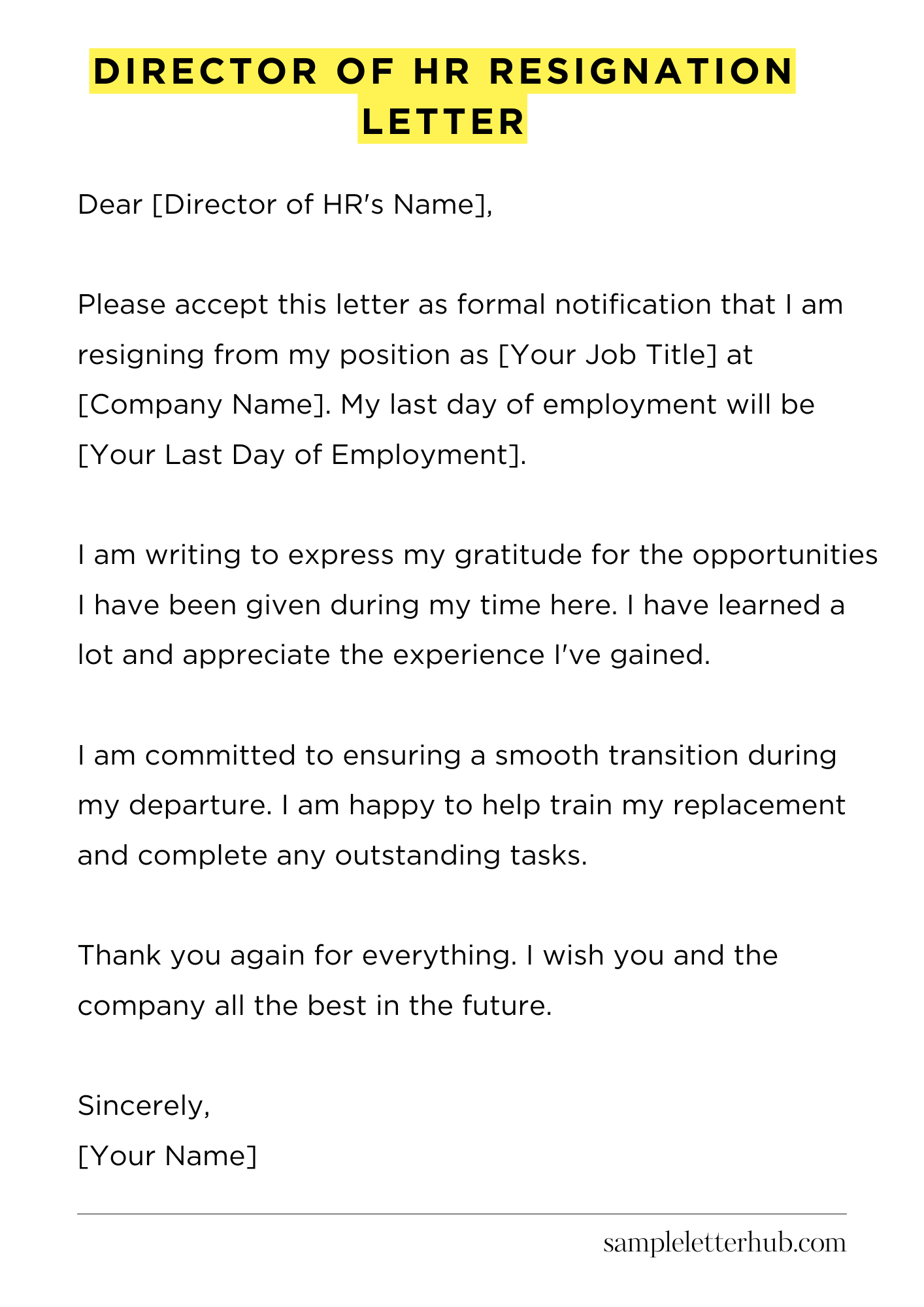
Dear [Director of HR’s Name],
Please accept this letter as formal notification that I am resigning from my position as [Your Job Title] at [Company Name]. My last day of employment will be [Your Last Day of Employment].
I am writing to express my gratitude for the opportunities I have been given during my time here. I have learned a lot and appreciate the experience I’ve gained.
I am committed to ensuring a smooth transition during my departure. I am happy to help train my replacement and complete any outstanding tasks.
Thank you again for everything. I wish you and the company all the best in the future.
Sincerely,
[Your Name]
How to Write Director of HR Resignation Letter
Understanding the Basics
Resigning from any position is a significant step. It’s even more critical when it comes to a Director of HR. A well-crafted resignation letter is your formal announcement of departure, and it’s a reflection of your professionalism.
Before you even start typing, consider the nuances of your situation. Think about the company’s culture and what would be considered appropriate in this context.
Your goal is to leave on good terms, maintain your reputation, and ensure a smooth transition. That makes this letter super important! This is especially important for an HR Director, who understands compliance and company policy.
Crafting the Structure
Let’s get down to the structure! The standard format is key. Your letter should include several key components. Start with your name, address, date, and the recipient’s information. Next, it’s time for the salutation. Use a formal greeting, like “Dear [Manager’s Name]”.
The body of the letter is where you will state your intention to resign. Keep it clear and concise. State your position and the effective date of your resignation. After this, include a brief sentence or two expressing gratitude for the opportunity.
Writing the Main Points
The core of your letter should communicate your departure professionally and respectfully. Explicitly state your resignation. For instance, “Please accept this letter as formal notification that I am resigning from my position as Director of HR, effective [Date].”
Keep your tone positive. You can include a short expression of gratitude for the opportunity you’ve been given at the organization. Avoid any negative comments about the company or its employees.
Offer to assist in the transition. This shows dedication and consideration. Indicate your willingness to help train your replacement, document procedures, or assist with any other handover tasks.
The Final Touches and Review
Conclude your letter with a polite closing. Examples include “Sincerely,” or “Respectfully,” followed by your name and signature. Sign the hard copy of the letter.
Proofread everything carefully! Check for any typos or grammatical errors. Before sending it, ask someone you trust to read it over. A fresh pair of eyes can catch mistakes you might have missed.
Consider the tone and delivery method. Is it best to hand it to your supervisor directly? Does company policy mandate a digital submission? Knowing the correct protocol demonstrates professionalism.
Example and Practical Considerations
Here’s a basic example to adapt:
“[Your Name]
[Your Address]
[Date]
[Recipient Name]
[Recipient Title]
[Company Name]
[Company Address]
Dear [Manager’s Name],
Please accept this letter as formal notification that I am resigning from my position as Director of HR, effective [Date].
I am grateful for the opportunities I have been given during my time here. I am happy to assist with the transition.
Sincerely,
[Your Signature]
[Your Typed Name]”
Remember to personalize it! This is just a starting point. Adjust the tone to fit your style. Adapt the example to meet your unique circumstances.
FAQs about Director Of HR resignation letter
What is the most appropriate tone for a Director of HR resignation letter?
The tone of a Director of HR resignation letter should be professional, respectful, and positive. Even if the circumstances leading to the resignation are less than ideal, maintain a courteous and composed demeanor. Avoid negativity or overly emotional language. Express gratitude for opportunities and experiences, and focus on a smooth transition.
What key information must be included in a Director of HR resignation letter?
The key information includes a formal statement of resignation, the effective date of departure, a brief expression of gratitude for the employment opportunity, and an offer to assist with the transition.
It is also good practice to confirm the return of company property and outline the handover process if any. Consider adding contact information for future communication and reiterate thanks.
How much notice should a Director of HR give when resigning?
The notice period for a Director of HR should align with the employment contract or company policy. Typically, a Director might provide at least four weeks’ notice, but six weeks to two months is common to allow adequate time for recruitment and transition. Always adhere to what is specified in your employment agreement.
Should a Director of HR explain the reasons for resignation in the letter?
The level of detail regarding the reasons for resignation is a personal choice. While it is not always necessary to provide extensive explanations, it is acceptable to offer a brief, general statement.
Avoid being overly specific about negative experiences. If you want to share specific reasons, do so in a separate conversation with your manager or HR. The formal letter is for the official record.
How should a Director of HR handle the transition process after submitting the resignation letter?
After submitting the letter, the Director of HR should be prepared to assist in a smooth transition. This involves collaborating with the HR team and management, documenting ongoing projects, training replacements, and handing over critical responsibilities. Act professionally and cooperate fully to leave the company in a good position, ensuring a positive final impression.
Related:
Resignation letter due to rude boss
Resignation letter moving to another state
Resignation letter due to illness of family member
Resignation letter due to study