

A Director of Food and Beverage resignation letter is a formal document. It announces your departure from the role. The letter informs your employer of your decision. It also states your last day of employment.
Are you a Director of Food and Beverage looking to move on? We understand crafting the perfect resignation letter can be tricky. This article provides helpful examples. You will find different templates here. They are designed to suit various situations.
We have compiled various samples for you. These will guide you through the process. Whether you are aiming for a graceful exit or need a specific tone, we’ve got you covered. These samples make writing your own letter easy.
Director Of Food And Beverage Resignation Letter
Below is a sample of a Director Of Food And Beverage Resignation Letter:
[Your Name]
[Your Address]
[Your Phone Number]
[Your Email Address]
[Date]
[Director of Food and Beverage’s Name]
[Company Name]
[Company Address]
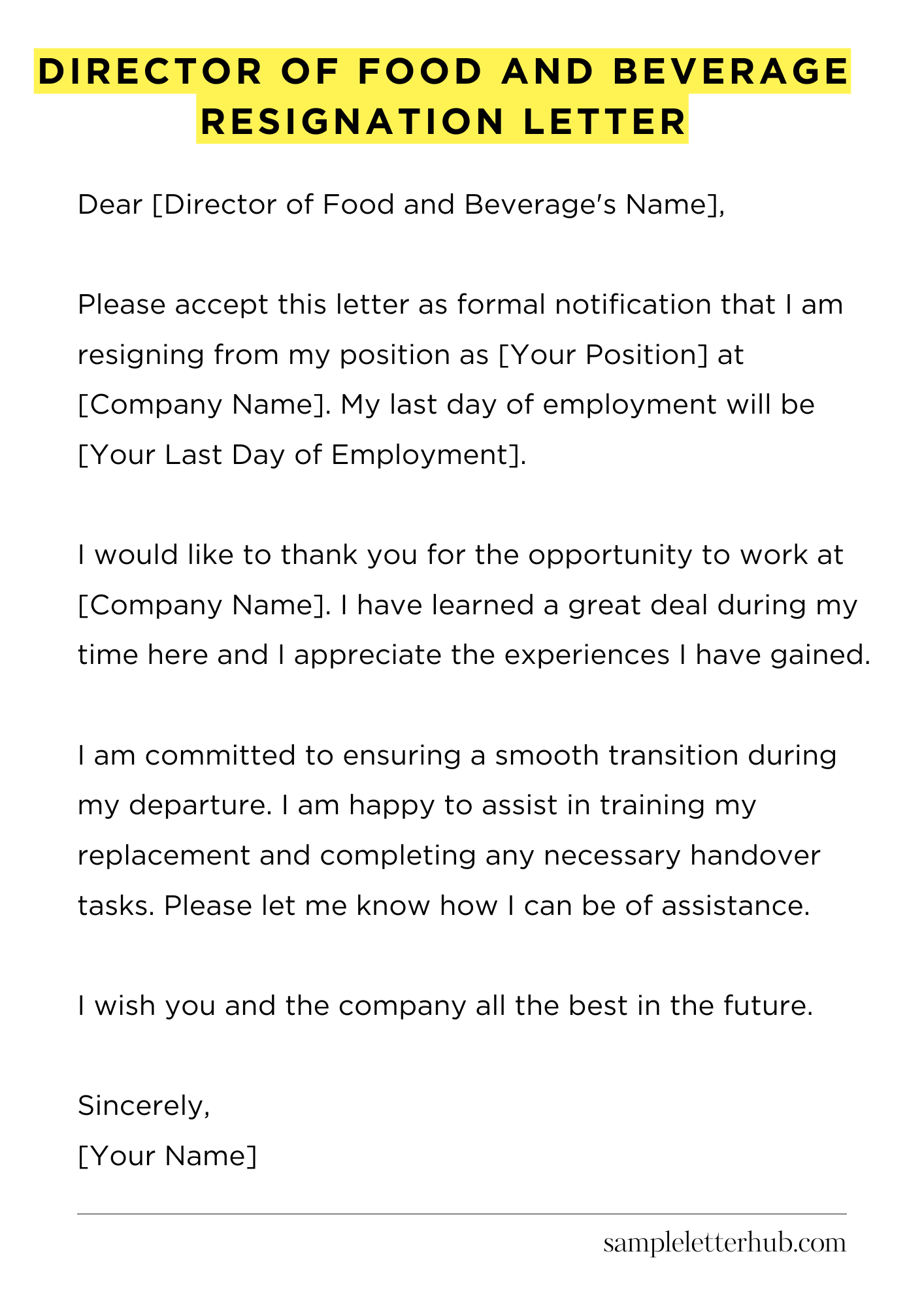
Dear [Director of Food and Beverage’s Name],
Please accept this letter as formal notification that I am resigning from my position as [Your Position] at [Company Name]. My last day of employment will be [Your Last Day of Employment].
I would like to thank you for the opportunity to work at [Company Name]. I have learned a great deal during my time here and I appreciate the experiences I have gained.
I am committed to ensuring a smooth transition during my departure. I am happy to assist in training my replacement and completing any necessary handover tasks. Please let me know how I can be of assistance.
I wish you and the company all the best in the future.
Sincerely,
[Your Name]
How to Write Director Of Food And Beverage Resignation Letter
1. Getting Started: The Crucial First Steps
Resigning from your role as Director of Food and Beverage is a significant career move. A well-crafted resignation letter is absolutely essential. It’s more than just a formality; it’s a professional statement. It sets the tone for your departure and can impact future opportunities.
Start by considering your last day of employment. This is where you put your notice. This date should align with your contract and any company policies regarding resignation.
Be sure to review your employment agreement. You will need to determine the required notice period. This can vary, but generally, two weeks is considered standard. Now you’re ready to start composing your letter.
2. Crafting the Content: What to Include
Your resignation letter should be clear, concise, and professional. Begin with a formal salutation. Address it to the appropriate person, usually your direct supervisor or the Human Resources department. State your intention to resign explicitly in the first paragraph. Specify your last day of employment.
This removes any ambiguity. Next, express your gratitude. Acknowledge the opportunities you’ve been given during your time with the company. Be specific! Mention any particular experiences that have contributed to your growth.
Briefly explain your reason for leaving. You do not have to provide detailed explanations but can offer a brief reason if you want. (e.g., “to pursue another opportunity”).
3. Offering Assistance and Transition
Demonstrating a willingness to assist with the transition is a mark of professionalism. Offer your support during the handover process. Offer assistance in training your replacement. Indicate your availability to help in any way you can before your departure. Offer to help document any ongoing projects or essential tasks.
This gesture showcases your commitment to ensuring a smooth workflow. Provide your contact information for any follow-up questions from the company. This shows you’re still on their side.
4. Formatting and Proofreading: Precision is Key
The format of your letter matters. Use a professional business letter format. This is important. Keep it concise. A one-page letter is usually sufficient. Proofread your letter meticulously.
Check for grammar and spelling errors. Errors can undermine your credibility. It’s helpful to have someone else review it before sending it. Double-check all dates and names.
Print the letter on good-quality paper if you’re delivering a physical copy. Consider a digital version too. Ensure that the formatting is consistent and easy to read. Your goal is to show a polished image of yourself.
5. Delivery and Follow-Up: The Final Touches
Submit your resignation letter according to company policy. Deliver the letter in person if possible. This allows you to discuss your departure with your supervisor directly.
Obtain confirmation that your resignation has been received. This ensures there are no misunderstandings. After delivering the letter, be prepared for a response.
Your supervisor may want to discuss your reasons for leaving. Remain professional and positive in all your communications. Use this time to conduct your handover duties. Thank you again for your time and the opportunity.
FAQs about Director Of Food And Beverage resignation letter
How do I start a Director of Food and Beverage resignation letter?
Begin by clearly stating your intention to resign from your position as Director of Food and Beverage. Include the date of your resignation and the date of your last day of employment. Use a professional and respectful tone throughout the letter.
What key information should be included in the body of the resignation letter?
The body should include a brief statement of your gratitude for the opportunity to have worked at the company. You may briefly mention reasons for your departure, but it’s not required. You should also offer to assist with the transition of your duties and responsibilities. Finally, reiterate your last day of employment.
What is the appropriate tone for a Director of Food and Beverage resignation letter?
Maintain a professional and positive tone. Express gratitude for the opportunity, avoid negative comments about the company or colleagues, and focus on the future. The tone should reflect a respectful farewell.
Should I provide a reason for resigning in the letter?
It is not mandatory to include a specific reason for your resignation. If you choose to, keep it brief and professional. Some common reasons mentioned include pursuing other opportunities, personal reasons, or career advancement. Avoid sharing sensitive information or engaging in criticism.
What is the proper format for delivering the resignation letter?
The letter should be written in a formal business format. Address it to your direct supervisor or the appropriate person in the Human Resources department. Deliver it in person, if possible, or via email. Always keep a copy for your records.
Related:
Resignation letter due to rude boss
Resignation letter moving to another state
Resignation letter due to illness of family member
Resignation letter due to study