

A Director of Admissions resignation letter is a formal document. It announces a decision to leave a position. The letter notifies the employer of the departure. It also states the last day of employment.
Writing this letter can feel tricky. It should be professional. It needs to be clear and concise. We understand this. That is why we provide guidance.
We’ll share examples here. You’ll find templates and samples. These will help you craft your own letter. This article simplifies the process. It aims to make it stress-free.
Director Of Admissions Resignation Letter
Below is a sample of a Director Of Admissions Resignation Letter:
[Your Name]
[Your Address]
[Your Phone Number]
[Your Email Address]
[Date]
Director of Admissions
[University/Institution Name]
[University/Institution Address]
Dear Director of Admissions,
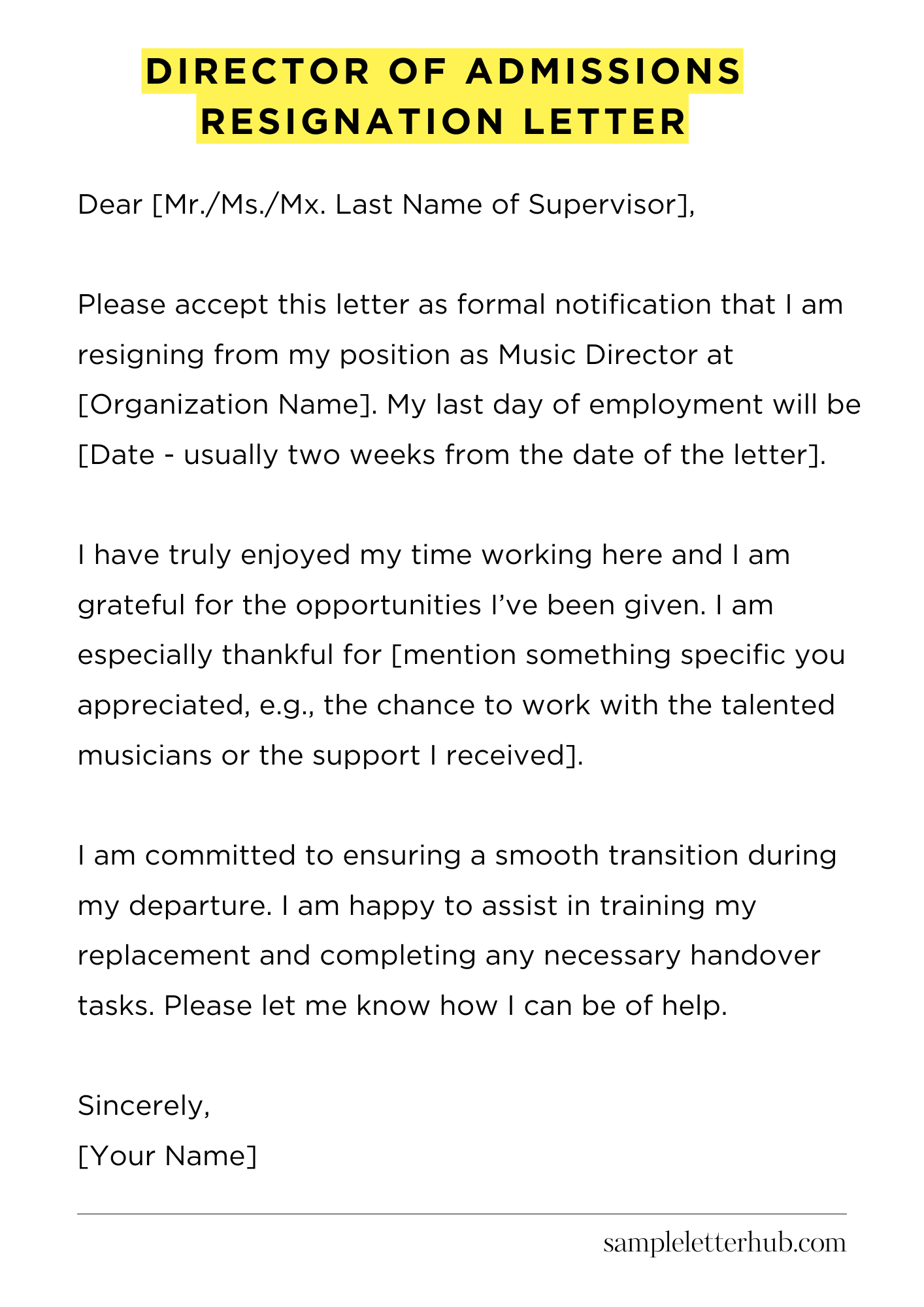
Please accept this letter as formal notification that I am resigning from my position as Director of Admissions, effective two weeks from today, [Date – e.g., November 10, 2024].
I have enjoyed my time at [University/Institution Name] and am grateful for the opportunities I have been given. I appreciate the support I have received from my colleagues and the chance to work with the students.
I am committed to ensuring a smooth transition during my departure. I am available to help train my replacement and assist in any way possible to minimize disruption. I am also happy to complete all my outstanding tasks before my last day.
I wish the university and all its staff the very best for the future.
Sincerely,
[Your Name]
How to Write a Director of Admissions Resignation Letter
So, you’re ready to move on. Being a Director of Admissions is a challenging role, and it’s completely understandable why someone would seek new opportunities.
You’ve likely invested significant time and energy into this position. Now it’s time to craft that resignation letter. Getting this right is crucial for maintaining a positive professional image. A well-written letter can pave the way for a smooth transition and preserve valuable connections. Let’s break down how to do it effectively.
1. Start with Clarity and Conciseness
Your opening paragraph is your first impression. Keep it clear, direct, and to the point. State your intention to resign unequivocally. There’s no need for beating around the bush. Begin by stating your name, your current position (Director of Admissions), and the date you intend to leave.
This immediately establishes the formal purpose of your communication. For example: “Dear [Recipient Name], Please accept this letter as formal notification that I am resigning from my position as Director of Admissions, effective [Your Last Day of Employment].” This is a simple, yet effective way to start.
2. Express Gratitude and Acknowledge Your Time
Even if the role wasn’t always easy, show your appreciation. Reflect positively on your experience. This section allows you to express your gratitude for the opportunity. Mention any positive aspects of your time at the organization. Did you learn a lot? Did you enjoy working with a specific team?
Acknowledge the experience. Thank the people you worked with, especially your direct supervisor or the board of directors. You might say something like: “I am grateful for the opportunity to have served as Director of Admissions for the past [Number] years.
I have valued my time here and appreciate the experiences I have gained.” Keep it genuine and concise. Avoid negativity or any unnecessary details.
3. Provide a Reasonable Transition Period
Your resignation letter isn’t just about saying goodbye; it’s about professionalism. Consider the needs of your employer and your colleagues. Offer to assist with the transition.
The amount of notice you provide will depend on your contract and company policy. Two weeks is a common standard, but a longer notice period might be required, especially in a leadership role. Indicate your willingness to help train your replacement, complete any ongoing projects, and ensure a smooth handover.
For example: “I am committed to assisting with the transition process and will do everything I can to ensure a seamless handover of my responsibilities before my departure.” This shows you’re taking your departure seriously.
4. Keep It Professional and Positive
Maintain a professional tone throughout the entire letter. Avoid discussing personal grievances or the reasons for your departure. While you might have many reasons for leaving, this isn’t the place to air them. Focus on the positive and future opportunities. You don’t want to burn any bridges.
Keep it short, sweet, and to the point. Also, avoid using any slang or informal language. Stick to a formal, respectful tone. Re-read the letter before sending it to ensure there are no grammatical errors or typos. Remember, this letter is a reflection of your professionalism.
5. Formal Closing and Contact Information
End the letter with a formal closing and your contact information. Use a professional closing such as “Sincerely,” or “Respectfully,” followed by your full name.
Provide your contact information, including your phone number and email address. This allows your employer to easily reach you if they have any questions or require further clarification.
Here’s an example: “Sincerely, [Your Full Name] [Your Phone Number] [Your Email Address].” Make sure all the details are accurate. Once you have finalized your resignation letter, make a copy of it for your records. Good luck!
FAQs about Director Of Admissions resignation letter
Understanding the nuances of a Director of Admissions resignation letter is crucial for a smooth transition. Here are some frequently asked questions about this important document.
What key elements should be included in a Director of Admissions resignation letter?
A Director of Admissions resignation letter should include:
- A formal statement of resignation.
- The effective date of resignation.
- A brief, professional reason for leaving (optional).
- An expression of gratitude for the opportunity.
- An offer to assist with the transition, if applicable.
- Contact information (optional, but helpful).
- Your signature.
How much notice should a Director of Admissions give when resigning?
The standard notice period for a Director of Admissions is typically between four to six weeks, though this can vary based on the specific employment contract or company policy. Review your employment agreement to clarify the required notice. Giving ample notice allows for a smoother transition of responsibilities.
What is the appropriate tone for a Director of Admissions resignation letter?
The tone of the letter should be professional, respectful, and positive. Avoid negativity or personal complaints. Express gratitude for the opportunities you’ve had and a willingness to assist with the handover process. Maintain a formal and courteous tone throughout the letter.
Should I include a reason for leaving in my Director of Admissions resignation letter?
Including a reason for leaving is optional. If you choose to provide a reason, keep it brief and professional. It could be for personal or professional growth, a new opportunity, or a change in personal circumstances. Avoid going into excessive detail. If you are comfortable, you can share the reason with your supervisor in person rather than in the letter.
What should be done after submitting the Director of Admissions resignation letter?
After submitting your letter, schedule a meeting with your supervisor to discuss your departure. Be prepared to answer questions and offer assistance with the transition.
Cooperate in the handover process, which might involve training a replacement, documenting procedures, and transferring knowledge. Maintain a positive and professional attitude throughout your remaining tenure.
Related:
Resignation letter due to rude boss
Resignation letter moving to another state
Resignation letter due to illness of family member
Resignation letter due to study