

A Direct Support Professional (DSP) resignation letter formally announces your departure from a DSP role. It serves as an official notice to your employer. The letter states your last day of employment. It ensures a smooth transition.
This article is designed to help you. We understand writing a resignation letter can be tricky. We’ve got you covered. You will find different resignation letter templates here. These examples will get you started.
We will provide diverse letter samples. They cover various situations. You can adapt them to your specific needs. Crafting your DSP resignation letter will be easier.
Direct Support Professional Resignation Letter
Below is a sample of a Direct Support Professional Resignation Letter:
[Your Name]
[Your Address]
[Your Phone Number]
[Your Email Address]
[Date]
[Supervisor’s Name] (or “Hiring Manager”)
[Facility/Company Name]
[Facility/Company Address]
Dear [Supervisor’s Name],
Please accept this letter as formal notification that I am resigning from my position as a Direct Support Professional at [Facility/Company Name]. My last day of employment will be [Your Last Day of Employment].
I would like to express my appreciation for the opportunity to have worked here. I have learned a great deal during my time in this role.
I am committed to assisting with a smooth transition during my departure. Please let me know if there is anything I can do to help with the handover of my responsibilities.
Thank you again for the experience. I wish you and [Facility/Company Name] the best in the future.
Sincerely,
[Your Signature]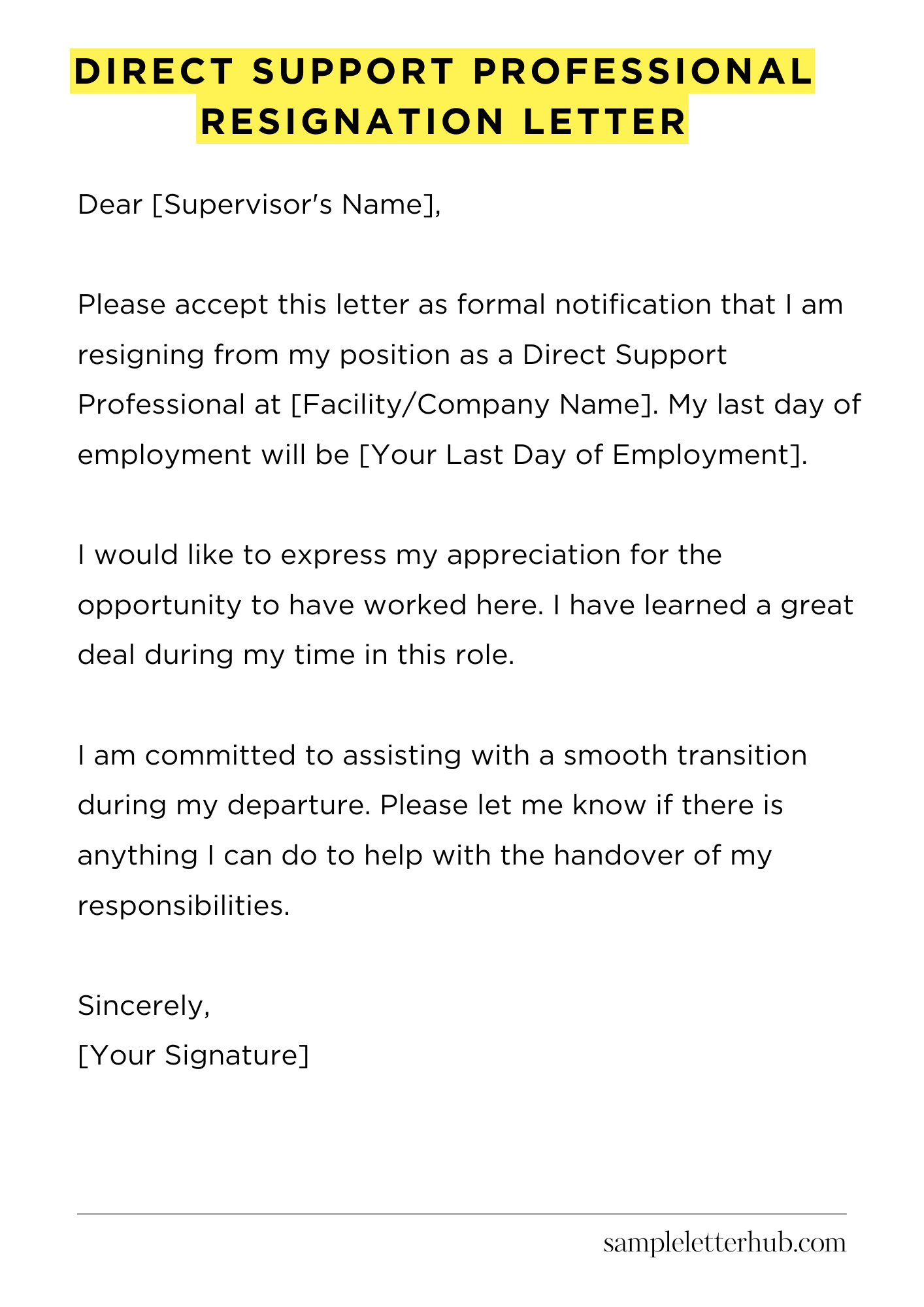
How to Write a Direct Support Professional Resignation Letter
Leaving a job, even one that may not be a perfect fit, can be tricky. You want to ensure you depart on good terms. A well-crafted resignation letter is crucial. It’s a professional courtesy and helps protect your future career prospects. This is especially true in the field of Direct Support, where references are often critical.
1. Keep it Concise and Clear
Simplicity is key. You don’t need to write a novel. State your intention to resign. Specify your last day of employment. These are the two most important pieces of information. This should be very straightforward.
For example, “This letter is to inform you of my resignation from my position as a Direct Support Professional, effective [Your Last Day of Employment].” This is a great starting point. Consider this carefully before you move on.
2. Express Gratitude and Professionalism
Even if the job wasn’t ideal, there’s always something to appreciate. Acknowledge your time with the organization. It’s good practice. Mention any positive experiences, such as opportunities for growth or the support you received from colleagues. Show respect.
A simple “I am grateful for the opportunity to have worked at [Organization Name] and for the experiences I’ve gained” can go a long way. Maintain a professional tone throughout. This is really important.
3. Provide Necessary Details and Information
Your employer needs some basic information. This helps with the transition process. Be sure to confirm the date of your last day of employment. Offer your assistance during the transition period, if you’re able and willing.
Consider saying, “I am happy to assist in any way possible to ensure a smooth transition during my departure.” Consider how this will work with your schedule. Include your contact information in case they need to get in touch. Keep these things in mind.
4. Avoid Negativity and Over-Explanation
Resignation letters aren’t the place to air grievances. Keep it positive, even if you had negative experiences. Don’t dwell on problems you faced. Avoid long explanations of why you’re leaving.
A brief reason, such as “I am pursuing other opportunities,” is perfectly acceptable. Sticking to the facts is the best way forward. Remember, you don’t want to burn any bridges. Be as neutral as you can.
5. Proofread and Edit Carefully
Before you send your letter, check, check, and double-check! Errors in grammar or spelling can damage your professionalism. Read the letter aloud to make sure it flows well. Have a friend or family member look it over. Ensure all dates and names are correct. You want your letter to be a polished representation of you. This final step is important to get right.
FAQs about Direct Support Professional resignation letter
How do I write a Direct Support Professional resignation letter?
When drafting a resignation letter, start by stating your intention to resign and your last day of employment. Be sure to include your name, the date, and the recipient’s name and title. Briefly express your gratitude for the opportunity, if appropriate. It’s also a good idea to state your reason for leaving, but this is optional; you can keep it concise.
If you are willing, you can offer to assist with the transition. Finally, end the letter with a professional closing, such as “Sincerely” or “Respectfully,” followed by your name and signature.
What should I include in a Direct Support Professional resignation letter?
A professional DSP resignation letter should include: your name, date, the name and title of the recipient, a clear statement of resignation, your last day of employment, a brief expression of gratitude (optional), the reason for leaving (optional), an offer to assist with the transition (optional), a professional closing, and your signature.
What is the typical notice period for a Direct Support Professional resignation?
The standard notice period for a Direct Support Professional is typically two weeks. However, this can vary depending on your employer’s policy, your employment contract, or any union agreements.
It is crucial to review your employment agreement or employee handbook to confirm the required notice period. Adhering to the specified notice period is vital for a smooth transition.
Should I provide a reason for resigning in my Direct Support Professional resignation letter?
Providing a reason for resigning in your DSP resignation letter is optional. While it’s not required, including a brief reason can sometimes be helpful for your employer.
If you choose to share your reason, keep it concise and professional. You can state that you’re seeking another opportunity, relocating, or pursuing other personal or professional goals. If you choose not to share a reason, that is acceptable as well.
How should I deliver my Direct Support Professional resignation letter?
The best way to deliver your DSP resignation letter is usually in person to your supervisor, if possible. This allows for a more personal communication. If delivering in person isn’t feasible, sending it via email is a common and acceptable alternative. Always retain a copy of your resignation letter for your records.
Related:
Resignation letter due to rude boss
Resignation letter moving to another state
Resignation letter due to illness of family member
Resignation letter due to study