

A Desktop Engineer resignation letter is a formal document. It informs your employer of your intent to leave your job. The letter officially marks the end of your employment. It is a crucial step in the resignation process.
Need to quit your Desktop Engineer role? Writing the perfect letter can feel daunting. Don’t worry, we’ve got you covered. We’ll share several templates and examples. These will guide you.
Use these samples as your starting point. Customize them to fit your situation. Craft a professional, clear, and impactful letter. Your next chapter awaits!
Desktop Engineer Resignation Letter
Below is a sample of a Desktop Engineer Resignation Letter:
[Your Name]
[Your Address]
[Your Phone Number]
[Your Email Address]
[Date]
[Employer’s Name]
[Company Name]
[Company Address]
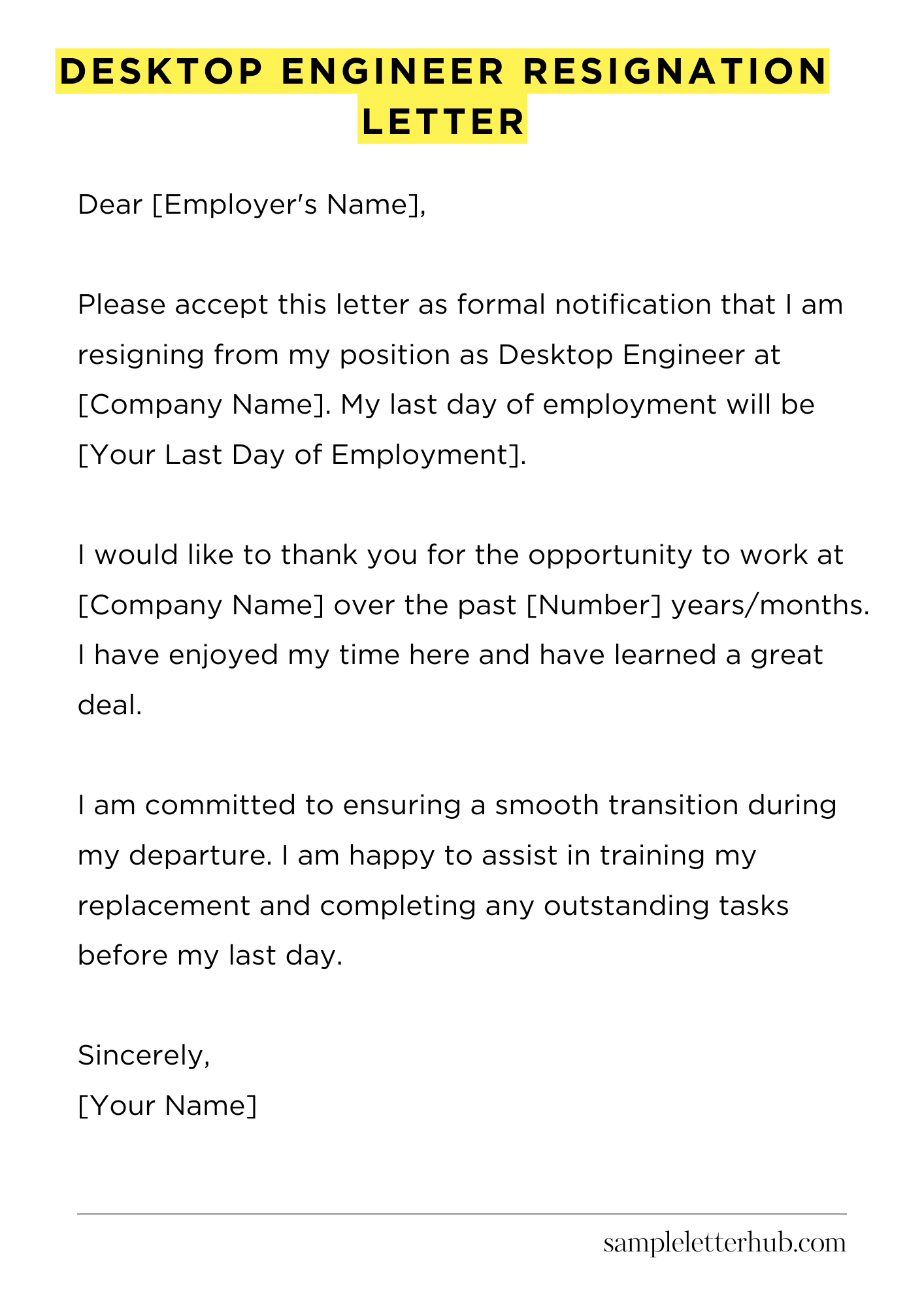
Dear [Employer’s Name],
Please accept this letter as formal notification that I am resigning from my position as Desktop Engineer at [Company Name]. My last day of employment will be [Your Last Day of Employment].
I would like to thank you for the opportunity to work at [Company Name] over the past [Number] years/months. I have enjoyed my time here and have learned a great deal.
I am committed to ensuring a smooth transition during my departure. I am happy to assist in training my replacement and completing any outstanding tasks before my last day.
I wish you and the company all the best in the future.
Sincerely,
[Your Name]
How to Write a Desktop Engineer Resignation Letter
Why a Good Resignation Letter Matters
Leaving a job is a big step. No matter your reasons, you should handle it professionally. It is very important to do this right. A well-written resignation letter is a cornerstone of this process. It helps ensure a smooth transition and preserves a positive relationship with your employer. This is very important.
Essential Elements: What to Include
Your Desktop Engineer resignation letter needs a few key elements. First, state your intention to resign clearly. Be specific about your last day of employment. This is where it all begins. Next, express gratitude for the opportunities you’ve been given. Briefly mention any accomplishments or positive experiences.
A brief thanks is always appreciated. Finally, offer assistance with the handover of your duties. This shows you’re a team player and willing to help. This goes a long way!
Structuring Your Letter: A Practical Guide
Start with your name, address, and the date. Then, address your letter to your supervisor or HR manager. Use a formal and polite tone throughout. Begin with a clear statement of your resignation. For instance, “Please accept this letter as formal notification that I am resigning from my position as Desktop Engineer, effective [Your Last Day of Employment].”
Keep it direct. Next, express your thanks for the opportunity to work there. Now offer to help in the transition. Keep it relatively short and to the point. Proofread carefully before sending it.
Example Resignation Letter for Desktop Engineers
Here’s a basic template you can adapt.
[Your Name]
[Your Address]
[Your Phone Number]
[Your Email Address]

[Date]

[Supervisor/HR Manager Name]
[Their Title]
[Company Name]
[Company Address]

Dear [Supervisor/HR Manager Name],

Please accept this letter as formal notification that I am resigning from my position as Desktop Engineer, effective [Your Last Day of Employment].

I am grateful for the opportunities I have been given during my time at [Company Name]. I have learned a lot. I also appreciate the support I have received.

I am committed to ensuring a smooth transition. I am happy to assist in any way possible to transfer my responsibilities.

Thank you again for the experience. I wish you and the company all the best in the future.

Sincerely,
[Your Signature]
[Your Typed Name]
Remember to customize it with your specific details. This is just a guide!
Beyond the Basics: Making a Positive Impression
While a basic resignation letter suffices, you can enhance it further. Consider highlighting any positive experiences or contributions you made. You can also mention specific skills you developed. Avoid negative comments about your employer or colleagues. Keep it professional.
Maintain a positive and respectful tone. This is the last impression you’ll leave. Strive to leave a good one. A positive departure can lead to positive references in the future.
FAQs about Desktop Engineer Resignation Letter
What is the primary purpose of a Desktop Engineer resignation letter?
The primary purpose of a Desktop Engineer resignation letter is to formally notify your employer of your intention to leave your position. It serves as an official record of your departure, enabling a smooth transition and helping the company understand your final day of employment.
What essential information should be included in a Desktop Engineer resignation letter?
An effective resignation letter should include your formal statement of resignation, the date of your last day of employment, your acknowledgment of any obligations (like returning company property), and an expression of gratitude (optional, but often appreciated) for the opportunity to work at the company.
It may also include a brief, professional reason for leaving, if desired.
How much notice should a Desktop Engineer provide when resigning?
The standard notice period for a Desktop Engineer, like most professionals, is typically two weeks. However, this can vary based on your employment contract or company policy. It’s crucial to review your employment agreement to confirm the required notice period to avoid any potential issues.
Should I provide a reason for resigning in my Desktop Engineer resignation letter?
While not mandatory, it’s generally a good practice to briefly mention the reason for your resignation. You can keep it concise and professional, such as “to pursue a new opportunity” or “to relocate.” Avoid providing overly detailed or negative explanations, especially if the reason involves conflicts.
What is the recommended format for a Desktop Engineer resignation letter?
A typical resignation letter should be formal and professional. Start with your name and address, followed by the date, and the recipient’s information (name, title, company address).
Use a clear and concise tone throughout the letter, and conclude with a professional closing (e.g., “Sincerely” or “Regards”) followed by your signature and typed name. It should be written in business letter format.
Related:
Resignation letter due to rude boss
Resignation letter moving to another state
Resignation letter due to illness of family member
Resignation letter due to study