

A “Deputy General Manager resignation letter” is a formal document. It announces your departure from the company. It serves as a professional notification to your employer.
Leaving a job can be tricky. Writing the perfect resignation letter is essential. We’ve got you covered. We’ll share several templates and examples.
These samples will make things simpler. They are easy to adapt. Use them to craft your own resignation letter. Make your exit smooth and professional.
Deputy General Manager Resignation Letter
Below is a sample of a Deputy General Manager Resignation Letter:
[Your Name]
[Your Address]
[Your Phone Number]
[Your Email Address]
[Date]
[Hiring Manager Name] (If known, otherwise use title)
Deputy General Manager
[Company Name]
[Company Address]
Dear [Mr./Ms./Mx. Last Name],
Please accept this letter as formal notification that I am resigning from my position as Deputy General Manager at [Company Name]. My last day of employment will be [Your Last Day of Employment].
I have enjoyed my time at [Company Name] and appreciate the opportunities I have been given during my employment. I have learned a great deal and value the relationships I have built with my colleagues.
I am committed to assisting with the transition of my responsibilities. I am happy to help train my replacement and ensure a smooth handover of my duties. Please let me know how I can be of assistance during this period.
I wish [Company Name] continued success in the future.
Sincerely,
[Your Signature]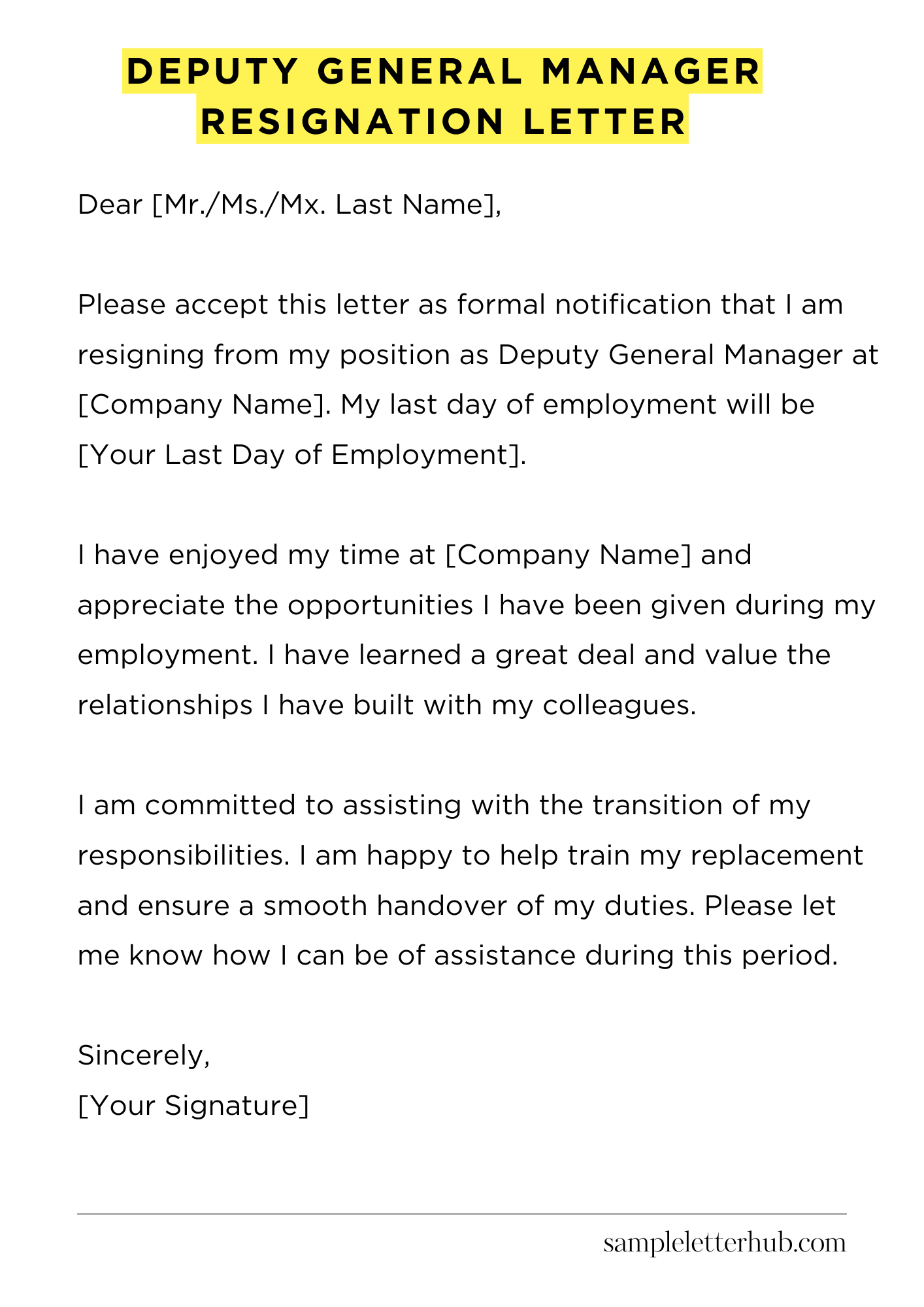
How to Write Deputy General Manager Resignation Letter
1. Getting Started: The Basics You Need
Leaving a job, especially at a Deputy General Manager level, requires careful planning. You’re not just sending a quick email; this is a formal declaration. You’ll need a well-crafted resignation letter. First things first: gather essential details. Include your full name, current title (Deputy General Manager), and the date you’re writing the letter.
Always state the effective date of your resignation. Be clear. Be concise. A good resignation letter sets the stage for a smooth transition.
2. Structure is Key: Formatting Your Letter Properly
Good formatting lends credibility. It shows professionalism. Begin with your contact information. Your name, address, phone number, and email. Then, add the date. Next, include the recipient’s information: The General Manager or the appropriate person, their title, and the company address. Your letter should have a clear structure.
Use a formal business letter style. Keep it simple with clear paragraphs and avoid excessive jargon.
3. The Content: What to Include and How to Say It
The core of your letter is, of course, the message. Start with a direct statement of your resignation. For example: “Please accept this letter as formal notification that I am resigning from my position as Deputy General Manager, effective [Date].” You don’t need to go into a lengthy explanation about why you are leaving, unless you choose to.
A brief expression of gratitude for the opportunity to work there is always a good idea. Consider mentioning any contributions you’re proud of. Briefly express your willingness to assist with the handover process. Avoid negativity; keep a positive tone.
4. The Professional Touch: Tips for a Positive Departure
Maintain professionalism, always. Even if your experience wasn’t ideal. Keep it positive. Be gracious. This helps you maintain a strong professional reputation. Avoid airing grievances. Refrain from making personal attacks or criticizing the company. Proofread your letter carefully. Check for any typos or grammatical errors.
Before sending it, make a copy for your records. Consider keeping a copy of the final letter and any acknowledgment received from your employer. This is for your future reference.
5. Wrapping it Up: Next Steps and Considerations
Once you’ve finalized your letter, it’s time to deliver it. Typically, you’ll hand it to your manager or HR. Sometimes, the company has a specific protocol. Ensure you follow it. After submitting, be prepared for a response. They might schedule a meeting to discuss your departure. Remain professional and cooperative during this process.
A good resignation letter sets a positive tone. It helps to ensure a smooth transition and leaves a lasting positive impression. Remember, your departure is the final impression.
FAQs about Deputy General Manager resignation letter
What is the primary purpose of a Deputy General Manager resignation letter?
The primary purpose is to formally notify an employer of an employee’s intent to leave their position as Deputy General Manager. It serves as an official record of the resignation, the effective date of departure, and, often, a statement of gratitude or explanation.
What key elements should be included in a Deputy General Manager resignation letter?
Essential components include a clear statement of resignation, the position held (Deputy General Manager), the effective date of resignation, a brief expression of appreciation (optional but recommended), and the employee’s signature. It may also include a reason for leaving, though this is not always mandatory.
How much notice should a Deputy General Manager provide when resigning?
The required notice period is typically stipulated in the employment contract or company policy. Common notice periods for senior management roles like Deputy General Manager are often between 30 and 90 days. It is crucial to adhere to the agreed-upon timeframe to avoid potential legal or professional complications.
Should a Deputy General Manager explain the reason for leaving in the resignation letter?
While not always mandatory, providing a brief explanation can be beneficial. It allows for transparency and may help maintain a positive relationship with the employer. Common reasons cited include pursuing a new opportunity, personal growth, or a change in circumstances. However, avoid negativity or excessive detail.
How should a Deputy General Manager deliver the resignation letter?
It is generally best practice to deliver the resignation letter in writing. A hard copy is often preferred, but an email is also acceptable. Ensure the letter is addressed to the appropriate person (typically the General Manager, CEO, or Human Resources) and that a copy is retained for personal records.
It is advisable to also have a brief, in-person conversation with your superior to discuss your resignation.
Related:
Resignation letter due to rude boss
Resignation letter moving to another state
Resignation letter due to illness of family member
Resignation letter due to study