

It is time for a change. A “D Artist resignation letter” is a formal notice. It’s a statement. You are leaving your job as a “D Artist.” This letter officially informs your employer of your departure.
Are you struggling to find the right words? Don’t worry. This article is for you. We’ll offer a helping hand. We’ve compiled examples. You can use them to write your own letter.
Need a simple template? We got you. Want something more creative? We have that too. Let these samples inspire your perfect resignation. Let’s get started.
D Artist Resignation Letter
Below is a sample of a D Artist Resignation Letter:
[Your Name]
[Your Address]
[Your Phone Number]
[Your Email Address]
[Date]
[Recipient Name]
[Recipient Title]
[Company Name]
[Company Address]
Dear [Recipient Name],
Please accept this letter as formal notification that I am resigning from my position as a D Artist at [Company Name]. My last day of employment will be [Your Last Day of Employment].
I would like to thank you for the opportunity to work at [Company Name]. I have enjoyed my time here and have learned a great deal.
I am committed to ensuring a smooth transition during my departure. I am happy to assist in training my replacement and completing any outstanding tasks. Please let me know how I can be of assistance.
I wish you and [Company Name] all the best in the future.
Sincerely,
[Your Signature]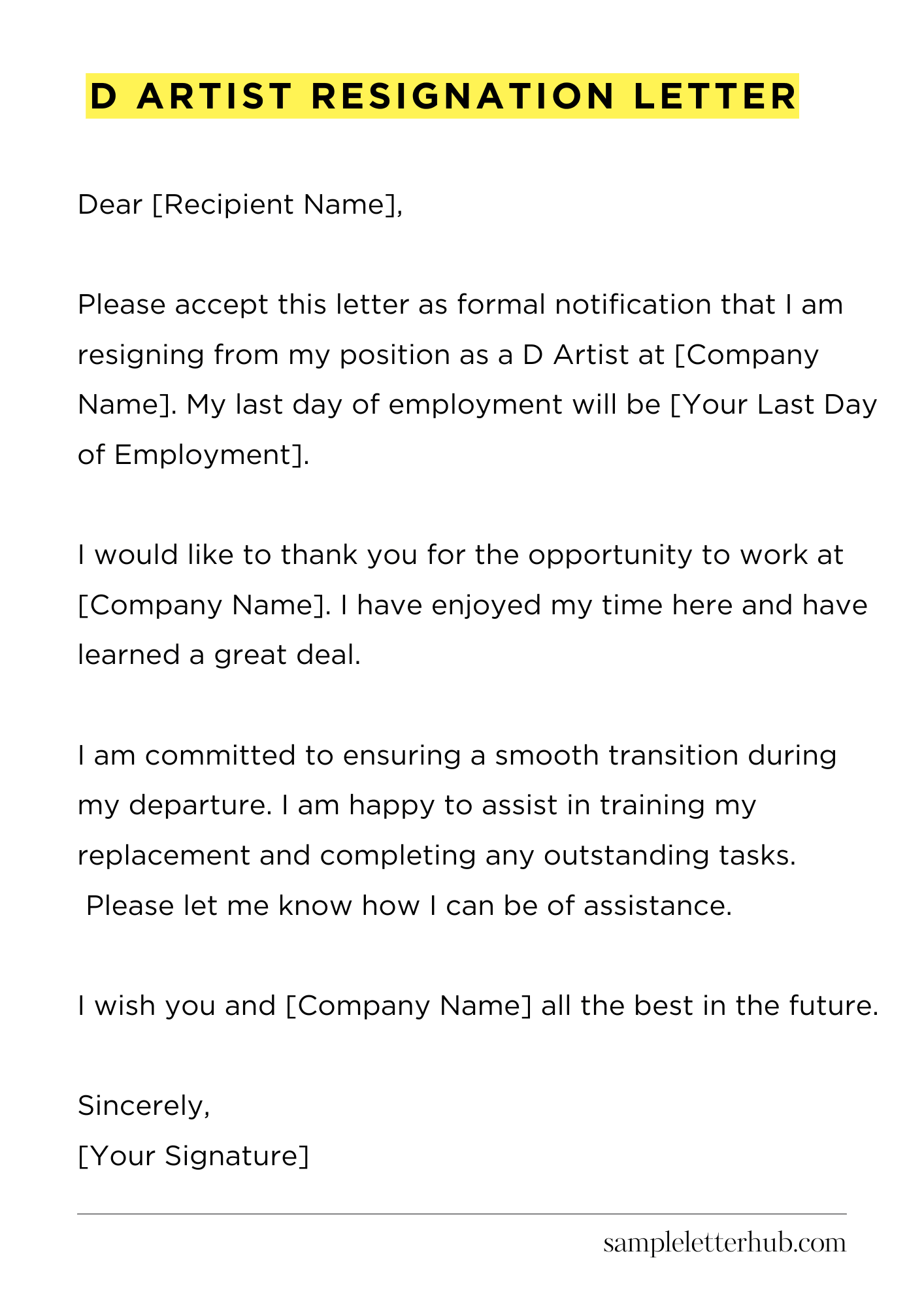
How to Write a D Artist Resignation Letter
Know Your Audience (and Yourself)
Before you even begin typing, think about who you’re writing to. Who is your direct supervisor? Is there an HR department you need to involve? This will inform the tone and formality of your letter.
Now, let’s talk about what *you* want. Why are you leaving? Are you taking a new job? Retiring? Need a career change? Understanding your own motivations is crucial for clarity. You do not want any room for assumptions.
Honesty is important, but so is professionalism. Your letter should reflect your personal situation. Consider your relationship with the D Artist and your reasons for leaving. It is a very important part of the job.
The Anatomy of a Resignation Letter
Every well-crafted resignation letter follows a general structure. Start with a clear and concise statement of your intention to resign. The date you are officially leaving should be noted right away.
Next, state your last day of employment. This is usually determined by your contract or company policy. Then, include the main body. The most critical part. Your message.
This is where you briefly state your reason for leaving. A general statement such as “pursuing other opportunities” is perfectly acceptable. Next, express your gratitude for the opportunity to work there. Mention specific experiences, if appropriate. It is not necessary, though it does look good.
Finally, end with a polite and professional closing. This is to ensure a smooth transition. Offer to assist with the handover process if needed.
Crafting the Right Tone
The tone of your letter is just as important as the content. Avoid negativity, even if you had a negative experience. Maintain a professional and respectful tone throughout. Regardless of how you feel, remember the future. The professional world is often small. Maintain a positive relationship. Avoid getting into disagreements. Don’t burn any bridges.
Consider the company culture. A more formal, structured environment might require a more formal letter. A more relaxed culture could allow for a slightly more personal touch. However, always err on the side of professionalism. It’s better to be safe than sorry.
Essential Elements to Include
Your letter should contain several key elements. First, include your name and contact information. Your letter should be dated, and the recipient’s name and title. Next, state your clear intention to resign. State your last day of employment. This is what you must provide. No discussion.
Then, provide a brief reason for your departure. Express gratitude. Offer assistance. For a smooth transition, offer to assist with any handover tasks. Don’t forget a professional closing. Think of things like “Sincerely” or “Best regards.” Sign the letter and if necessary, type your full name beneath your signature.
Proofreading and Delivery
Before sending your letter, proofread it carefully. Check for any grammatical errors and spelling mistakes. Even a small error can undermine your professionalism. Remember, this is the last impression. Make it count. It shows your work ethic. Double-check all dates and contact information. Be certain everything is correct.
Consider the delivery method. For a formal resignation, it is usually delivered in person. Follow your company’s policy. Make sure you keep a copy of your letter for your records.
This is vital. Consider notifying your supervisor and HR at the same time. This ensures everyone is aware and informed of your departure. Finally, submit your resignation with grace and confidence. You’ve earned it!
FAQs about D Artist resignation letter
How should I format my D Artist resignation letter?
Your resignation letter should be concise and professional. Begin with a clear statement of your resignation, including the effective date. State your position and to whom the letter is addressed. Keep the body brief, expressing your gratitude (optional), and avoid negativity. Close with a professional closing and your signature. Ensure it’s typed and easy to read.
What key information must I include in my D Artist resignation letter?
Crucially, your letter must state your intention to resign and the last day of your employment (effective date). Include your name, your position, and the name of the recipient (usually your direct supervisor or HR). While optional, it’s often customary to express gratitude for the opportunities you’ve been given. Confirm all the information that is included is accurate.
Is it necessary to provide a reason for resigning in my D Artist resignation letter?
Generally, providing a reason for your resignation is not mandatory. You’re not obligated to share the specifics of your departure. However, you may choose to briefly explain if you feel it’s appropriate, for instance, for a new opportunity or a personal reason. Keep your explanation brief and positive.
What if I need to adjust my resignation date in the D Artist letter?
If you need to change your resignation date after submitting the letter, it’s essential to communicate with your supervisor or HR immediately. A revised letter might be necessary, including a new effective date. Ensure to obtain written confirmation of any changes to avoid misunderstandings.
How should I deliver my D Artist resignation letter?
Deliver your letter in a manner that aligns with your company’s policy, usually via email or a physical copy delivered to your supervisor or HR. Maintain a professional approach, and it is usually best to have a hard copy of the letter delivered, but in the case that you are remote, an email is acceptable. Always keep a copy of your letter for your records.
Related:
Resignation letter due to rude boss
Resignation letter moving to another state
Resignation letter due to illness of family member
Resignation letter due to study