

Need to prove you own something? A “Cover Letter for Submitting Proof of Ownership” is your friendly introduction. It comes with your important documents. Its purpose? To clearly state what you’re sending and why. It helps the receiver understand everything easily. This is all about proof of ownership!
We understand writing these letters can be tricky. That’s why we’re here to help! We’ve prepared various cover letter templates and examples. You’ll find sample cover letters here. These are crafted to suit different situations. We aim to simplify the process.
Our goal is simple. We provide easy-to-use samples. They’re perfect for your proof of ownership letter needs. Feel free to use and modify them. Writing cover letters just got easier!
[Your Name/Your Company Name]
[Your Address]
[Your Phone Number]
[Your Email Address]
[Date]
[Recipient Name/Company Name]
[Recipient Address]
Dear [Recipient Name],
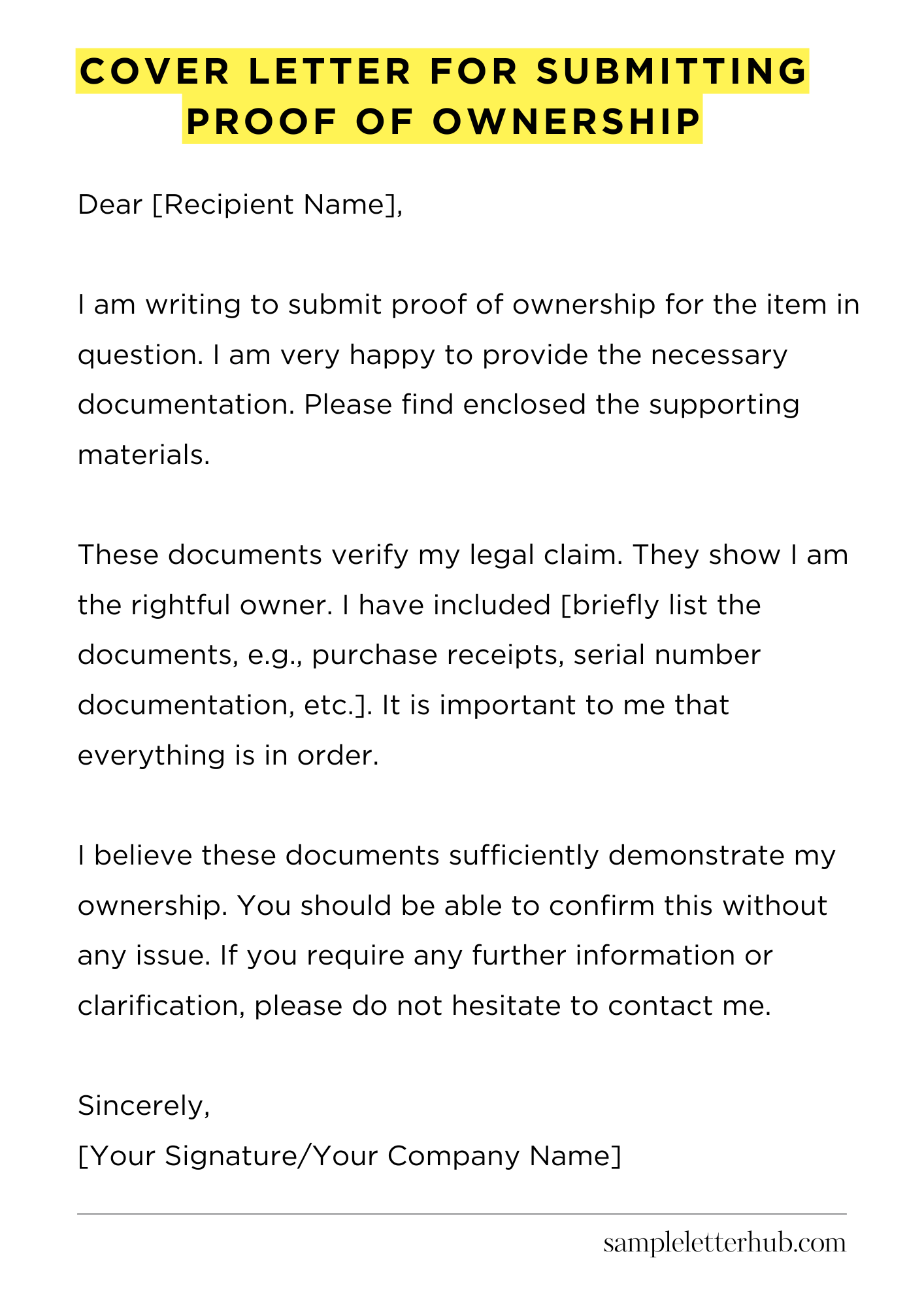
I am writing to submit proof of ownership for the item in question. I am very happy to provide the necessary documentation. Please find enclosed the supporting materials.
These documents verify my legal claim. They show I am the rightful owner. I have included [briefly list the documents, e.g., purchase receipts, serial number documentation, etc.]. It is important to me that everything is in order.
I believe these documents sufficiently demonstrate my ownership. You should be able to confirm this without any issue. If you require any further information or clarification, please do not hesitate to contact me. I am available to assist you in any way possible.
Thank you for your time and attention to this matter. I appreciate your prompt consideration. I am looking forward to hearing from you soon.
Sincerely,
[Your Signature/Your Company Name]
How to Write Cover Letter for Submitting Proof of Ownership
Submitting proof of ownership can be a complex affair, often requiring a carefully crafted cover letter to ensure clarity and expediency.
A well-constructed cover letter serves as the initial emissary, clarifying the context and purpose of the submitted documentation. Here’s a comprehensive guide to help you navigate the process effectively:
1. Commence with a Formal Salutation
Begin your missive with a professional salutation. Address the recipient appropriately. Determine their title and name. If it is unspecified, opt for “To Whom It May Concern,” while bearing in mind this is less efficacious. This initial courtesy sets a tone of professionalism.
2. Explicitly State Your Purpose
The cardinal objective of your cover letter is to make your purpose unmistakably clear from the outset. Your opening paragraph should unambiguously state that you are submitting proof of ownership.
Specify the type of asset. Elaborate on what you are trying to achieve through this submission. Be direct and avoid circumlocution.
3. Provide Comprehensive Identification
The next step is to unequivocally identify yourself and the asset in question. Include your full legal name, contact information (address, phone number, and email address), and any relevant identification numbers.
For the asset, specify its make, model, serial number, and any other unique identifiers. This helps the recipient to immediately ascertain who and what you are referring to.
4. Enumerate the Enclosed Documentation
Detail each piece of documentation enclosed with your letter. A meticulous inventory is imperative. List each document. Specify the date. Briefly describe its content. This aids the recipient in verifying that they have received all the required materials.
5. Substantiate Your Claim with Context
Provide a concise rationale for why you are submitting the proof of ownership. Explain the situation necessitating the submission. Be brief but informative.
For instance, are you attempting to resolve a dispute? Are you claiming a lost item? Giving context will augment the significance of your proof.
6. Express Gratitude and Offer Contact Information
Conclude your letter with a gracious closing. Express your appreciation for the recipient’s time and attention. Reiterate your contact information.
This allows the recipient to easily reach out to you should any further clarifications be required. Encourage open communication for the sake of efficiency.
7. Adopt a Polished Conclusion
Finalize your cover letter with a professional closing, such as “Sincerely” or “Respectfully.” Sign the letter manually, if possible, before scanning it and attaching it digitally.
Always proofread your letter meticulously before submission to eliminate errors and ensure clarity. Remember, the letter is a reflection of your commitment to detail and a valuable tool in substantiating your claim.
FAQs about Cover Letter for Submitting Proof of Ownership
1. What is the purpose of a cover letter when submitting proof of ownership?
The primary purpose of a cover letter accompanying proof of ownership is to formally introduce the attached documents, clearly state the intent of the submission (e.g., to establish ownership, claim a property, etc.), and provide any relevant context or explanation.
It serves as a professional introduction and helps the recipient understand the significance of the enclosed documentation.
2. What specific information should be included in a cover letter for proof of ownership?
A cover letter should include the sender’s full name and contact information, the recipient’s information (if known), a clear statement of the purpose (e.g., “to provide proof of ownership for…”), a concise description of the attached documents (e.g., “enclosed are copies of the deed and title insurance policy”), and any necessary background information or clarifications.
It should also request confirmation of receipt or any further instructions if required.
3. What types of documents typically require a cover letter for proof of ownership?
Documents requiring a cover letter for proof of ownership often include deeds, titles, certificates of ownership (for vehicles, stocks, etc.), insurance policies, receipts, and any other documentation used to verify ownership of a specific asset or property.
The specific documents will depend on the nature of the asset and the reason for submitting proof of ownership.
4. Is there a specific format or template that should be followed for this type of cover letter?
While there isn’t one universal template, it’s advisable to follow a standard business letter format. This typically includes a formal salutation (e.g., “Dear [Recipient Name]”), a clear and concise body outlining the purpose and attached documents, and a professional.
5. How can I ensure the cover letter is legally sound and effectively conveys the necessary information?
To ensure legal soundness and effectiveness, the cover letter should be clear, concise, and accurate. Avoid ambiguous language and ensure all relevant details are included.
Consider consulting legal counsel if the proof of ownership relates to a complex or high-value asset, or if there’s any uncertainty about the requirements of the recipient or the specific legal context.
Related:
Resignation letter due to rude boss
Resignation letter moving to another state
Resignation letter due to illness of family member
Resignation letter due to study