

A corporate controller’s resignation letter is a formal document. It announces their departure from a company. Its purpose is to officially inform the employer. It also communicates the last day of employment.
Writing this letter can feel tricky. Don’t worry, we’re here to help. We’ll share several templates. You’ll find different examples. These samples will guide you.
Use them to create your own letter. Need a simple, straightforward format? We have you covered. Want to express gratitude? We can show you how.
Corporate Controller Resignation Letter
Below is a sample of a Corporate Controller Resignation Letter:
[Your Name]
[Your Address]
[Your Phone Number]
[Your Email Address]
[Date]
[Recipient Name]
[Recipient Title]
[Company Name]
[Company Address]
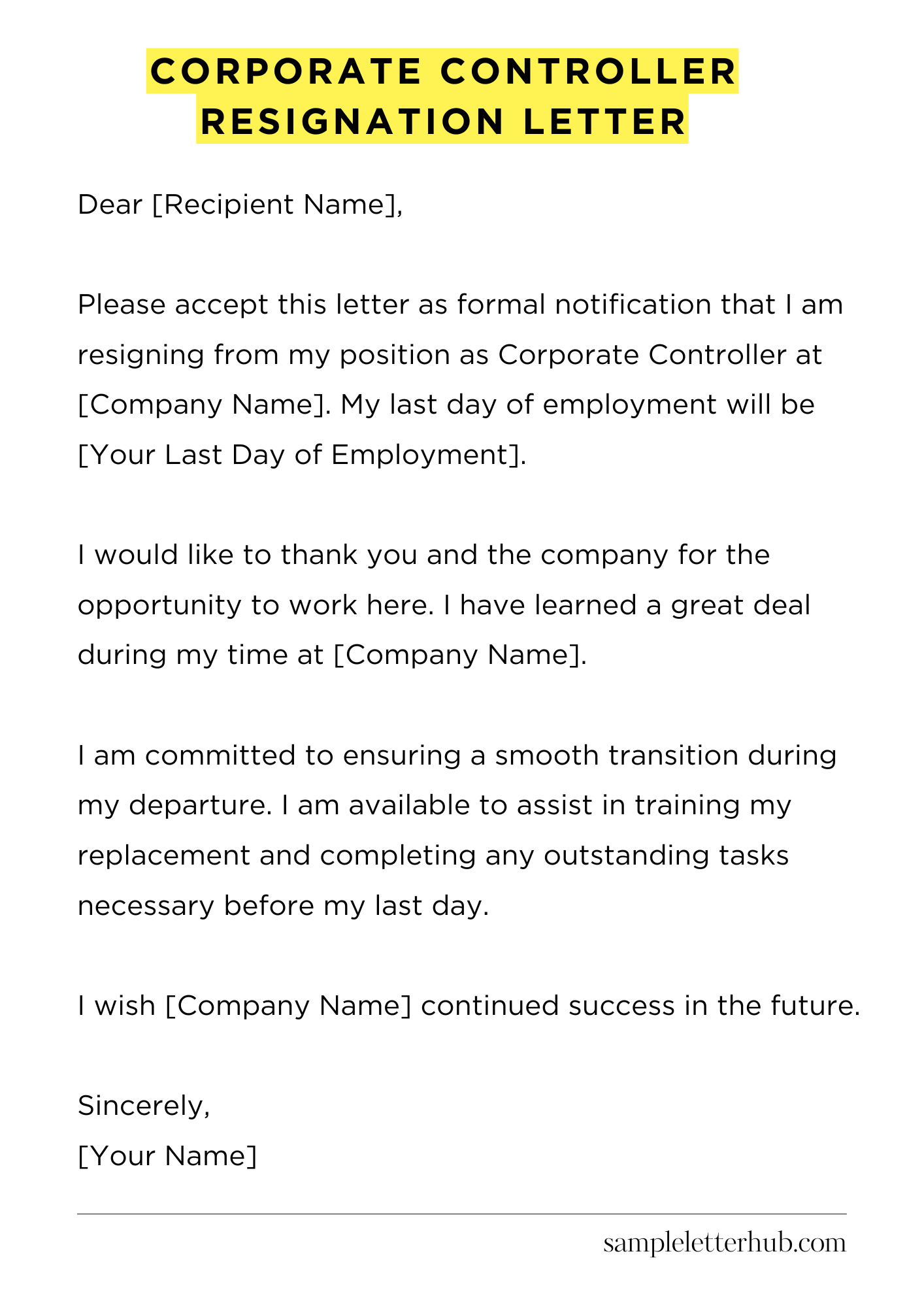
Dear [Recipient Name],
Please accept this letter as formal notification that I am resigning from my position as Corporate Controller at [Company Name]. My last day of employment will be [Your Last Day of Employment].
I would like to thank you and the company for the opportunity to work here. I have learned a great deal during my time at [Company Name].
I am committed to ensuring a smooth transition during my departure. I am available to assist in training my replacement and completing any outstanding tasks necessary before my last day.
I wish [Company Name] continued success in the future.
Sincerely,
[Your Name]
How to Write a Corporate Controller Resignation Letter
So, you’re moving on. Leaving a job is a big decision, especially when you’re the Corporate Controller. You’re in charge of the financial health of the company, and that’s a serious responsibility. Because of this, your resignation letter needs to be handled with professionalism and care. Here’s a guide to help you craft a letter that leaves a positive lasting impression.
1. Keep it Short and Sweet (and Professional)
First things first: brevity is key. You don’t need a novel. A well-written resignation letter is direct and to the point. State your intent to resign, the effective date of your departure, and nothing more, at least initially. Remember, you’re aiming for a clean break. This isn’t the time to list every single thing you dislike about the role.
Keep your language formal. Avoid slang or overly casual terms. Stick to phrases that are clear and concise. “I am writing to inform you” is preferable to “I’m peacing out.”
2. State the Essentials Clearly
Your letter must include the key details. Specifically, state that you are resigning from your position as Corporate Controller. Then, clearly state your last day of employment. Make sure this date is in agreement with your employment contract or any agreements you’ve made.
Double-check this! Your HR department can help you if there’s any confusion. A good example is, “Please accept this letter as formal notification that I am resigning from my position as Corporate Controller, effective [Date].”
Do not include explanations or justifications in this initial section. Your focus should be on providing the essential information required for the process to begin.
3. Express Gratitude (And Offer a Smooth Transition)
Even if things didn’t always go swimmingly, it’s wise to express gratitude for the opportunity. Mentioning your time with the company in a positive light shows professionalism. You can say something like, “I am grateful for the opportunities I have been provided during my time at [Company Name].”
Then, offer your assistance in the transition. This is crucial for a smooth handover. Offer to help train your replacement, complete any outstanding tasks, and provide documentation.
Consider a phrase along the lines of, “I am committed to ensuring a smooth transition during my departure and am happy to assist in any way possible to train my replacement.” This demonstrates your integrity and commitment.
4. Formalities and Formatting
Formatting is important. Use a business letter format. Your address should be at the top, followed by the date, and then the recipient’s name and title. Use a professional font like Times New Roman or Arial. Keep the tone formal throughout.
Always address the letter to the appropriate person, usually your direct supervisor or the CEO. If you’re unsure, check with HR to confirm who should receive the letter. Proofread your letter carefully before sending it. Typos and grammatical errors are never a good look.
5. Delivery and Follow-Up
Once your letter is ready, consider how you’ll deliver it. While email is common, delivering a physical letter, if possible, can be seen as more professional. If you are submitting it digitally, make sure to save it as a PDF.
After you submit the letter, be prepared for a response. Your supervisor or HR may schedule a meeting to discuss your departure. Be prepared to answer questions.
They might want to discuss your reasons for leaving or to clarify any transition details. Be prepared to be flexible during the transition phase. This is your chance to solidify your professional reputation. Even as you move on, a positive attitude can go a long way.
FAQs about Corporate Controller resignation letter
What is the primary purpose of a Corporate Controller’s resignation letter?
The primary purpose of a Corporate Controller’s resignation letter is to formally notify the employer of the intent to leave the position. It serves as an official record of the departure, specifies the last day of employment, and can include a statement of gratitude or explanation for leaving.
It is a crucial document for initiating the transition process and ensuring a smooth handover of responsibilities.
What key information must be included in a Corporate Controller’s resignation letter?
Essential components of a Corporate Controller’s resignation letter include: a clear statement of resignation, the effective date of resignation, the intended last day of employment, and a formal salutation and closing.
While not mandatory, it’s often beneficial to express gratitude for the opportunity and briefly state the reason for leaving. Contact information and a professional tone are also crucial.
How should a Corporate Controller handle sensitive information or confidential data in their resignation letter?
When addressing sensitive information or confidential data in a resignation letter, it is generally advisable to avoid disclosing specific details about the reasons for departure.
Instead, focus on a general statement of intent to leave. Reference any existing non-disclosure agreements and ensure that all confidential company information is handled with the utmost discretion during the transition period. Emphasize commitment to maintaining confidentiality post-employment is also essential.
What is the recommended format and tone for a Corporate Controller’s resignation letter?
A Corporate Controller’s resignation letter should adhere to a professional business letter format, including the date, recipient’s name and title, and a formal salutation.
The tone should be respectful, positive, and concise. While expressing appreciation for the opportunity is customary, the focus should remain on the official notification of resignation and the last day of employment. Avoid negative comments or unnecessary personal details.
What steps should a Corporate Controller take after submitting their resignation letter?
After submitting the resignation letter, the Corporate Controller should collaborate with the employer to ensure a smooth transition. This involves participating in handover processes, preparing documentation, and training any replacement.
Adhering to the terms of any employment agreements and maintaining professionalism during the transition period are also essential. It’s often beneficial to offer assistance in any way possible to ensure a seamless workflow.
Related:
Resignation letter due to rude boss
Resignation letter moving to another state
Resignation letter due to illness of family member
Resignation letter due to study