

A “Corporate Communications resignation letter” is a formal document. Its main goal is simple. It officially informs your employer of your decision to leave. It also states your last day of employment.
Are you looking to make a graceful exit? You have landed in the right place. We have prepared helpful templates. Examples are available. These will help you craft your own resignation letter.
Consider these your building blocks. Use them as inspiration. Customize them to fit your specific situation. Writing your resignation just got easier!
Corporate Communications Resignation Letter
Below is a sample of a Corporate Communications Resignation Letter:
[Your Name]
[Your Address]
[Your Phone Number]
[Your Email Address]
[Date]
[Recipient’s Name]
[Recipient’s Title]
[Company Name]
[Company Address]
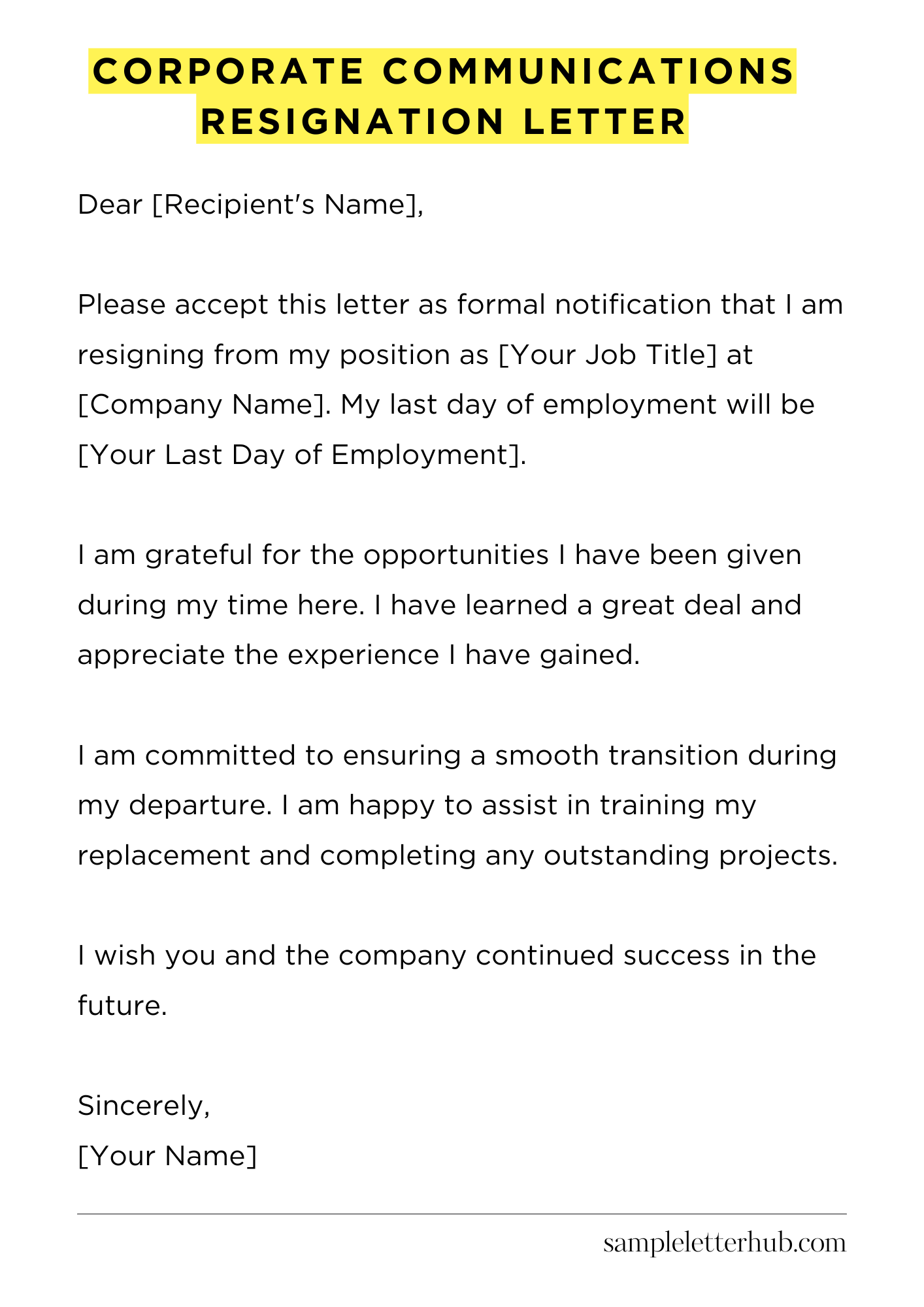
Dear [Recipient’s Name],
Please accept this letter as formal notification that I am resigning from my position as [Your Job Title] at [Company Name]. My last day of employment will be [Your Last Day of Employment].
I am grateful for the opportunities I have been given during my time here. I have learned a great deal and appreciate the experience I have gained.
I am committed to ensuring a smooth transition during my departure. I am happy to assist in training my replacement and completing any outstanding projects.
I wish you and the company continued success in the future.
Sincerely,
[Your Name]
How to Write a Corporate Communications Resignation Letter
Leaving a job is a big decision. And when it comes to corporate communications, the way you exit is just as important as the work you did while employed. Your resignation letter is your final statement, the last impression you leave. So, how do you craft a resignation letter that’s professional, gracious, and leaves a positive legacy?
1. Keep it Concise and Clear: Get Straight to the Point
Don’t beat around the bush. The purpose of your letter is to formally announce your departure. Start with a clear declaration of your intent. State your resignation, the date of your last day of employment, and your position.
A simple sentence like, “Please accept this letter as formal notification that I am resigning from my position as Corporate Communications Manager, effective October 27, 2024,” does the trick. Avoid lengthy narratives or overly emotional language. Keep it brief; you want to make it easy to understand.
2. Express Gratitude (and Be Sincere!)
This is crucial. Even if your experience wasn’t perfect, find something to be thankful for. Acknowledge the opportunities you were given, the skills you gained, or the colleagues you enjoyed working with.
Phrases like, “I am grateful for the opportunities I’ve been given during my time here,” or, “I appreciate the experience and support I’ve received from my team,” demonstrate professionalism and grace. Be sincere in your thanks; even a small expression of appreciation can make a big difference.
3. Offer Assistance with the Transition (if Possible)
Showing a willingness to help during the transition period is a mark of a good employee. Offer to assist with the handover of your responsibilities. You could write: “I am happy to assist in the transition process and will do everything I can to ensure a smooth handover of my duties.”
This demonstrates your commitment to your former employer and makes the transition easier for everyone involved. However, consider your current workload and personal commitments before over-promising.
4. Maintain Professionalism: Avoid Negativity
This is a rule you should always adhere to. Steer clear of negative comments about your colleagues, superiors, or the company. Do not include grievances, complaints, or gossip.
Even if you’re leaving because of issues within the organization, your resignation letter isn’t the appropriate forum to air your grievances. Focus on the positive aspects of your employment and end on a high note. Remember, your resignation letter can potentially follow you.
5. Proofread and Edit, Then Proofread Again!
This is extremely important. Before you hit “send,” carefully proofread your letter. Check for spelling errors, grammatical mistakes, and any inconsistencies.
A polished, error-free letter reflects your attention to detail and professionalism. Ask a trusted friend or colleague to review it as well. Fresh eyes can often catch errors you might miss. A well-written letter is a lasting testament to your capabilities.
FAQs about Corporate Communications Resignation Letter
What are the essential elements to include in a Corporate Communications resignation letter?
A well-crafted Corporate Communications resignation letter should include your formal announcement of resignation, the effective date of your departure, a concise statement of your reason for leaving (if desired, though not mandatory), expressions of gratitude for the opportunities provided, and a professional offer to assist with the transition.
It should also be addressed to the appropriate person, usually your direct supervisor or HR representative. Finally, proofread it carefully to avoid any errors.
How should I address my Corporate Communications resignation letter?
The letter should be addressed formally to your direct supervisor or the Human Resources department. It’s generally best to start with their title and full name, such as “Dear Mr./Ms. [Last Name]”.
Avoid informal greetings unless you have a very close professional relationship and that is the established norm within your company. Be sure to spell the recipient’s name correctly and be sure the letter is formatted correctly.
Can I include a reason for leaving in my Corporate Communications resignation letter, and should I?
You are not obligated to include a reason for leaving. However, if you choose to, keep it brief, professional, and positive. Avoid negativity or making complaints. A simple statement such as “I am pursuing other opportunities” or “I am seeking a new challenge” is often sufficient. If you are leaving due to a positive opportunity, that can be mentioned without specific detail.
What is the appropriate tone for a Corporate Communications resignation letter?
Maintain a professional and respectful tone throughout your letter. Express gratitude for the opportunities you’ve been given, and avoid any negative comments about your employer, colleagues, or the work environment.
The goal is to leave on good terms, preserving your professional reputation. Keep the writing style professional by using business appropriate grammar and terminology.
How far in advance should I submit my Corporate Communications resignation letter?
The standard practice is to provide at least two weeks’ notice, but this can vary depending on your company’s policy and your role. Some senior-level positions may require longer notice periods.
Review your employment contract or company handbook to understand the required notice period. If you are unsure, it is best to check with your supervisor or HR department to ensure you are compliant with the requirements of your employment.