

Facing a job change? A “Corporate Account Manager resignation letter” is your formal notice. It’s a crucial document. It officially communicates your decision to leave your current role. It’s also about maintaining a professional image.
This article is designed to help you. We understand writing these letters can be tricky. We’ve compiled helpful samples and templates. They cover various scenarios and situations.
Get ready to draft your letter with ease. You’ll find different formats. Choose the one that best suits your needs. We’ve simplified the process.
Corporate Account Manager Resignation Letter
Below is a sample of a Corporate Account Manager Resignation Letter:
[Your Name]
[Your Address]
[Your Phone Number]
[Your Email Address]
[Date]
[Hiring Manager Name] (If known, otherwise use title)
[Hiring Manager Title]
[Company Name]
[Company Address]
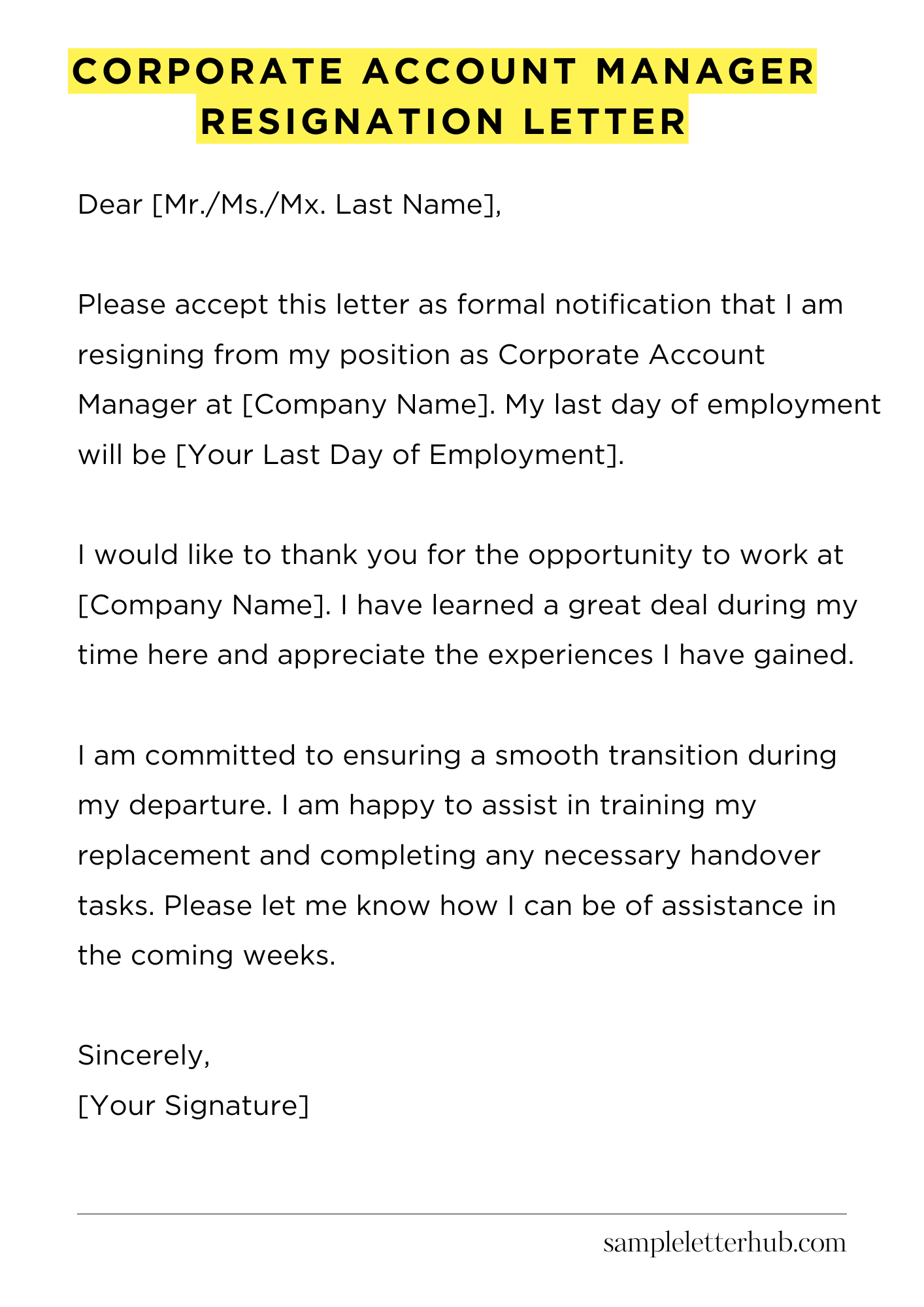
Dear [Mr./Ms./Mx. Last Name],
Please accept this letter as formal notification that I am resigning from my position as Corporate Account Manager at [Company Name]. My last day of employment will be [Your Last Day of Employment].
I would like to thank you for the opportunity to work at [Company Name]. I have learned a great deal during my time here and appreciate the experiences I have gained.
I am committed to ensuring a smooth transition during my departure. I am happy to assist in training my replacement and completing any necessary handover tasks. Please let me know how I can be of assistance in the coming weeks.
I wish you and the company all the best in the future.
Sincerely,
[Your Signature]
How to Write a Corporate Account Manager Resignation Letter
So, you’ve made the decision. You’re ready to move on from your role as a Corporate Account Manager. Congratulations on taking the next step in your career journey!
But before you can embark on that new adventure, there’s one crucial task remaining: crafting a professional resignation letter. This isn’t just a formality; it’s a vital piece of communication that can impact your future opportunities.
1. Keep it Concise and Clear
First and foremost, keep it brief. No need for lengthy explanations or dramatic farewells. Your primary goal is to formally announce your departure. State your intention to resign, the effective date of your last day of employment, and your official title. It should be easily understandable.
For example, you might start with something like, “Please accept this letter as formal notification that I am resigning from my position as Corporate Account Manager, effective [Your Last Day of Employment].” Remember, clarity is key in corporate communication. Avoid ambiguity.
2. Express Gratitude (and Keep it Professional)
While you might have mixed feelings, expressing gratitude is important. Even if the job wasn’t perfect, there were likely opportunities for growth, learning, and experience. A simple “Thank you for the opportunity to have worked here” or “I am grateful for the experience and opportunities I’ve received at [Company Name]” is usually sufficient.
Avoid any negative comments or complaints. Your resignation letter is not the place to air grievances. Maintain a positive and professional tone throughout, regardless of your true sentiments.
3. Address Your Responsibilities (and Offer Assistance)
Part of being a responsible employee is ensuring a smooth transition. Briefly mention your willingness to assist with the handover of your duties. You can state something along the lines of, “I am committed to ensuring a smooth transition and am happy to assist in any way possible to train my replacement or transfer my responsibilities.”
Consider offering to prepare documentation, train your colleagues, or help answer questions related to your accounts. This shows professionalism and consideration for your former employer. It also helps preserve good relationships with colleagues. It’s often worthwhile in the long run.
4. Maintain a Positive Tone (Even If You’re Ready to Leave)
As mentioned earlier, negativity is a no-no. It is absolutely important to maintain a positive and professional tone throughout your letter. Refrain from making disparaging remarks about your manager, the company, or your colleagues. Keep the focus on the future. Consider your goal: to leave a good impression.
Use positive language and focus on the opportunities ahead. This shows maturity and leaves a lasting positive impact, regardless of your reasons for leaving.
5. Review, Edit, and Proofread (It’s Absolutely Essential!)
Before you hit send, read your letter multiple times. Check for any grammatical errors, spelling mistakes, or typos. Have a friend or colleague proofread it too. A polished, error-free letter reflects your professionalism and attention to detail. This is what you must do.
Make sure the tone is appropriate for a formal business communication. Also, confirm the formatting is correct. Ensure that all the key information is clearly presented. A well-written resignation letter can make a difference in how your departure is perceived and how you’re remembered.
FAQs about Corporate Account Manager Resignation Letter
What is the primary purpose of a Corporate Account Manager resignation letter?
The primary purpose of a resignation letter is to formally notify your employer of your intent to leave your position. It serves as an official record of your departure, enabling a smooth transition and helping to protect both you and your employer. This is critical for HR records and legal purposes.
What key elements should be included in a Corporate Account Manager resignation letter?
A well-crafted resignation letter should include: a clear statement of your intent to resign, the date of your last day of employment, a brief expression of gratitude for the opportunity, and any necessary information regarding the handover of your responsibilities. It may also include a statement of willingness to assist with the transition, contact information, and your signature.
How much notice should a Corporate Account Manager give when resigning?
The standard notice period is typically two weeks, but this can vary depending on company policy or your employment contract. It’s crucial to review your employment agreement to determine the required notice period. Providing adequate notice ensures a professional departure and demonstrates respect for your employer.
Should a Corporate Account Manager explain the reasons for leaving in their resignation letter?
While not mandatory, it is generally recommended to keep your reasons for leaving brief and professional. You can state that you are pursuing other opportunities or are seeking a new career path without going into excessive detail. Focus on a positive and respectful tone, even if your reasons are not entirely positive. Avoid negativity or making personal attacks.
How should a Corporate Account Manager handle the handover of their responsibilities after submitting their resignation?
After submitting your resignation letter, it’s essential to cooperate fully in the handover process. This includes preparing a detailed plan for transferring your responsibilities, documenting key processes, and training your replacement.
Be available to answer questions and assist with the transition during your remaining time with the company. Professionalism during this phase is paramount.
Related:
Resignation letter due to rude boss
Resignation letter moving to another state
Resignation letter due to illness of family member
Resignation letter due to study