

A coordinator resignation letter is a formal document. It announces your decision to leave a coordinator position. The purpose is to officially inform your employer about your departure. It outlines your last day of work.
Planning to resign? Writing a resignation letter can be tough. We’re here to help you. We have crafted helpful samples for you. These examples will make the process easier.
These templates cover various scenarios. They’re designed to fit different coordinator roles. Use them as a starting point. Feel free to adjust them to fit your needs.
Coordinator Resignation Letter
Below is a sample of a Coordinator Resignation Letter:
[Your Name]
[Your Address]
[Your Phone Number]
[Your Email Address]
[Date]
[Recipient Name]
[Recipient Title]
[Company Name]
[Company Address]
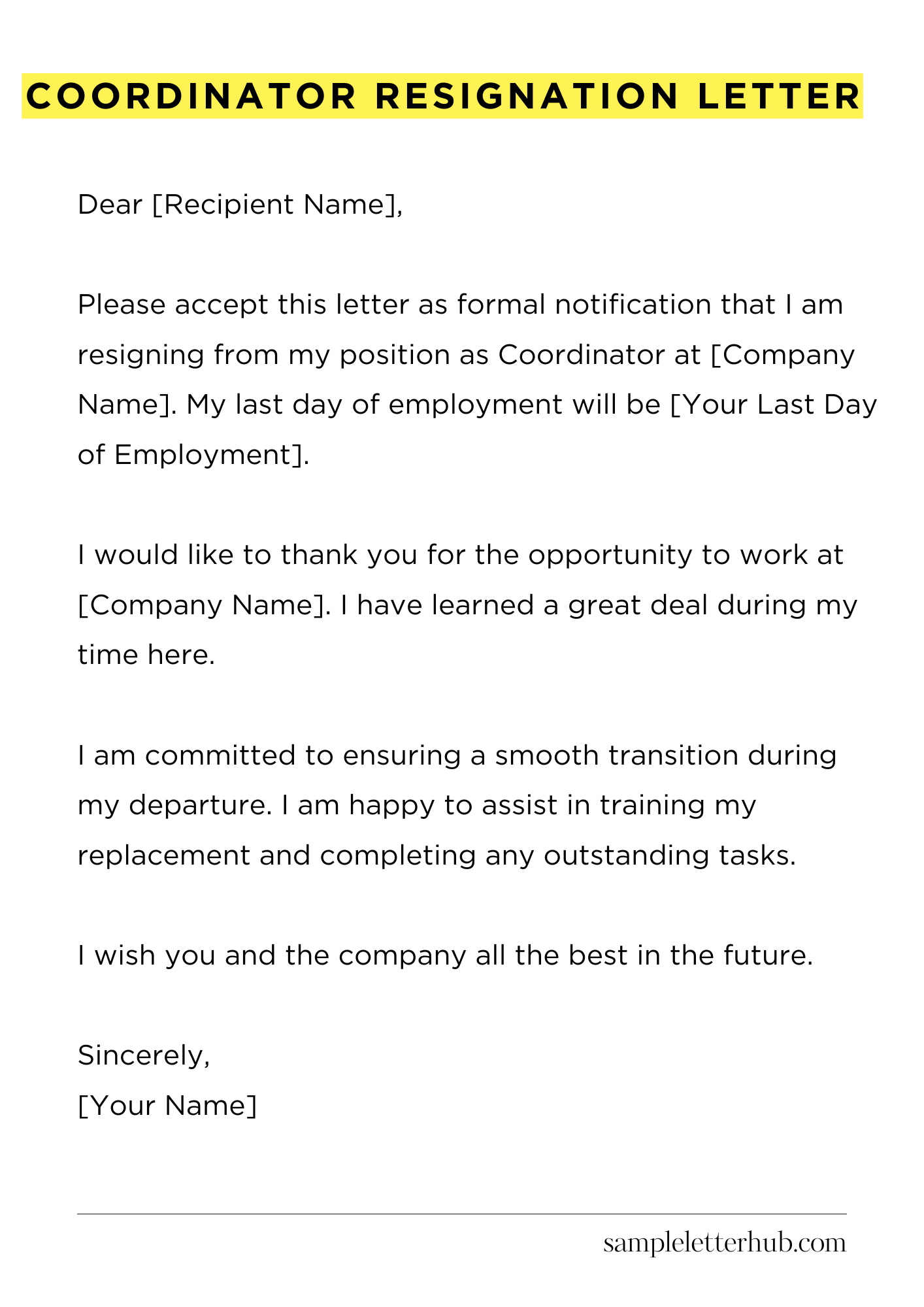
Dear [Recipient Name],
Please accept this letter as formal notification that I am resigning from my position as Coordinator at [Company Name]. My last day of employment will be [Your Last Day of Employment].
I would like to thank you for the opportunity to work at [Company Name]. I have learned a great deal during my time here.
I am committed to ensuring a smooth transition during my departure. I am happy to assist in training my replacement and completing any outstanding tasks.
I wish you and the company all the best in the future.
Sincerely,
[Your Name]
How to Write a Coordinator Resignation Letter
1. Why Resign, and Why a Letter?
So, you’re moving on. That’s a big step! Maybe it’s a new job, a career change, or even a personal decision. Regardless, you’ll need to officially inform your employer of your departure. A resignation letter is the standard way to do this.
Think of it as a formal goodbye. It’s a professional courtesy and a crucial step in the process. It keeps things tidy. A letter documents your decision, the date, and gives your employer the time they need to prepare. Plus, it protects you and your job. Make sure everything is documented and there are no misunderstandings.
2. Essential Elements: What to Include
What should you put in your letter? Don’t worry, it’s pretty straightforward. You’ll need a few key pieces of information.
- Your Name and Contact Information: Start at the top. This is just for them to know it is you.
- The Date: Very important; it sets the clock ticking.
- Your Manager’s Name and Title: Address it correctly to the appropriate person.
- A Clear Statement of Resignation: State plainly that you are resigning from your position. Don’t beat around the bush; be direct.
- Your Last Day of Employment: Give them proper notice. Common practice is two weeks. Check your employment contract for specifics.
- A Brief Statement of Gratitude (Optional but Recommended): Briefly thank your employer for the opportunity.
- A Professional Closing: Use a formal closing, like “Sincerely” or “Best Regards.”
- Your Typed Name: Sign your name too.
3. Formatting for Success
Good formatting makes your letter easy to read. Let’s look at some important considerations.
- Use a professional font: Times New Roman or Arial are safe choices.
- Keep it concise: Aim for one page, if possible.
- Use clear and concise language: Avoid jargon or overly emotional language.
- Proofread! Proofread! Proofread!: Check for typos and grammatical errors. Nothing looks less professional than mistakes.
Take care with details. It reflects on you.
4. Writing Tips: Making it Count
You’re ready to start writing, so let’s get into the details.
- Be Positive: Even if you’re leaving due to negative circumstances, keep the tone positive and professional.
- Focus on the Facts: Stick to the essential information.
- Offer Assistance with the Transition: This shows your commitment to a smooth handover. Offer to help train your replacement. This is not always necessary but it helps.
- Avoid Criticism: Refrain from complaining about your job or employer. It’s not the time or place.
- Keep a Copy for Yourself: Always keep a copy of the letter for your records.
Keep your response easy for your employer to understand.
5. After the Letter: What Comes Next?
Once you’ve submitted your letter, the process is not complete.
- Inform Your Colleagues: Let them know, but be mindful of your company’s policy and protocol.
- Complete any Exit Procedures: Return company property, complete any necessary paperwork, and attend an exit interview.
- Be Professional Until Your Last Day: Continue to perform your duties to the best of your ability. The relationship remains important, and you never know when you’ll cross paths again.
Good luck with your next adventure! Leaving on good terms is always the best approach.
FAQs about Coordinator Resignation Letter
What is the primary purpose of a coordinator resignation letter?
The primary purpose of a coordinator resignation letter is to formally notify an employer of your intention to leave your position. It serves as an official record of your departure and provides essential details like the effective date of your resignation.
What key elements should be included in a coordinator resignation letter?
A comprehensive coordinator resignation letter should include: your formal announcement of resignation, the date of your last day of employment, a statement of gratitude for the opportunity (optional but recommended), any necessary handover details, and your signature. It’s often advisable to keep the tone professional and positive.
How much notice should a coordinator typically provide in their resignation letter?
The standard notice period for a coordinator usually ranges from two to four weeks, but this can vary depending on company policy, your employment contract, or any industry norms. Always refer to your employment agreement or consult with your supervisor or HR department to determine the appropriate timeframe.
Should I provide a reason for resigning in my coordinator resignation letter?
While not mandatory, it’s generally a good practice to briefly state your reason for leaving, especially if it’s due to an offer that helps in your career progression. However, you are not obligated to disclose the precise details. A simple statement such as “pursuing other opportunities” or “seeking a new challenge” is often sufficient.
How should I deliver my coordinator resignation letter?
The most common and professional method is to provide a physical, printed copy of your resignation letter to your direct supervisor or the HR department. You may also send an electronic copy, such as an email attachment, after you’ve delivered the physical copy. Always retain a copy for your records. Check if the company has a specific protocol for submitting resignations.
Related:
Resignation letter due to rude boss
Resignation letter moving to another state
Resignation letter due to illness of family member
Resignation letter due to study