

So, you’re a content creator ready to move on. A content creator resignation letter is your official notice to your employer. It’s a formal document. Its purpose is to announce your departure. It also serves as a record of your last day.
Writing a resignation letter can be tricky. You want to be professional. You want to be clear. We understand. This article is here to help.
We’ve got you covered. We’re sharing templates and examples. Use them as a starting point. Tailor them to fit your specific situation. Craft your letter with ease.
Content Creator Resignation Letter
Below is a sample of a Content Creator Resignation Letter:
[Your Name]
[Your Address]
[Your Phone Number]
[Your Email Address]
[Date]
[Employer’s Name]
[Employer’s Title]
[Company Name]
[Company Address]
Dear [Employer’s Name],
Please accept this letter as formal notification that I am resigning from my position as Content Creator at [Company Name]. My last day of employment will be [Your Last Day of Employment].
I would like to thank you for the opportunity to work here. I have learned a great deal and appreciate the experiences I’ve gained during my time with the company.
I am committed to ensuring a smooth transition during my departure. I am happy to assist in training my replacement and completing any outstanding projects to the best of my ability.
I wish you and [Company Name] all the best in the future.
Sincerely,
[Your Name]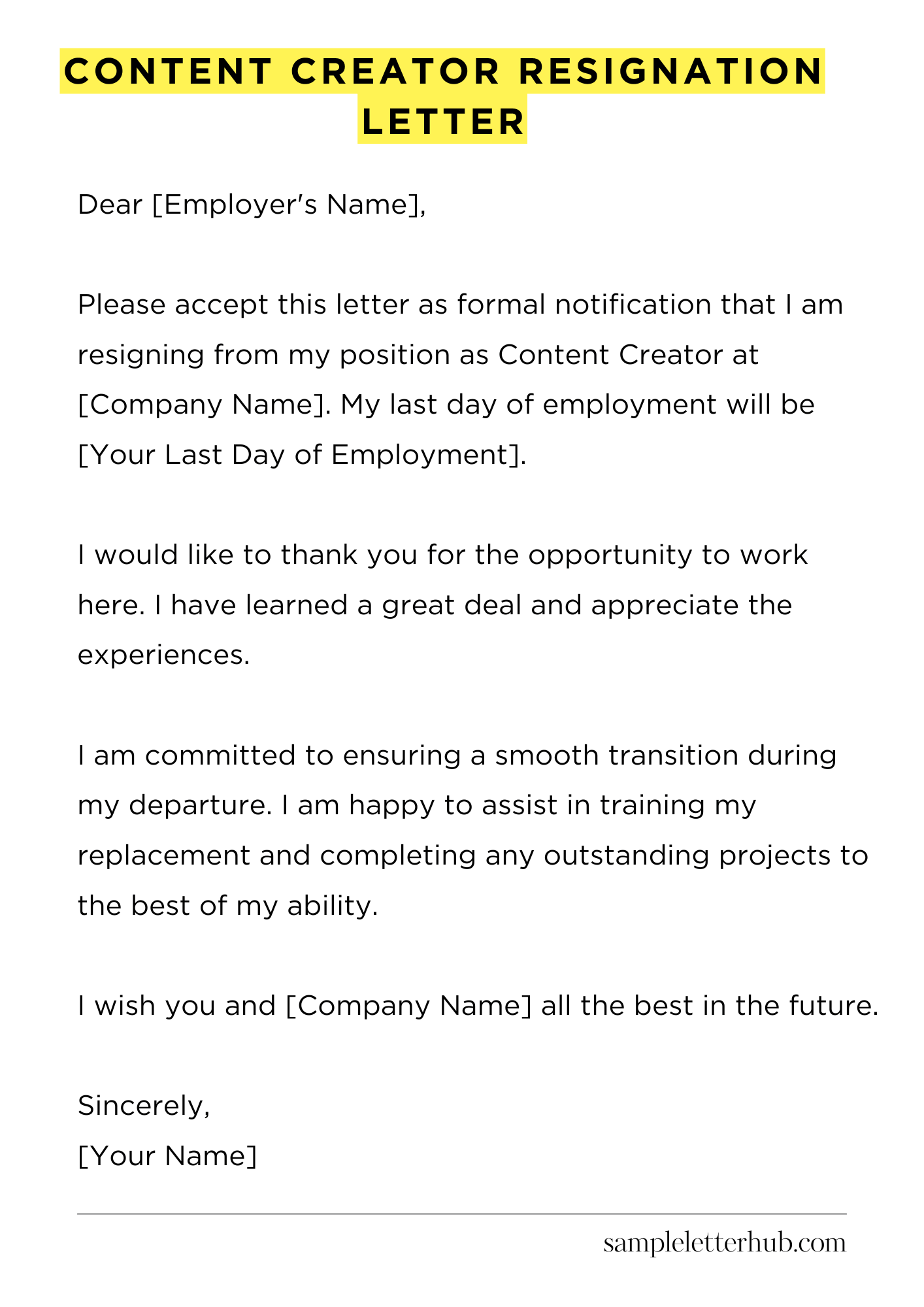
How to Write a Content Creator Resignation Letter
Why You Need a Resignation Letter
Leaving a job, even if it’s a content creation role, requires professionalism. You may not think it’s necessary, but it is. A well-crafted resignation letter is more than just a formality; it serves several crucial purposes. Firstly, it officially informs your employer of your decision to leave. It creates a paper trail. This documentation is essential.
This can be helpful later. Secondly, it allows you to express your gratitude for the opportunity. This is always a great touch. Finally, a clear and concise letter helps ensure a smooth transition, which is beneficial for both you and your soon-to-be former employer. This can help with things like references and future opportunities.
Essential Elements to Include
There are some things that every resignation letter, no matter the role, should include. You’ll need key components. Start with a formal salutation, addressing the appropriate person. Be polite. Then, clearly state your intention to resign and your last day of employment. This is the most important part! Be specific.
Next, express your gratitude for the experience and opportunities you’ve been given. Briefly mention any key accomplishments you achieved during your tenure. Keep it concise. Offer to assist with the transition. Be professional. Finally, close with a professional closing, such as “Sincerely” or “Best regards,” followed by your name and signature. Remember to date your letter.
Crafting the Right Tone
The tone of your letter is critical. It should be professional and respectful, even if you’re leaving due to negative circumstances. Avoid negativity. Avoid making personal attacks. Maintain a positive attitude. Focus on your future plans or the reasons for your departure without dwelling on issues.
You might want to thank specific individuals. Be sincere. Keep the language clear and concise, avoiding jargon or overly casual language. Proofread carefully before sending it. Errors do not look professional.
Formatting and Presentation Tips
The appearance of your letter matters. Use a professional-looking font, such as Times New Roman or Arial, with a standard font size (e.g., 12 points). Use one-inch margins. Keep the letter to a single page, if possible.
Avoid long paragraphs; break up the text for easy readability. Ensure your letter is free from any grammatical errors or typos. Consider using a template. This can help you get started. Always save a copy of the letter for your records. Check the company’s internal guidelines, they may have specific requirements.
Sample Letter and Customization
Below is a sample resignation letter that you can adapt. Remember to customize it to fit your specific situation and role.
[Your Name]
[Your Address]
[Your Phone Number]
[Your Email Address]
[Date]
[Employer’s Name]
[Employer’s Title]
[Company Name]
[Company Address]
Dear [Mr./Ms./Mx. Last Name],
Please accept this letter as formal notification that I am resigning from my position as Content Creator at [Company Name]. My last day of employment will be [Your Last Day of Employment].
I am grateful for the opportunities I have been given during my time here. I have learned a lot. I am particularly proud of [mention a specific achievement, e.g., “the successful launch of the new blog”].
I am happy to assist in the transition process.
I wish you and the company all the best in the future.
Sincerely,
[Your Signature]
[Your Typed Name]
Remember to tailor this template. You can add or modify sentences to suit your individual circumstances. Good luck in your future endeavors!
FAQs about Content Creator resignation letter
What is the primary purpose of a content creator resignation letter?
The primary purpose of a content creator resignation letter is to formally notify an employer of your intent to leave your current position. It serves as a record of your departure and outlines the terms of your leaving, such as the effective date of your resignation. It also provides an opportunity to express gratitude and offer assistance with the transition.
What key elements should be included in a content creator resignation letter?
A well-crafted resignation letter should include: a clear statement of your resignation, the date your resignation takes effect, a concise and professional tone, an expression of gratitude for the opportunity, and an offer to assist with the transition. It can also include brief reasons for leaving, if desired, and contact information.
How much notice should a content creator give when resigning?
The amount of notice a content creator should give typically depends on their employment contract or company policy. However, two weeks’ notice is a standard and widely accepted practice. It’s always best to review your employment agreement to understand the specific requirements, as this can vary by company and location.
Should a content creator provide a reason for resigning in their letter?
Providing a reason for resigning in your letter is optional. While it’s generally a good practice to keep the tone positive and professional, you may choose to briefly state your reason, such as “to pursue new opportunities” or “for personal reasons.” However, you are not obligated to disclose detailed explanations.
How should a content creator handle the transition of their duties?
To ensure a smooth transition, a content creator should offer to help with the handover of their responsibilities. This can include: documenting processes, training colleagues, and creating a list of ongoing projects. Cooperating with the employer in a professional manner is critical to leaving a positive lasting impression.
Related:
Resignation letter due to rude boss
Resignation letter moving to another state
Resignation letter due to illness of family member
Resignation letter due to study