

A consultant resignation letter is a formal document. It announces your departure from a consulting role. Its primary purpose is to inform your client or employer. It clearly states your intent to leave and the effective date.
Writing this letter can feel tricky. Don’t worry, it doesn’t have to be. We are here to help you. We have prepared several templates and examples. These samples cover various situations and roles.
Inside, you’ll find different formats. We provide options for different scenarios. Use these to create your own perfect resignation letter. Make your exit smooth and professional.
Consultant Resignation Letter
Below is a sample of a Consultant Resignation Letter:
[Your Name]
[Your Address]
[Your Phone Number]
[Your Email Address]
[Date]
[Recipient’s Name]
[Recipient’s Title]
[Company Name]
[Company Address]
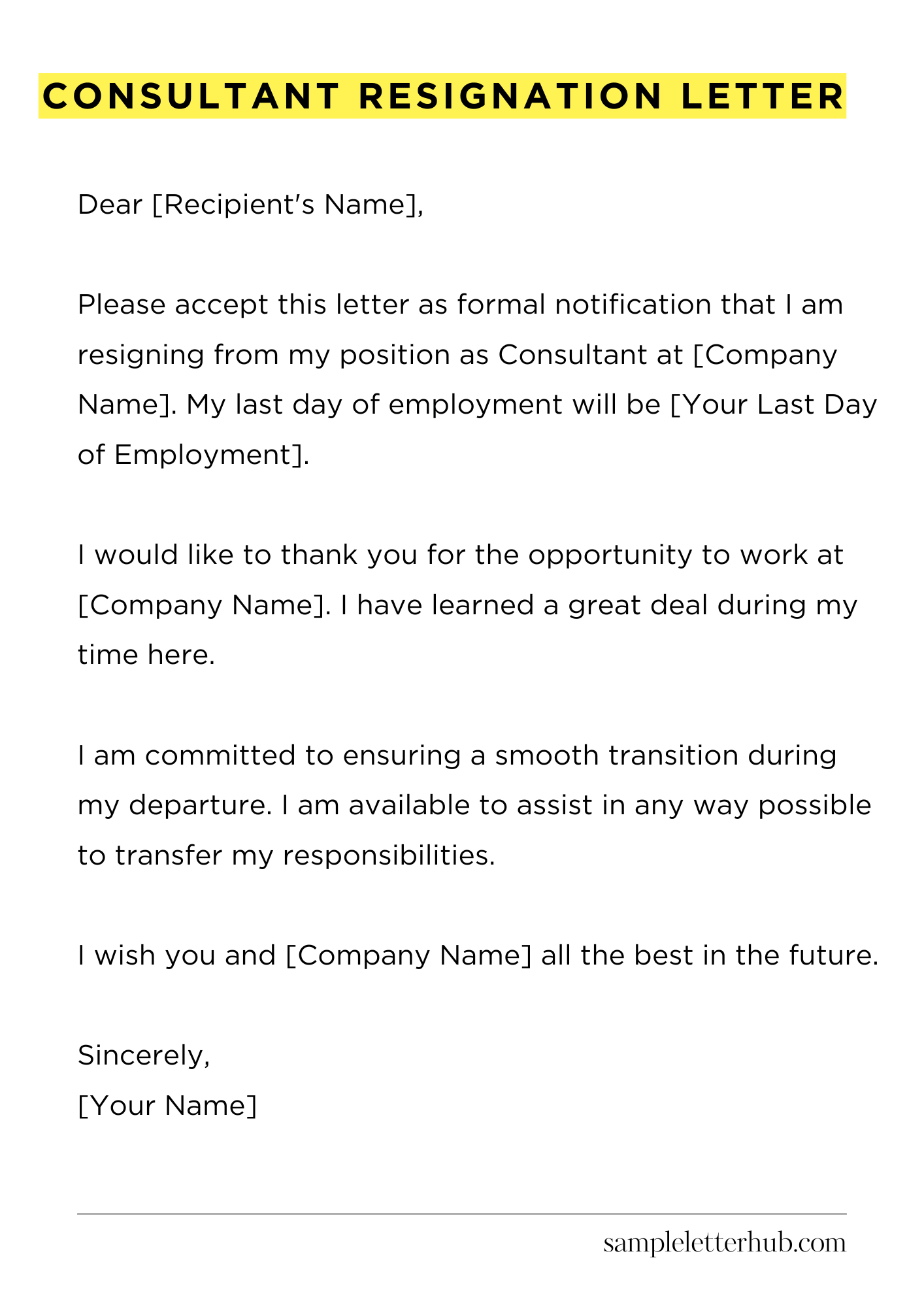
Dear [Recipient’s Name],
Please accept this letter as formal notification that I am resigning from my position as Consultant at [Company Name]. My last day of employment will be [Your Last Day of Employment].
I would like to thank you for the opportunity to work at [Company Name]. I have learned a great deal during my time here.
I am committed to ensuring a smooth transition during my departure. I am available to assist in any way possible to transfer my responsibilities.
I wish you and [Company Name] all the best in the future.
Sincerely,
[Your Name]
How to Write Consultant Resignation Letter
Knowing When to Say Goodbye
Consulting, with its demanding schedule and ever-changing projects, isn’t for everyone. There comes a time when you have to face the music and move on. Maybe you’ve landed a new opportunity.
Perhaps the consulting lifestyle just isn’t a good fit. Whatever the reason, resigning professionally is key. The way you depart can significantly impact your future. This is because it directly affects your professional reputation and your future job prospects.
So, how do you make a graceful exit?
Crafting the Perfect Letter
Your resignation letter is more than just a formality; it’s a critical communication. It’s a snapshot of your professionalism. The tone should be polite and respectful, even if you’re not leaving on the best of terms. Keep it concise, direct, and to the point. Start with a clear and definitive statement of your resignation. After all, clarity is always the best policy.
Then, follow these crucial steps:
- Date: This is important, as it officially marks your departure.
- Formal Greeting: Address your letter to your immediate supervisor or the appropriate HR contact.
- State Your Intent: Be clear; state you are resigning from your position.
- Effective Date: Clearly mention the final day of your employment. Adhere to your contract’s notice period.
- Express Gratitude: Acknowledge the experience and opportunities gained during your time. Be appreciative!
- Brief Explanation (Optional): If you feel comfortable, briefly state your reason for leaving. But, this isn’t mandatory. Keep it positive.
- Offer Assistance: Offer your support during the transition period. This shows goodwill and professionalism.
- Closing: End with a professional closing, such as “Sincerely” or “Best Regards.”
- Your Signature: Sign your name. It seals the deal.
The Importance of Tone and Content
The words you choose carry significant weight. Avoid negativity, complaints, or making demands. No one likes a bitter departure. If you have concerns, address them separately, preferably during a one-on-one conversation.
Focus on the positives and express your appreciation for the experience, even if it wasn’t always smooth sailing. A well-written letter reflects positively on you and leaves a lasting impression.
Avoiding Common Mistakes
Let’s look at the pitfalls. Don’t be vague about your departure date. Don’t leave any doubt. Do not burn bridges by badmouthing the company or colleagues.
Resist the urge to include excessive details about your new opportunity. Keep it professional. Most importantly, don’t send it as a spur-of-the-moment email. Take your time, proofread carefully, and ensure your message is clear and professional.
Final Steps and Beyond
Before submitting your resignation letter, make a copy for your records. Consider discussing your resignation with your supervisor in person or via a phone call. This is a common courtesy.
Be prepared for a conversation about your departure and any handover procedures. After you submit the letter and leave the company, be sure to follow up with a thank-you note to anyone who provided help. This reinforces your positive image and strengthens your network. Now you are all set!
FAQs about Consultant Resignation Letter
What is the primary purpose of a consultant resignation letter?
The primary purpose of a consultant resignation letter is to formally notify the client or employer of your decision to end your consulting services. It serves as a legal document that officially marks the termination of the consulting agreement, providing a clear record of the date of departure and any other relevant information agreed upon.
What essential elements should be included in a consultant resignation letter?
A well-structured consultant resignation letter should include: your name and contact information, the date of the letter, the name and contact information of the recipient (client or employer), a clear statement of resignation, the effective date of resignation, a brief expression of gratitude (optional, but recommended), a professional and courteous closing, and your signature.
It’s often advisable to mention the handover process or any assistance you can provide during the transition.
How much notice should a consultant provide in a resignation letter?
The notice period depends on the terms outlined in your consulting agreement or employment contract. Generally, a minimum of two weeks’ notice is standard. However, some contracts may require longer notice periods, such as 30, 60, or even 90 days. It is crucial to review your agreement carefully and adhere to the stipulated timeframe to avoid any legal or contractual issues.
Can a consultant resignation letter be modified to address specific circumstances?
Yes, a consultant resignation letter can and should be customized to address specific circumstances. This might include explaining the reason for resignation (though not always necessary), offering to assist with the transition, mentioning any ongoing projects or deliverables, or clarifying the terms of your departure.
However, keep the tone professional and focus on the practical aspects of ending the consulting relationship.
What are some common mistakes to avoid in a consultant resignation letter?
Common mistakes to avoid in a consultant resignation letter include: being overly emotional or negative, failing to provide the required notice period, omitting key details like the effective date, neglecting to express gratitude (if applicable), including confidential information.
Related:
Resignation letter due to rude boss
Resignation letter moving to another state
Resignation letter due to illness of family member
Resignation letter due to study