

A computer resignation letter is a formal notice. It informs your employer that you’re leaving your job. The purpose is to officially document your departure. It also helps with a smooth transition.
This can be a tricky thing to do. You want to leave a good impression. Luckily, we’ve got you covered. We’re sharing templates and examples. These are for various situations.
You’ll find different sample letters here. Choose the one that suits you best. Then, customize it. It will make the process easier.
Computer Resignation Letter
Below is a sample of a Computer Resignation Letter:
[Your Name]
[Your Address]
[Your Phone Number]
[Your Email Address]
[Date]
[Recipient’s Name]
[Recipient’s Title]
[Company Name]
[Company Address]
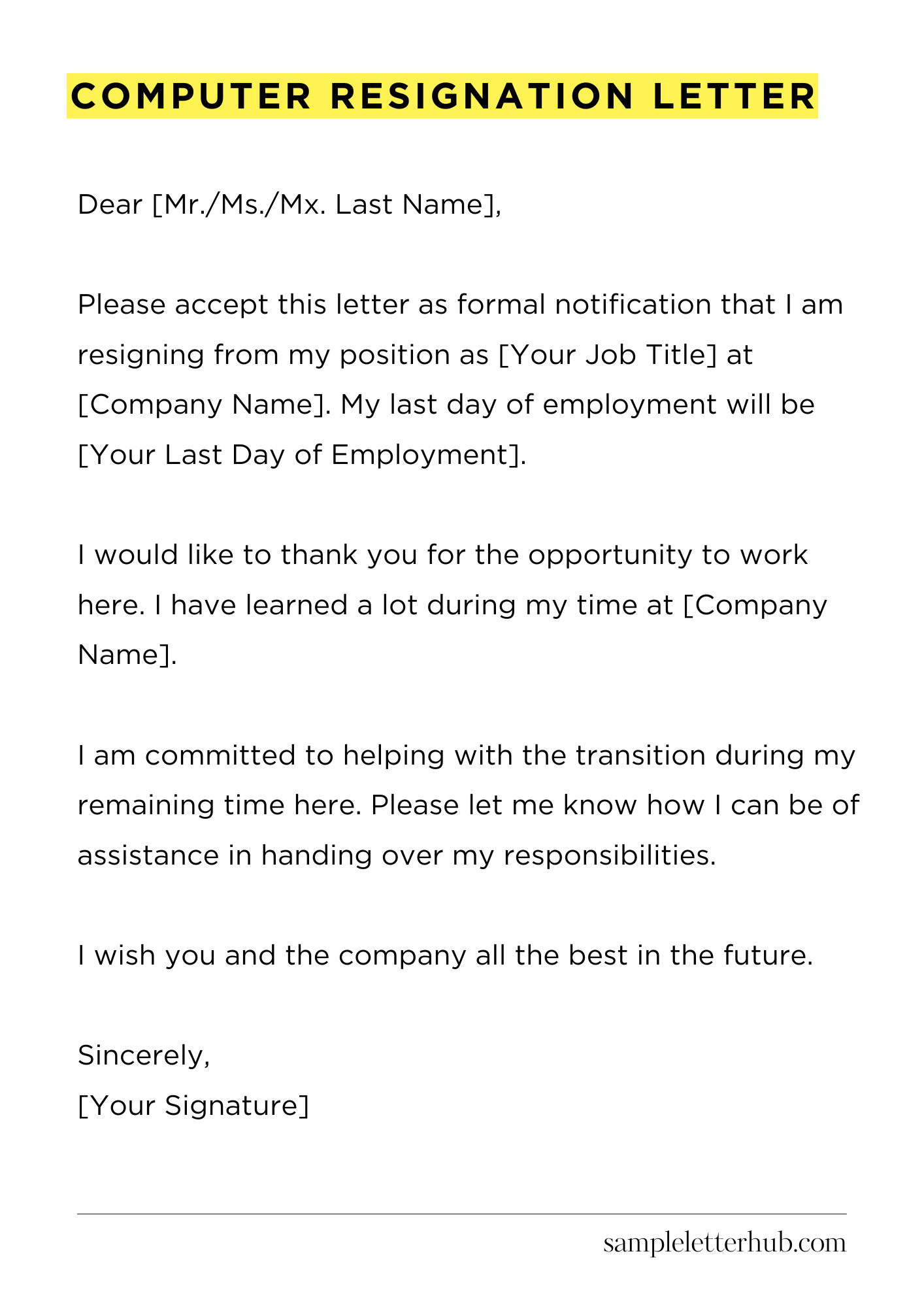
Dear [Mr./Ms./Mx. Last Name],
Please accept this letter as formal notification that I am resigning from my position as [Your Job Title] at [Company Name]. My last day of employment will be [Your Last Day of Employment].
I would like to thank you for the opportunity to work here. I have learned a lot during my time at [Company Name].
I am committed to helping with the transition during my remaining time here. Please let me know how I can be of assistance in handing over my responsibilities.
I wish you and the company all the best in the future.
Sincerely,
[Your Signature]
How to Write a Computer Resignation Letter
Leaving a job is a big step. Especially when it comes to the technical world of computers, it requires professionalism and clarity. You’ll need a well-crafted resignation letter. It is vital for a smooth transition. This document officially announces your departure.
1. Subject and Salutation: Set the Stage
First impressions matter, even in a resignation letter. Start with a clear subject line like “Resignation – [Your Name]”. This helps the recipient immediately understand the purpose.
Begin the body of your letter with a formal salutation. “Dear [Manager’s Name],” is a good choice. Or you can start with “Dear [Hiring Manager],” or “To Whom It May Concern,”. Choosing the appropriate salutation sets the tone.
2. The Official Announcement and Date
Now, state your intentions directly and clearly. The first paragraph is critical. Use a sentence like: “Please accept this letter as formal notification that I am resigning from my position as [Your Job Title] at [Company Name], effective [Your Last Day of Employment].”
Be concise, direct and provide the final date of your employment. This leaves no room for ambiguity. This helps ensure everyone is on the same page.
3. Expressing Gratitude and Professionalism
It’s important to acknowledge your experience, even when leaving. Although it’s your departure, it is very important. Briefly express your gratitude for the opportunities you’ve received.
Mentioning specific skills you’ve learned or projects you enjoyed adds a personal touch. For example: “I am grateful for the experience and the opportunity to work with the team.” Keep it sincere, even if the job wasn’t perfect.
Maintain a professional tone throughout. This leaves a positive impression, regardless of your reasons for leaving.
4. Transition and Assistance
Offer assistance with the transition. It shows you’re committed to a smooth handover. This is a very common step. Offer to help train your replacement, document your processes, or complete any ongoing tasks.
You might write: “I am happy to assist in the transition process. I am available to train my replacement.” Specify what you are willing to do and the timeframe you’re available. This benefits both the company and your professional reputation.
5. Closing, Signature, and Contact Details
End the letter with a professional closing. Use “Sincerely,” or “Regards,” followed by your full name. Provide your contact information, including your personal email address and phone number, for any follow-up questions. Consider adding a line like “I wish [Company Name] all the best in the future.”
Sign the letter by hand if you are submitting a physical copy. A digital signature is acceptable for email submissions. Proper formatting is essential; it’s a reflection of your attention to detail.
FAQs about Computer resignation letter
Understanding the nuances of a computer resignation letter is crucial for a smooth transition. Here are some frequently asked questions about this important document.
What should I include in my computer resignation letter?
Your computer resignation letter should include your formal resignation, the effective date of your departure, and a brief expression of gratitude. It’s also polite to offer assistance with the transition process.
Consider mentioning any projects you’re wrapping up and confirming the return of company property, such as laptops or access cards. Keep it concise, professional, and positive.
What is the proper format for a computer resignation letter?
The format should be professional. Begin with a formal greeting, followed by a clear statement of resignation and the last day of employment. Use a formal and polite tone. Include a closing, your signature, and your printed name. Ensure it is addressed to the appropriate person, such as your direct supervisor or HR department.
Can I submit my computer resignation letter via email?
Yes, submitting your resignation letter via email is generally acceptable and often preferred, especially in the tech industry. It allows for a documented record of your resignation and provides immediate confirmation of receipt. Make sure to use a professional subject line, like “Resignation – [Your Name]”.
Consider following up with a hard copy if requested by your employer.
How much notice should I give in my computer resignation letter?
The standard notice period is typically two weeks, but it’s important to review your employment contract or company policies, as some positions may require more.
Provide as much notice as possible, particularly if you have significant responsibilities or are involved in critical projects. This will show professionalism and allow for a seamless handover of your duties.
What if I need to leave my computer job immediately?
While giving proper notice is ideal, there may be instances where you need to leave immediately. This could be due to unforeseen circumstances or in situations where your work environment has become untenable.
In this scenario, you’ll still need to formally resign, explaining the situation and providing the date of your last day. Be aware that leaving without proper notice could have implications, so review your employment agreement and, if possible, consult with a legal professional.
Related:
Resignation letter due to rude boss
Resignation letter moving to another state
Resignation letter due to illness of family member
Resignation letter due to study