

A company owner resignation letter is a formal document. It is written by the owner of a company. The letter officially announces their departure. It informs the board, employees, and stakeholders. The purpose is to communicate the owner’s decision. It also outlines the transition plan.
Facing the daunting task of writing your own resignation? We’ve got you. This article will provide you with helpful examples. We’ll offer sample templates. They’ll ease the process. We understand it’s not easy.
Our goal is simple. We aim to help you. These samples cover various scenarios. You’ll find templates for different situations. Use them to craft your own perfect letter. Let’s make this process smoother.
Company Owner Resignation Letter
Below is a sample of a Company Owner Resignation Letter:
[Your Name]
[Your Address]
[Your Phone Number]
[Your Email Address]
[Date]
[Recipient Name] (If known, otherwise use title)
[Recipient Title]
[Company Name]
[Company Address]
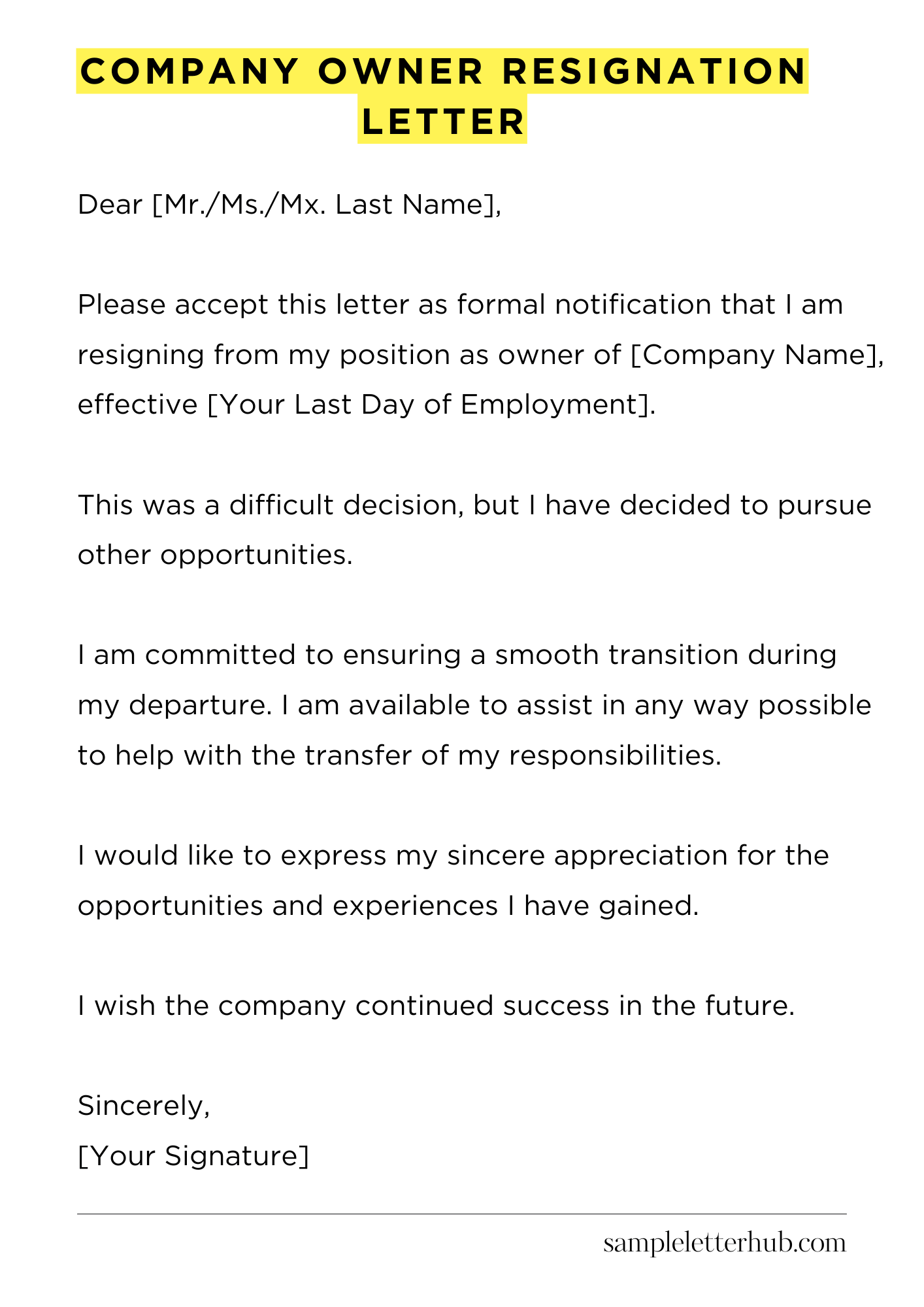
Dear [Mr./Ms./Mx. Last Name],
Please accept this letter as formal notification that I am resigning from my position as owner of [Company Name], effective [Your Last Day of Employment].
This was a difficult decision, but I have decided to pursue other opportunities.
I am committed to ensuring a smooth transition during my departure. I am available to assist in any way possible to help with the transfer of my responsibilities. Please let me know how I can be of assistance.
I would like to express my sincere appreciation for the opportunities and experiences I have gained during my time with [Company Name].
I wish the company continued success in the future.
Sincerely,
[Your Signature]
How to Write a Company Owner Resignation Letter
Resigning as a company owner is a significant step. It’s often a complex decision, and the resignation letter you write is a critical part of the process.
This document serves as your official notification, and it must be both professional and clear. Let’s delve into how to craft a resignation letter that effectively conveys your intentions while maintaining a positive tone.
1. Preparation is Key
Before putting pen to paper (or fingers to keyboard), take a moment to strategize. Think about your reasons for leaving. Consider the impact your departure will have on the company, and plan to be as helpful as possible during the transition. Review your employment contract or any partnership agreements.
This will shed light on required notice periods and other specific stipulations. It’s also wise to determine who you need to send the letter to (usually the board of directors, other partners, or a designated manager).
Knowing this information upfront makes the writing process smoother. This foresight ensures you meet all obligations and set a positive tone for your leaving. Remember, you want to leave on good terms, if possible.
2. The Essential Elements
A well-structured resignation letter needs to contain key information. Begin with a formal salutation, using the appropriate title (e.g., “Dear Board of Directors”).
Next, clearly state your intention to resign from your position as company owner, including the effective date of your resignation. Provide this date explicitly.
Include your reasons for leaving. Keep it brief and professional. Avoid lengthy explanations or negative comments. It’s smart to express your gratitude for the opportunity and any positive experiences you had.
Mention how you will assist with the transition process. Finally, offer your contact information (email address or phone number) for any further clarification or assistance.
End with a professional closing, such as “Sincerely” or “Respectfully,” followed by your full name and signature (if submitting a hard copy).
3. Crafting a Professional Tone
Your tone is crucial. Maintain a professional and respectful demeanor throughout the letter. Even if your departure is due to difficult circumstances, avoid negativity or expressing personal grievances.
Focus on the facts and the future. Be courteous and express appreciation for the company and the opportunities it provided. Avoid using slang or overly casual language.
A positive and professional tone reflects well on you. It also eases the transition for everyone involved. Keep it simple and to the point. Proofread carefully before sending to make sure there are no typos or grammatical errors. This attention to detail shows professionalism.
4. Sample Letter Template
Here’s a basic template that you can adapt to fit your specific situation:
[Your Name]
[Your Address]
[Your Phone Number]
[Your Email Address]

[Date]

[Recipient's Name/Title]
[Company Name]
[Company Address]

Dear [Recipient's Name],

Please accept this letter as formal notification that I am resigning from my position as owner of [Company Name], effective [Date of Resignation].

[Briefly state your reason for leaving].

I am grateful for the opportunity to have led [Company Name] and appreciate the experiences I have gained during my tenure. I am committed to assisting with a smooth transition during the handover period and will be available to help in any way possible.

[Optional: You can offer to train your replacement or stay for a period of time to help the new management.]

Please do not hesitate to contact me if you require further information.

Sincerely,

[Your Signature]

[Your Typed Name]
5. Final Review and Submission
Before submitting your letter, proofread it carefully. Check for any errors in grammar, spelling, and punctuation. Ensure the dates are accurate.
Confirm that you are sending the letter to the correct recipient(s). If possible, ask a trusted colleague or friend to review the letter for you. A fresh pair of eyes can often catch mistakes you might have missed.
Once you are completely satisfied with the letter, make a copy for your records. Then, submit it according to company protocol. This may involve sending a physical copy, an electronic version, or both. Following these steps helps ensure a smooth departure process. Good luck!
FAQs about Company Owner Resignation Letter
A company owner’s resignation letter is a crucial document, marking a significant transition for both the individual and the business. Understanding the common questions surrounding this topic can help ensure a smooth and professional departure.
What essential information should a company owner’s resignation letter include?
A company owner’s resignation letter must contain several critical pieces of information. This includes a clear and concise statement of resignation, the effective date of the resignation, and a brief statement of the reason for leaving (optional but often included for context).
The letter should also address the transfer of responsibilities, outlining plans for the handover of duties and any key contacts for ongoing operations. Finally, it should express gratitude to employees, partners, and any other stakeholders, showing respect and professionalism.
How far in advance should a company owner submit their resignation letter?
The timing of the resignation letter depends on the legal and contractual obligations specific to the company and the owner’s agreement.
While it’s advisable to provide as much notice as possible to allow for a smooth transition, a minimum notice period is typically specified in the operating agreement or employment contract. Generally, 30 to 90 days notice is a common practice, but this could vary.
It is important to consult the relevant legal documents and seek legal counsel if necessary to determine the appropriate timeframe and ensure compliance with all applicable regulations.
Who should a company owner address their resignation letter to?
The recipient of the resignation letter depends on the company’s structure and governance. In most cases, the letter should be addressed to the board of directors, if one exists, or to the other partners or shareholders.
If the owner is the sole owner and there is no board, the letter can be addressed to themselves, but a copy should be kept for record-keeping purposes. Always adhere to the company’s internal protocols and legal documents to ensure the letter reaches the correct recipient.
What legal and financial considerations should a company owner be aware of when resigning?
Several legal and financial matters must be addressed when a company owner resigns. These include the transfer of ownership (if applicable), resolving outstanding debts and obligations, and finalizing financial arrangements such as salary, benefits, and stock options.
The owner must also ensure all legal requirements are met, such as filing any necessary paperwork with regulatory bodies. Consulting with legal and financial advisors is critical to navigate these complexities and ensure a smooth and legally compliant departure.
How can a company owner ensure a smooth transition of responsibilities after resigning?
Ensuring a smooth transition of responsibilities involves several key steps. The outgoing owner should create a detailed handover plan, outlining each task, the current status of ongoing projects, and any relevant contacts.
They should train their successor or the designated person on essential duties and provide all necessary documentation and information. Communication with employees, customers, and partners is vital, keeping them informed of the transition and the plans for the future.
The departing owner should be available to assist with questions and issues for a limited time after their departure, and maintain a professional and supportive attitude throughout the process.
Related:
Resignation letter due to rude boss
Resignation letter moving to another state
Resignation letter due to illness of family member
Resignation letter due to study