

A “Communications Resignation Letter” is a formal document. It informs your employer you are leaving your job. The letter officially states your last day of employment. It helps ensure a smooth transition.
This can be a tricky thing to write, we know. That is why we are here to help. We’ll provide you with various letter templates. We’ll also give you samples and examples. Use them to craft your own resignation letter.
Think of it as your writing cheat sheet. We’ll make it easier for you. Writing this letter doesn’t have to be hard. Let’s get started.
Communications Resignation Letter
Below is a sample of a Communications Resignation Letter:
[Your Name]
[Your Address]
[Your Phone Number]
[Your Email Address]
[Date]
[Recipient’s Name]
[Recipient’s Title]
[Company Name]
[Company Address]
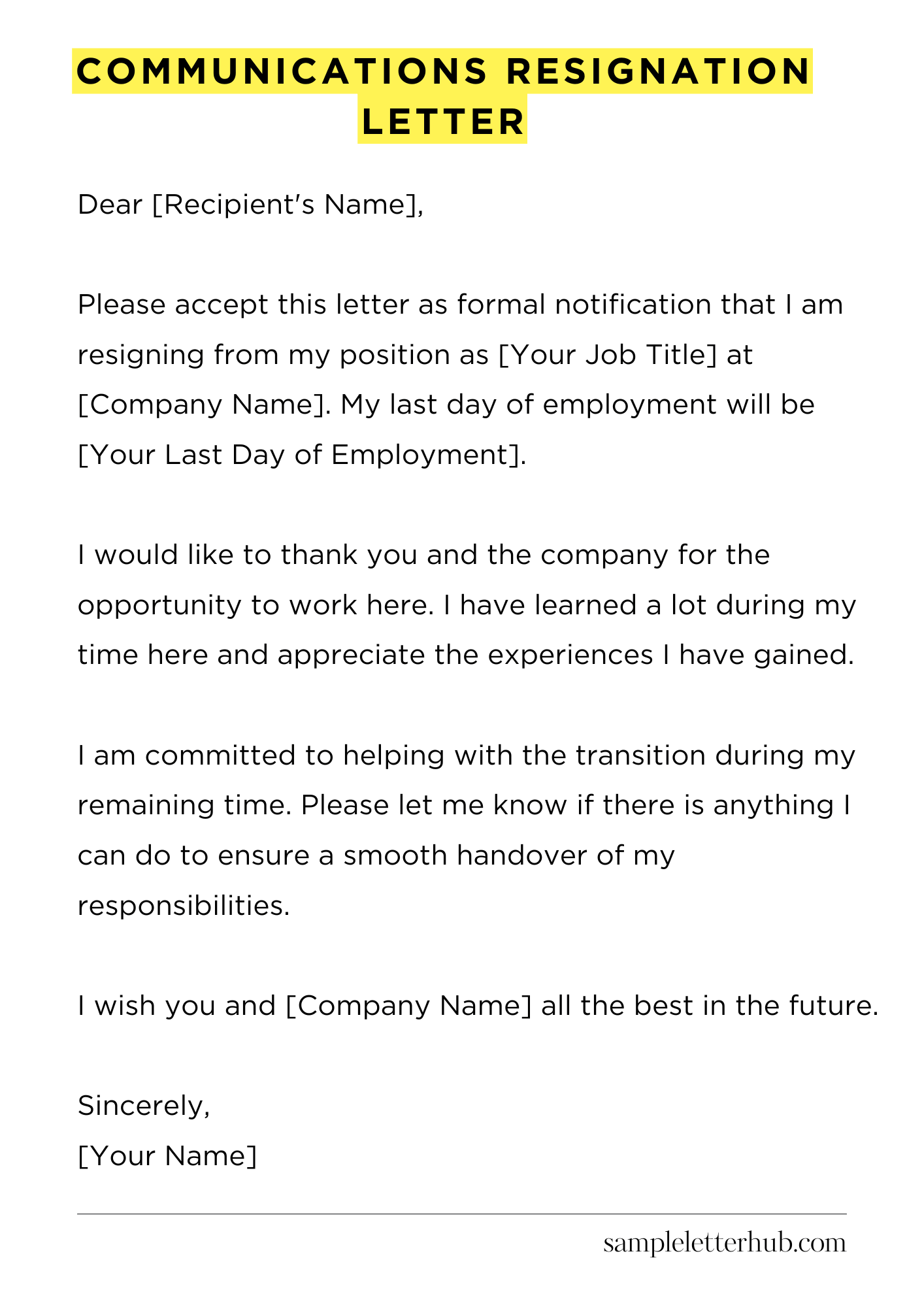
Dear [Recipient’s Name],
Please accept this letter as formal notification that I am resigning from my position as [Your Job Title] at [Company Name]. My last day of employment will be [Your Last Day of Employment].
I would like to thank you and the company for the opportunity to work here. I have learned a lot during my time here and appreciate the experiences I have gained.
I am committed to helping with the transition during my remaining time. Please let me know if there is anything I can do to ensure a smooth handover of my responsibilities.
I wish you and [Company Name] all the best in the future.
Sincerely,
[Your Name]
How to Write a Communications Resignation Letter
Understanding the Basics
Resigning from a job can be a daunting task. You need to do it professionally, even if you are leaving under less-than-ideal circumstances. A well-crafted resignation letter is critical.
It is a formal way to notify your employer of your departure. Your communications resignation letter should be clear, concise, and respectful. First impressions last, and this letter is often the last official piece of communication.
The primary purpose is to inform your employer of your intention to leave your role. Additionally, it offers you the opportunity to thank them for the experience. Make sure you avoid venting or negativity; keep it professional.
Key Elements: What to Include
Several components are essential to create a compelling and professional letter. Begin with your contact information at the top. This includes your name, address, phone number, and email. Next, write the date.
Then, address your letter to the appropriate person, usually your direct supervisor or HR department. Begin with a clear statement of your intent to resign, stating your position and the effective date of your resignation. Also, show appreciation for your employment.
Briefly, mention any positive aspects of your time at the company or express your gratitude for the opportunities you received. Also, express your willingness to assist with the transition process, if you wish.
This may include training a replacement or completing ongoing projects. Finally, end your letter with a professional closing, such as “Sincerely,” or “Respectfully,” followed by your full name.
Crafting the Right Tone
The tone of your letter is crucial. It needs to be polite, positive, and respectful. Avoid any negative language or personal grievances. Even if you’re leaving due to dissatisfaction, it is important to maintain a professional tone. Keep the language simple and direct. Ensure the tone aligns with your company’s culture.
Avoid excessive elaboration or overly emotional language. Stick to facts and information. Focus on the reason for your resignation (e.g., pursuing a new opportunity or personal reasons) without going into too much detail. A neutral tone also makes the letter easier to understand.
Formatting and Proofreading
The layout and the format of your letter can affect how your letter is perceived. Use a standard business letter format. Ensure there is a clear spacing between paragraphs, and use a professional font like Times New Roman or Arial. Keep it concise, ideally not exceeding one page.
Proofread carefully for any errors in grammar and spelling. Errors can undermine your professionalism. Ask someone else to review your letter before you send it. This can help you identify any mistakes you may have missed. The small details matter.
Finalizing and Delivering Your Letter
Once you are completely satisfied with the content and format, you can finalize your letter. Get a copy for your records, too. Consider the method of delivery. Most companies prefer a digital copy via email. Always keep a digital copy for your records. If your company requires a hard copy, be sure to print it on high-quality paper.
Provide it to the correct person. In most cases, this is your direct supervisor or HR. Adhere to your company’s policy regarding resignation letters. Doing so reflects well on you. Delivering your letter on time and in the correct format demonstrates professionalism and respect for your current employer.
FAQs about Communications Resignation Letter
Understanding the nuances of a communications resignation letter is crucial for a smooth and professional transition. Here are some of the most frequently asked questions to help you navigate this process:
What is the purpose of a communications resignation letter?
The primary purpose of a communications resignation letter is to formally notify your employer of your intent to leave your position. It serves as a written record of your resignation, the effective date of your departure, and often includes a brief statement of gratitude or farewell. This document is a crucial step in maintaining a professional relationship with your employer.
What key elements should be included in a communications resignation letter?
A well-crafted communications resignation letter should include: your official resignation, the date of your resignation letter, the date of your last day of employment, a concise statement of your intent to resign, your name and job title, and the recipient’s name and title. You can also include a brief, positive statement expressing your appreciation for the opportunity.
It’s often helpful to mention your willingness to assist in the transition.
How much notice should I give in my communications resignation letter?
The amount of notice required varies depending on your employment contract, company policy, and local labor laws. Typically, a minimum of two weeks’ notice is standard for most positions. However, higher-level positions or those requiring extensive handover periods may necessitate a longer notice period.
Always review your employment contract and company guidelines for specific requirements. If your employment contract does not specify a duration, it’s generally accepted to give two weeks’ notice.
Should I provide a reason for leaving in my communications resignation letter?
While not mandatory, providing a brief, professional reason for your departure in your resignation letter is often a good practice. However, you are not obligated to go into extensive detail.
Keep it simple and positive, such as “to pursue new opportunities” or “to focus on personal development.” Avoid negative comments about your current employer or colleagues. If you have been unhappy about the role, it is best to leave this out.
How should I deliver my communications resignation letter?
The standard practice is to deliver your resignation letter in writing, either as a physical hard copy or via email. Submit it directly to your supervisor or HR department. Ensure you obtain confirmation of receipt. If submitting via email, it’s advisable to request a confirmation of receipt from the recipient. This is also important to maintain a copy for your records.
Related:
Resignation letter due to rude boss
Resignation letter moving to another state
Resignation letter due to illness of family member
Resignation letter due to study