

A Communications Director resignation letter is a formal document. It announces your departure from the role. The letter informs your employer of your intention to leave. It also states the effective date of your resignation.
Crafting the perfect resignation letter can be tricky. Don’t worry, we’re here to help. We’ve compiled various templates. You’ll find different examples and samples. They cover a range of situations.
These examples are designed to get you started. They will make writing your own letter easy. Whether you need a simple or detailed letter, we have got you covered. Get ready to write a letter that is professional and personalized.
Communications Director Resignation Letter
Below is a sample of a Communications Director Resignation Letter:
[Your Name]
[Your Address]
[Your Phone Number]
[Your Email Address]
[Date]
[Recipient’s Name] (Communications Director’s Supervisor or HR)
[Recipient’s Title]
[Company Name]
[Company Address]
Dear [Recipient’s Name],
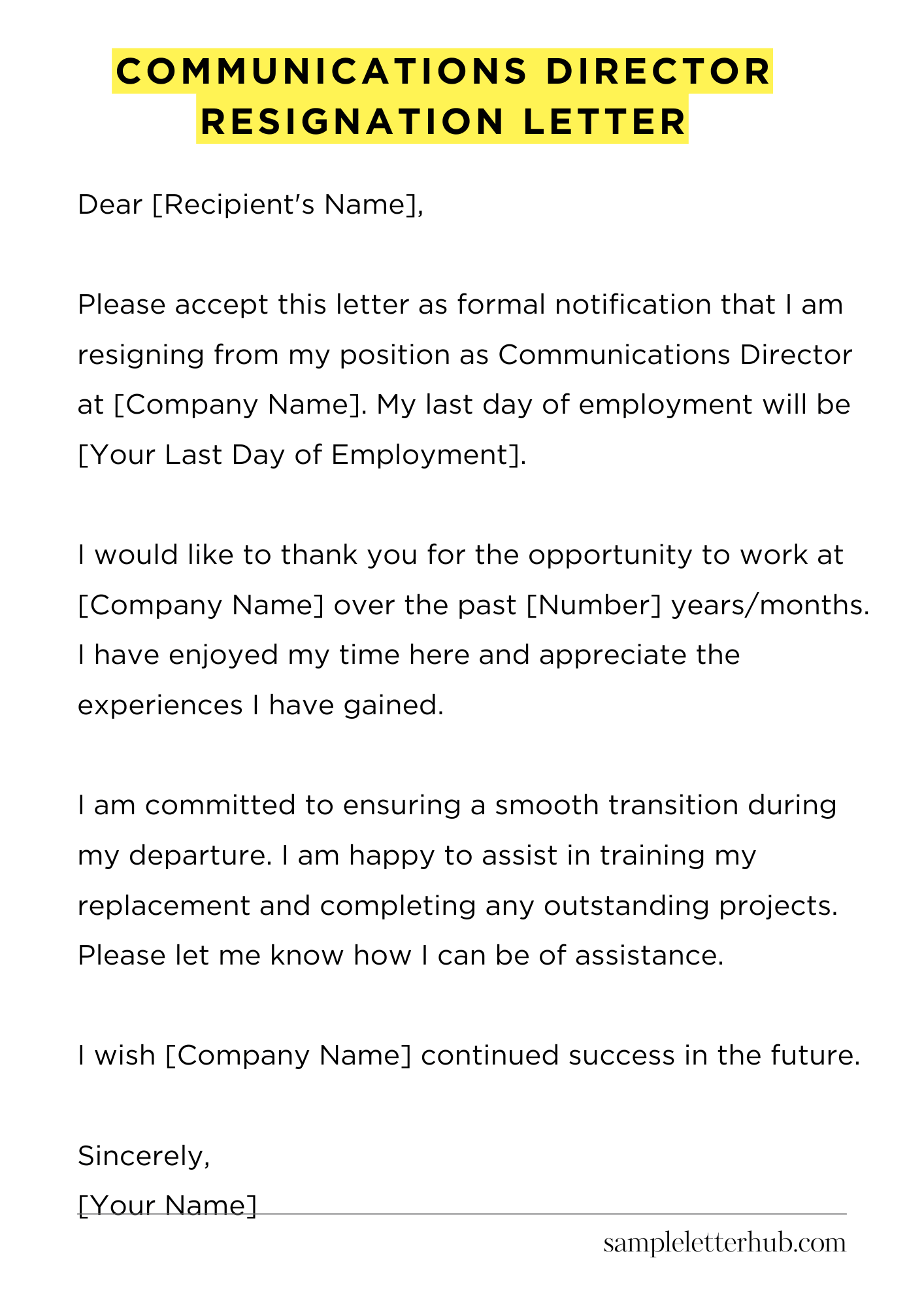
Please accept this letter as formal notification that I am resigning from my position as Communications Director at [Company Name]. My last day of employment will be [Your Last Day of Employment].
I would like to thank you for the opportunity to work at [Company Name] over the past [Number] years/months. I have enjoyed my time here and appreciate the experiences I have gained.
I am committed to ensuring a smooth transition during my departure. I am happy to assist in training my replacement and completing any outstanding projects. Please let me know how I can be of assistance.
I wish [Company Name] continued success in the future.
Sincerely,
[Your Name]
How to Write a Communications Director Resignation Letter
1. Grasp the Basics: Why You’re Actually Doing This
Resigning from a job, especially a senior role like Communications Director, is a significant step. It is crucial to approach this process with professionalism and a clear understanding of the implications.
You want to leave a positive lasting impression. Remember, your resignation letter serves as a formal declaration to your employer. It officially announces your departure.
Think of it as the ultimate summary of your intentions. Be concise, direct, and respectful throughout the whole writing process. Avoid burning bridges! You want to maintain a positive relationship.
2. Essential Elements: What Your Letter Needs
A well-crafted resignation letter is more than just a formality. It’s your final professional statement in the role. The letter should have several key ingredients. First, state your intention to resign. Second, specify your last day of employment. Third, briefly express gratitude for the opportunity.
Also, consider mentioning a brief overview of your time and the reasons for leaving (if you wish to). Lastly, keep it easy to read. A formal closing, such as “Sincerely” or “Best regards,” is expected, followed by your name and signature (if a physical copy).
Make sure all those are correctly there! Double-check everything.
3. Crafting the Content: Saying the Right Things
Let’s go into detail now. Start the letter with a clear and direct statement of your intent to resign, like “Please accept this letter as formal notification that I am resigning from my position as Communications Director.” Next, clearly state your last day of employment. This is important for a smooth transition. For example, “My last day of employment will be [Date].”
In the next paragraph, express your appreciation for the opportunity. Thank your employer for the experience and growth you’ve gained during your time there.
You could say, “I am grateful for the opportunities I’ve had during my time at [Company Name].” If you’re comfortable, you can briefly mention your reasons for leaving. But it is not a requirement! Remember, keeping it short and to the point is ideal.
4. Keeping it Professional: Dos and Don’ts
Professionalism is very important. Always maintain a positive tone. Avoid negative comments or criticisms about your current employer. This is not the time to air grievances.
Keep the language polite and respectful throughout the entire letter. Also, keep the letter concise. Lengthy explanations are usually not necessary. The letter’s purpose is to communicate your departure, not to write a novel. Proofread carefully before sending it. Check for any errors in grammar and spelling.
Always double-check your facts. Finally, consider whether you want to offer to assist with the transition of your responsibilities. Offering to help will show your commitment, making your departure even more positive. This is all you need!
5. Sample Letter: Putting it All Together
Here’s a sample you can adapt:
        [Your Name]
        [Your Address]
        [Your Phone Number]
        [Your Email]

        [Date]

        [Hiring Manager Name] (if known) or [Hiring Manager Title]
        [Company Name]
        [Company Address]

        Dear [Mr./Ms./Mx. Hiring Manager Last Name or Hiring Manager Title],

        Please accept this letter as formal notification that I am resigning from my position as Communications Director at [Company Name]. My last day of employment will be [Date].

        I am grateful for the opportunities I have had during my time at [Company Name].

        I am happy to assist in the transition of my responsibilities during my remaining time here.

        Sincerely,

        [Your Signature] (if submitting a physical copy)
        [Your Typed Name]
Adapt this template to fit your situation, and you’ll be well on your way to a professional and respectful resignation.
FAQs about Communications Director Resignation Letter
What is the primary purpose of a Communications Director resignation letter?
The primary purpose is to formally notify the employer of the Communications Director’s intent to leave their position. It serves as a legal document, providing a record of the resignation, the effective date of departure, and, often, a brief expression of gratitude or acknowledgment of the opportunity.
What key information must be included in a Communications Director resignation letter?
Essential components include the date of the letter, the intended effective date of resignation, a clear and concise statement of resignation, the Communications Director’s name and title, the recipient’s name and title, and a professional closing (e.g., “Sincerely” or “Respectfully”). Optionally, you might include a brief statement of gratitude or offer assistance with the transition.
What should be avoided in a Communications Director resignation letter?
Avoid excessive negativity or criticism of the company, colleagues, or specific policies. Refrain from including confidential information, making demands that are not already part of your employment agreement, or burning bridges. Keep the tone professional, even if your departure is due to negative circumstances.
How much notice should a Communications Director provide in their resignation letter?
The standard notice period varies based on the employment agreement, company policy, and local regulations. A minimum of two weeks is generally considered standard, but many companies expect four weeks or more, especially for senior-level positions like Communications Director.
It is crucial to review your employment contract or consult with HR to determine the required notice period.
Can a Communications Director include reasons for leaving in their resignation letter?
While not mandatory, a brief and neutral explanation of the reasons for leaving can sometimes be included. However, it’s generally advisable to keep the explanation brief and positive or neutral. Avoid going into excessive detail or expressing negative opinions. Consider what you want the company to remember about you.
Related:
Resignation letter due to rude boss
Resignation letter moving to another state
Resignation letter due to illness of family member
Resignation letter due to study