

A “Commercial Underwriter resignation letter” is a formal document. It is written by an underwriter. The underwriter is leaving their job. The letter officially informs their employer about their departure.
This article is designed to help. We’ll explore commercial underwriter resignation letters. You’ll find templates and examples. These examples will get you started. They will simplify the process.
We know writing can be tough. It doesn’t have to be. Use these samples to craft your own perfect letter. Make your exit smooth and professional.
Commercial Underwriter Resignation Letter
Below is a sample of a Commercial Underwriter Resignation Letter:
[Your Name]
[Your Address]
[Your Phone Number]
[Your Email Address]
[Date]
[Hiring Manager Name] (If known, otherwise use title)
[Hiring Manager Title]
[Company Name]
[Company Address]
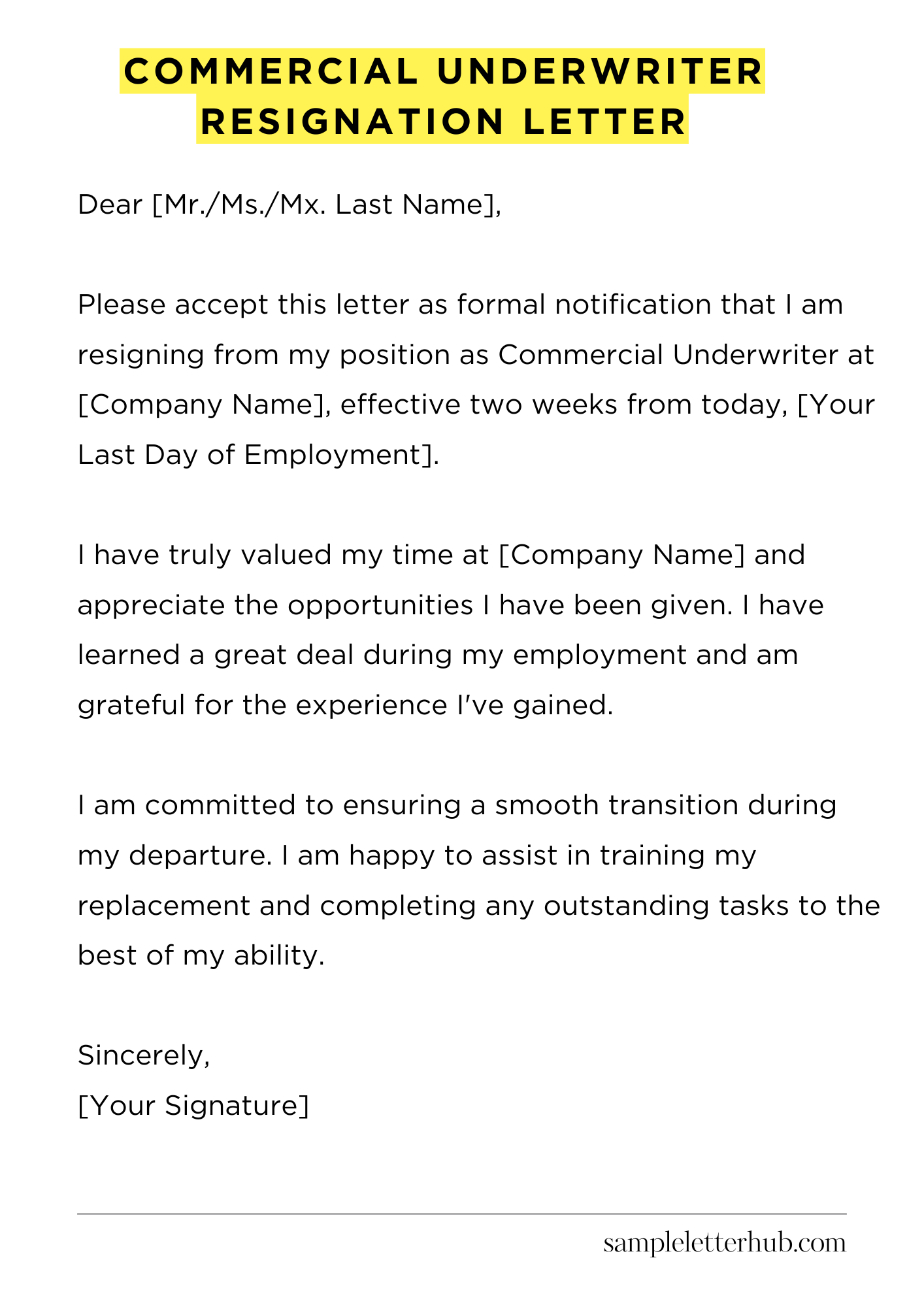
Dear [Mr./Ms./Mx. Last Name],
Please accept this letter as formal notification that I am resigning from my position as Commercial Underwriter at [Company Name], effective two weeks from today, [Your Last Day of Employment].
I have truly valued my time at [Company Name] and appreciate the opportunities I have been given. I have learned a great deal during my employment and am grateful for the experience I’ve gained.
I am committed to ensuring a smooth transition during my departure. I am happy to assist in training my replacement and completing any outstanding tasks to the best of my ability.
I wish you and [Company Name] all the best in the future.
Sincerely,
[Your Signature]
How to Write a Commercial Underwriter Resignation Letter
1. Grasp the Basics: Why a Resignation Letter Matters
Resigning from any job, especially one in a professional field like commercial underwriting, requires a carefully crafted letter. Think of it as your official farewell. It’s a formal declaration to your employer that you’re moving on.
This letter serves several critical purposes. Firstly, it documents your departure. This is crucial for HR records and your employment history. Secondly, a well-written letter maintains a professional image, even in leaving.
It’s a reflection of your character. It can also help smooth the transition for both you and your employer, leaving a positive lasting impression. Remember, you might need a reference in the future. So, this letter is more important than you think.
2. Essential Elements: What to Include
Your commercial underwriter resignation letter needs to be clear and concise. Don’t beat around the bush; get straight to the point. Start with a straightforward statement of your intention to resign. Be explicit about the date your employment will end. This is a must-have. State it clearly.
Next, express your gratitude for the opportunity to work at the company. Even if you’re not thrilled, a brief thank you goes a long way. Mentioning any positive experiences or skills you’ve gained can be beneficial.
Briefly, consider offering to assist with the transition. This shows goodwill and professionalism. If appropriate, you could offer to help train your replacement. Finally, end with a polite closing, such as “Sincerely” or “Best regards,” followed by your full name. Make sure your contact information is present.
3. Crafting the Content: Dos and Don’ts
Avoid negativity at all costs. This is not the place to air grievances. Keep it professional. Don’t criticize your colleagues or the company. Instead, focus on your future plans. Be brief. Your letter should be short and to the point. No need for lengthy explanations. Use a formal tone. Avoid slang or overly casual language.
Proofread meticulously. Check for any grammatical errors or typos before sending. Ensure the date is correct. Get a second pair of eyes to check the letter before you submit. It can make a difference. It’s best to keep your future plans private, unless you wish to share them.
4. Tailoring it to Your Situation: Specific Examples
Consider the specific circumstances of your departure. Are you leaving for a new job in the insurance industry? Mentioning this can be helpful. However, keep it brief. If you’re leaving for personal reasons, state that succinctly. For instance: “I am resigning due to personal circumstances.”
If you have a specific role or responsibilities, you may want to highlight the areas you are willing to assist with during the transition. For example, “I am happy to assist in training my replacement on…” Tailor the language to fit your relationship with your employer. If you have a close relationship with your manager, you can add a more personal touch, but always maintain professionalism.
If you have been promoted and are moving internally, the letter will be different; consult your company’s internal guidelines. Check with HR.
5. Formatting and Submission: The Final Steps
Format your letter professionally. Use a standard business letter format. Include your name, address, date, and the recipient’s name and title. Use a clear, easy-to-read font, such as Times New Roman or Arial.
Keep the font size between 10 and 12 points. Avoid complex formatting. Save the letter as a PDF file, to preserve the formatting. This also makes it more professional. Before submitting, proofread one last time.
Make sure you are using a recent version of the document. Then, deliver the letter according to company policy. Usually, you’ll give it to your immediate supervisor or HR department. Always keep a copy for your records. Consider sending a digital copy via email and a printed copy if required.
FAQs about Commercial Underwriter Resignation Letters
1. What are the essential components of a Commercial Underwriter resignation letter?
A well-crafted resignation letter for a Commercial Underwriter typically includes the following: a clear statement of resignation, the effective date of your departure, a concise expression of gratitude for the opportunity, and optional details regarding assistance with the transition.
It is also common to include a professional closing. Ensure the letter is professional and reflects positively on your time at the company.
2. Should I provide a reason for my resignation in the letter?
While not mandatory, it’s generally acceptable to briefly state your reason for leaving, especially if you have positive things to say about your experience, or you’re moving to a different role.
Avoid overly negative comments or excessive detail. A simple “to pursue other opportunities” or “to accept a new position” is often sufficient. If you are comfortable, providing constructive feedback can benefit the company, but only if it’s done professionally and respectfully.
3. How much notice should I give when resigning as a Commercial Underwriter?
The standard notice period is typically two weeks. However, the exact timeframe might be outlined in your employment contract or company policy. Always review your contract to ensure compliance.
More senior positions or those requiring extensive handover may warrant a longer notice period, potentially 30 days. Consider your current workload and the needs of your team when deciding the appropriate notice.
4. How should I deliver my Commercial Underwriter resignation letter?
The standard method is to provide a hard copy of your resignation letter to your direct supervisor. Some companies might prefer electronic submission via email, so be sure to confirm the preferred method with your manager or HR department. Regardless of the method, always maintain a professional tone and ensure the letter is clear and easy to read.
5. What should I do after submitting my resignation letter?
After submitting your letter, be prepared to discuss your departure with your manager. Offer your assistance in the transition process.
This might involve training your replacement, documenting your key responsibilities, or completing any outstanding tasks. Maintain a positive and professional attitude throughout your remaining time with the company. Be sure to collect any necessary documents, such as your final paycheck or letter of recommendation.
Related:
Resignation letter due to rude boss
Resignation letter moving to another state
Resignation letter due to illness of family member
Resignation letter due to study