

Navigating a career change? A “Clinical Specialist resignation letter” is your formal announcement. It’s how you officially inform your employer of your departure. This letter serves a crucial purpose: to communicate your decision clearly and professionally.
Thinking about stepping away from your Clinical Specialist role? Crafting the perfect resignation letter might seem daunting. But don’t worry! We’ve got you covered.
We’re sharing ready-to-use templates. Explore various examples and samples. Simplify your letter-writing process. Choose the best format for your needs.
Clinical Specialist Resignation Letter
Below is a sample of a Clinical Specialist Resignation Letter:
[Your Name]
[Your Address]
[Your Phone Number]
[Your Email Address]
[Date]
[Employer’s Name]
[Employer’s Title]
[Company Name]
[Company Address]
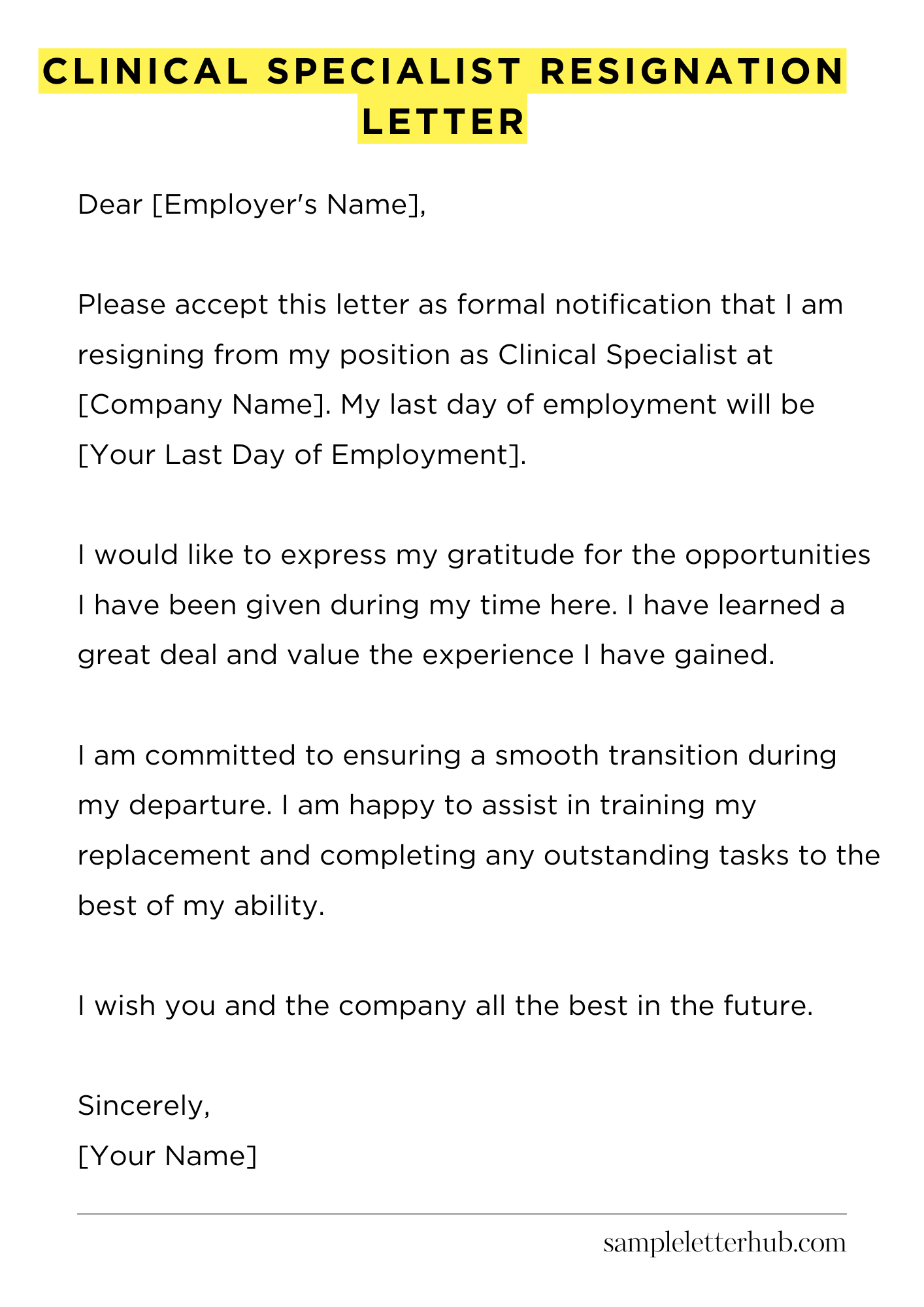
Dear [Employer’s Name],
Please accept this letter as formal notification that I am resigning from my position as Clinical Specialist at [Company Name]. My last day of employment will be [Your Last Day of Employment].
I would like to express my gratitude for the opportunities I have been given during my time here. I have learned a great deal and value the experience I have gained.
I am committed to ensuring a smooth transition during my departure. I am happy to assist in training my replacement and completing any outstanding tasks to the best of my ability.
I wish you and the company all the best in the future.
Sincerely,
[Your Name]
How to Write a Clinical Specialist Resignation Letter
1. Why is a Good Resignation Letter Important?
Leaving a job is a big step. And how you leave is almost as important as why you leave. A well-crafted resignation letter, particularly for a Clinical Specialist, is your official farewell. It helps ensure a smooth transition. Think about it: your letter is a crucial record. It’s formal and professional, and it sets the tone for your departure.
It’s the first impression you make when leaving, so make it a good one! This letter is your opportunity to maintain a positive relationship with your employer. It can also help you for future references. Moreover, it solidifies your professionalism.
2. Key Elements to Include
Okay, so what exactly goes into this letter? First, keep it concise. Clarity is key. Begin with a clear statement of your intent to resign, including your official last day of employment. This is non-negotiable! Next, express your gratitude for the opportunity. Mentioning specific experiences or skills you gained is a nice touch.
Now, depending on the situation, offer assistance during the transition. Consider offering to train your replacement or assist with documentation. Also, be sure to keep the tone positive and avoid any negative comments about your experience there. Finally, don’t forget your signature and printed name.
3. Formatting Your Letter for Success
Presentation matters. Seriously! Start with your contact information at the top. The date is also necessary. After that, address the letter to your direct supervisor or the appropriate HR representative. Keep the font professional; think Times New Roman or Arial. Use standard margins and single spacing within paragraphs, double spacing between paragraphs.
Your tone should be polite, respectful, and professional. Avoid slang or overly casual language. Proofread carefully. Check for grammar and spelling errors. Errors can undermine your credibility.
4. Tailoring Your Letter: Examples and Variations
While the core elements remain consistent, you can tailor your letter to your specific circumstances. Are you leaving for a better opportunity? Mention it briefly. If you have specific projects you want to see completed, note that you are willing to help, if needed. If you’re leaving due to personal reasons, you can choose how much information you want to share.
A short, polite explanation is sufficient. If you’re unsure, a simple “personal reasons” is okay. Adapt your letter to reflect your unique situation. This will let your employer know that you are a serious and responsible person.
5. What to Avoid in Your Resignation Letter
Let’s talk about what *not* to do. Do not burn bridges. Avoid negativity, complaints, or harsh criticism. Don’t go into too much detail about your reasons for leaving, unless you have a good reason to do so. Refrain from making demands or ultimatums. Avoid bringing up future plans unless relevant.
Keep the focus on your departure and positive contributions. Lastly, avoid sending the letter via email without a formal version on letterhead or an attachment if that is how it’s commonly practiced at your work. Keeping all these suggestions in mind ensures you leave a positive impression.
FAQs about Clinical Specialist Resignation Letter
What is the most professional way to start a Clinical Specialist resignation letter?
The most professional way to start a resignation letter for a Clinical Specialist role is to directly state your intent to resign, followed by the effective date of your resignation. Maintain a formal and respectful tone. For example, you might begin with: “Please accept this letter as formal notification that I am resigning from my position as Clinical Specialist, effective [Date].”
What key information should be included in a Clinical Specialist resignation letter?
Essential information includes: a clear statement of resignation, the effective date of your resignation, and a brief expression of gratitude for the opportunity. You may also include a statement regarding your willingness to assist with the transition of your responsibilities. Avoid negative comments about your employer or colleagues.
Is it necessary to provide a reason for resigning in the Clinical Specialist resignation letter?
Providing a reason for your resignation is generally not required. However, if you choose to include one, keep it concise and positive. For example, you might state you are “pursuing other opportunities” or “seeking a new career path.” Avoid going into excessive detail or including complaints.
How should a Clinical Specialist end their resignation letter?
Conclude your letter by reiterating your gratitude, offering assistance during the transition period (if applicable), and providing your contact information. You can use a professional closing such as “Sincerely,” or “Respectfully,” followed by your full name and signature.
What is the proper format for a Clinical Specialist resignation letter?
The letter should be formatted professionally: use a standard business letter format. Include your contact information (name, address, phone number, email) at the top, followed by the date, and the recipient’s information (name, title, company address).
The body of the letter should be concise, clear, and focused on the key points outlined above. Ensure you proofread it carefully for any errors.
Related:
Resignation letter due to rude boss
Resignation letter moving to another state
Resignation letter due to illness of family member
Resignation letter due to study