

A Client Advisor resignation letter is a formal document. It informs your employer of your decision to leave your job. The letter also states your last day of employment. Its primary purpose is to officially communicate your departure.
This article is for you. Are you planning on leaving your role? Perhaps you need help crafting the perfect resignation letter. We understand this can be tricky. Don’t worry, we’ve got you covered.
We’ve compiled helpful samples and templates. They will make writing your letter simple. Choose the one that suits your needs. Feel free to adapt them. Your transition can be smooth and professional.
Client Advisor Resignation Letter
Below is a sample of a Client Advisor Resignation Letter:
[Your Name]
[Your Address]
[Your Phone Number]
[Your Email Address]
[Date]
[Client Advisor’s Manager Name]
[Client Advisor’s Manager Title]
[Company Name]
[Company Address]
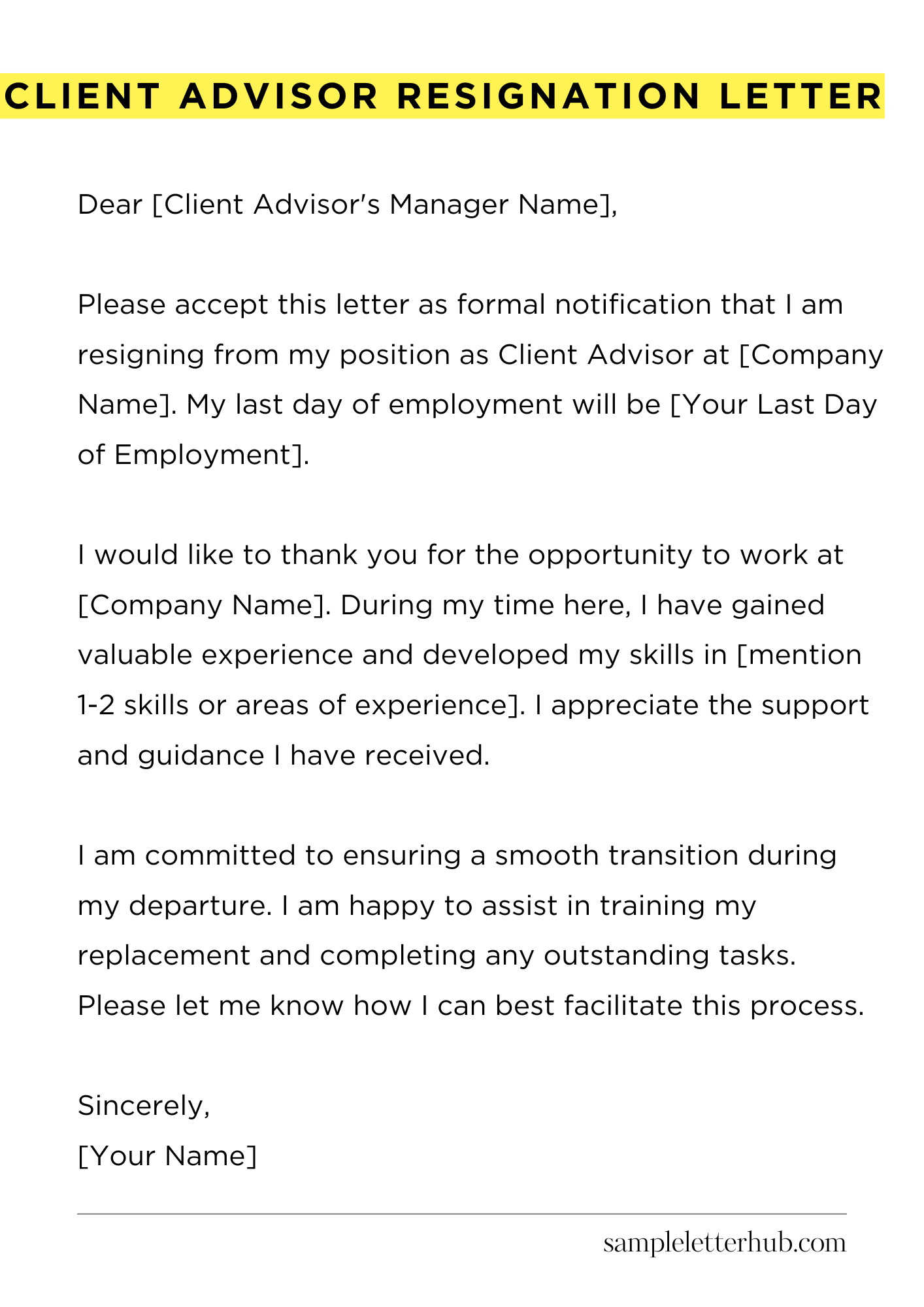
Dear [Client Advisor’s Manager Name],
Please accept this letter as formal notification that I am resigning from my position as Client Advisor at [Company Name]. My last day of employment will be [Your Last Day of Employment].
I would like to thank you for the opportunity to work at [Company Name]. During my time here, I have gained valuable experience and developed my skills in [mention 1-2 skills or areas of experience]. I appreciate the support and guidance I have received.
I am committed to ensuring a smooth transition during my departure. I am happy to assist in training my replacement and completing any outstanding tasks. Please let me know how I can best facilitate this process.
I wish you and [Company Name] all the best in the future.
Sincerely,
[Your Name]
How to Write a Client Advisor Resignation Letter
Leaving a job is a big decision. It’s even bigger when that job involves clients. As a Client Advisor, your relationships are your currency. Your clients trust you. They rely on you for guidance. That’s why a well-crafted resignation letter is absolutely essential when you decide to move on.
It’s not just a formality; it’s a critical bridge, allowing for a smooth transition and protecting your professional reputation. Think of it as a farewell note, not a fiery exit.
1. Start with Clarity and Professionalism
First things first: Be direct. State your intention clearly and concisely in the opening paragraph. Avoid beating around the bush. You’re resigning. This is the key. Include the date you intend for your resignation to be effective.
For example: “Please accept this letter as formal notification that I am resigning from my position as Client Advisor, effective [Date].” Use professional language throughout. Keep the tone respectful, even if you’re leaving because you’re unhappy. This isn’t the time to air grievances; it is a time for grace.
2. Express Gratitude and Acknowledge Relationships
Next, show your appreciation. Thank your employer for the opportunity to have worked there. Highlight any positive experiences. Mention any skills you’ve gained or enjoyed developing. Specifically address the impact of your role. If you can, briefly touch on your client relationships.
You may write something like: “I am grateful for the opportunity to have served our clients over the past [duration]. I have genuinely enjoyed building relationships and assisting them with their financial goals.” A touch of genuine appreciation can go a long way.
3. Facilitate a Smooth Transition: The Details Matter
This is where you demonstrate your professionalism and commitment to a seamless handover. Offer your assistance in the transition process. This might involve training your replacement, documenting client information, or answering questions. Be specific about what you’re willing to do.
“I am committed to ensuring a smooth transition. I am happy to assist in training my replacement and providing any necessary documentation.” Include any deadlines you think you can realistically achieve. Remember, you want to leave a positive lasting impression. Include your contact information in case they need to contact you after you have left the organization.
4. Keep it Concise and Avoid Negativity
Keep your letter brief. Avoid getting into the specifics of why you’re leaving, unless asked. This isn’t a performance review; it’s a resignation. Focus on the positives, your intentions, and your commitment to helping. Do not include any negative comments.
Refrain from criticizing the company, your colleagues, or any other aspect of your employment. This can backfire and can burn bridges with your peers. Keep your tone positive and professional. Remember you are leaving to pursue other opportunities.
5. Proofread and Review: The Final Step
Before submitting your letter, proofread it thoroughly. Check for any grammatical errors, spelling mistakes, or typos. Ask a trusted colleague or friend to review it as well.
A fresh pair of eyes can often catch mistakes you might have missed. Ensure the formatting is clean and easy to read. Double-check all dates and contact information. Your final impression should be one of professionalism, consideration, and respect. It must be polished and ready to go.
FAQs about Client Advisor Resignation Letter
What is the primary purpose of a Client Advisor resignation letter?
The primary purpose of a Client Advisor resignation letter is to formally notify the employer of the employee’s intent to leave their position. It serves as a legal document, providing a written record of the resignation, the effective date, and the employee’s acknowledgment of their departure.
It also allows the employee to express gratitude and offer assistance during the transition period.
What key elements should be included in a Client Advisor resignation letter?
A well-structured Client Advisor resignation letter should include the following: a clear statement of resignation, the specific effective date of resignation, a brief expression of gratitude for the opportunity, any relevant details regarding the handover of responsibilities, and the employee’s contact information. Optionally, you may include the reason for leaving.
How much notice should a Client Advisor provide when resigning?
The amount of notice a Client Advisor should provide depends on their employment contract, company policy, and local labor laws. Generally, a minimum of two weeks’ notice is considered standard practice.
However, senior roles or those with more complex responsibilities may require a longer notice period, potentially a month or more. It is crucial to review the employment contract for specified guidelines.
Can a Client Advisor include a reason for resignation in their letter, and if so, what are the best practices?
Yes, a Client Advisor can include the reason for their resignation, though it’s not always mandatory. If included, it’s advisable to keep the reason concise and professional.
Common reasons include accepting a new job opportunity, pursuing further education, or seeking a better work-life balance. Avoid negative comments about the employer or colleagues. Focusing on future goals rather than past grievances is often the best approach.
How should a Client Advisor handle the handover of client relationships and responsibilities?
A Client Advisor should handle the handover of client relationships and responsibilities in a structured and professional manner. This typically involves preparing a detailed handover document outlining client contacts, ongoing projects, and any specific client needs.
The Client Advisor should then work closely with their replacement or assigned team member to ensure a seamless transition, including providing training, answering questions, and assisting with client introductions. Maintaining confidentiality and ensuring a positive client experience during this period is essential.
Related:
Resignation letter due to rude boss
Resignation letter moving to another state
Resignation letter due to illness of family member
Resignation letter due to study