

A Claims Examiner resignation letter is a formal document. Its purpose is to officially inform an employer about leaving a job. The letter should include the date of resignation and the last day of employment. It can also express gratitude and explain the reason for leaving.
Writing this letter can feel tricky. You might be unsure where to start. We are here to help. We’ll share several templates. These templates offer examples of different resignation letters.
We’ve crafted various samples. They cover different scenarios. You can adapt them to your needs. This makes writing your own letter a breeze. Now, let’s get started and find the perfect words!
Claims Examiner Resignation Letter
Below is a sample of a Claims Examiner Resignation Letter:
[Your Name]
[Your Address]
[Your Phone Number]
[Your Email Address]
[Date]
[Employer’s Name]
[Company Name]
[Company Address]
Dear [Employer’s Name],
Please accept this letter as formal notification that I am resigning from my position as Claims Examiner at [Company Name]. My last day of employment will be [Date – usually two weeks from the letter date].
I would like to thank you for the opportunity to work at [Company Name]. I have learned a great deal during my time here. I especially appreciate [mention something specific you appreciated, e.g., the training I received, the supportive team environment, etc.].
I am committed to helping with the transition during my remaining time here. I am happy to assist in any way possible to ensure a smooth handover of my responsibilities. Please let me know how I can be of assistance.
I wish you and [Company Name] all the best in the future.
Sincerely,
[Your Signature]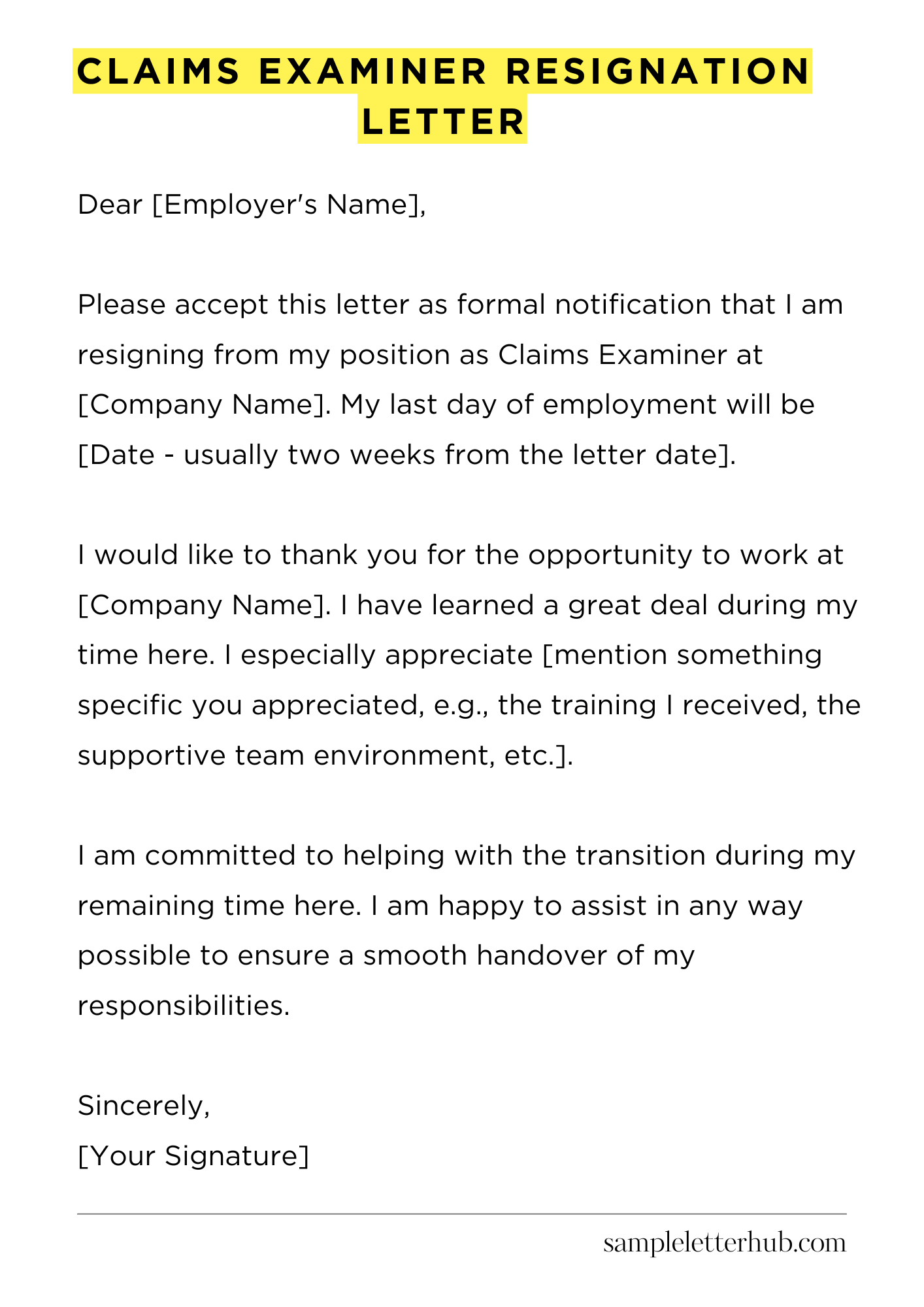
How to Write a Claims Examiner Resignation Letter
Know When It’s Time to Go
Leaving a job is a big decision, especially in a field like claims examination. You’ve likely spent time honing your skills, navigating complex policies, and dealing with sensitive situations. But maybe it’s time for a change. Perhaps a better opportunity has presented itself, the work environment isn’t a good fit, or you’re simply burnt out.
Realize that this is your life, and you’re in charge. You will make better decisions when you know when to walk away. Whatever the reason, deciding to resign is the first step.
Before you put pen to paper (or fingers to keyboard), take some time to reflect. Understand exactly why you are resigning. This self-awareness will help you craft a clearer and more professional letter. Think about the specific triggers and circumstances that have led you to this choice. This helps you keep the tone consistent.
Crafting the Core of Your Letter
The core of your resignation letter needs to be clear, concise, and professional. Start with a straightforward statement of your intention. Something like, “Please accept this letter as formal notification that I am resigning from my position as Claims Examiner, effective [Your Last Day of Employment].” This leaves no room for confusion.
Next, it’s crucial to state the last day you will be working. Be sure this aligns with company policy, which typically requires a two-week notice. You are expected to make it easy for HR to understand. Include the date in the statement above. Keep it short and sweet, yet it needs to convey the seriousness of your intention. Make it professional.
Highlighting Your Contributions (Optional, But Recommended)
While not strictly necessary, acknowledging your time with the company and highlighting some of your accomplishments can be beneficial. It shows you aren’t just leaving, you’re leaving with a positive outlook and perspective. Consider a brief mention of your experience or notable achievements.
For instance, “I have valued my time at [Company Name] and am grateful for the experience gained over the past [Number] years/months.”
You could also mention a specific project you contributed to or a skill you developed. This is a good time to shine and show off a little. This helps to leave a positive lasting impression. Remember, you might need a reference from this company in the future. It’s always a good idea to leave things on a positive note.
Expressing Gratitude and Providing Assistance
Always express gratitude for the opportunities you’ve been given. Even if you’re not thrilled about leaving, showing appreciation is a sign of professionalism. A simple “Thank you for the opportunities I’ve been given” goes a long way. It also prevents hard feelings. Offering your assistance during the transition is also a nice touch.
For instance, “I am committed to ensuring a smooth handover of my responsibilities and am available to assist in any way possible during the transition period.”
Be specific, if you can, about how you will help. This could mean training a replacement or documenting key processes. This adds value. This shows a commitment to ensuring a seamless transition. This also increases your chances of a positive reference.
Finalizing Your Letter and Polishing It Up
Before sending, review and proofread everything. Check for any typos, grammatical errors, or awkward phrasing. Make sure the tone is professional, and your language is clear and polite. You should always use a professional font, such as Times New Roman or Arial. Keep it simple and easy to read.
Sign the letter, if you are sending a physical copy. If sending electronically, use your name and a professional closing, such as “Sincerely” or “Best Regards.” Finally, keep a copy of your resignation letter for your records. You never know when you might need it.
FAQs about Claims Examiner resignation letter
How do I write a resignation letter as a Claims Examiner?
When composing your Claims Examiner resignation letter, begin with a clear and concise statement of your intent to resign, including your last day of employment. Be sure to include your name, the date, and the recipient’s name and title. Briefly express your gratitude for the opportunity to work at the company.
Keep the tone professional and positive, avoiding any negativity or complaints. You may optionally state a brief reason for your departure (e.g., pursuing other opportunities), but this is not mandatory. Include your contact information for any necessary follow-up communication. Proofread carefully before submitting.
What should be the key elements of a Claims Examiner resignation letter?
The key elements include a formal salutation (e.g., Dear [Manager’s Name]), a clear statement of resignation and the effective date, an expression of gratitude for the employment opportunity, optional brief reason for leaving, a professional tone, and a formal closing (e.g., Sincerely).
Ensure your letter is concise, well-formatted, and free of grammatical errors. It should reflect your professionalism and leave a positive lasting impression.
Can I include a reason for leaving in my Claims Examiner resignation letter?
While not required, you may optionally include a brief and professional reason for leaving. This could be to pursue another opportunity, relocate, or for personal reasons.
Avoid negative statements about your current employer or colleagues. If you choose to include a reason, keep it concise and positive, focusing on the future rather than past issues. Keeping it vague and polite is the best option to use.
Should I offer to help with the transition after resigning as a Claims Examiner?
Offering to assist with the transition is a thoughtful and professional gesture. You can state your willingness to train a replacement, transfer your knowledge, or help in any other reasonable way.
This demonstrates your commitment to a smooth handover and leaves a positive impression on your employer. Ensure you are realistic about the time you can dedicate to the transition period.
How should I deliver my Claims Examiner resignation letter?
The best practice is to deliver your resignation letter in person to your direct supervisor, if possible. This allows for a face-to-face discussion. If an in-person meeting is not feasible, send it via email.
Always retain a copy of your resignation letter for your records. It is a good practice to follow up with a quick email confirming the acceptance of your resignation and the last day of work.
Related:
Resignation letter due to rude boss
Resignation letter moving to another state
Resignation letter due to illness of family member
Resignation letter due to study