

Dealing with a theft can be devastating. After a theft incident, you file an insurance claim. Sometimes, the insurance company denies or undervalues your claim. That’s when a Claim Settlement Appeal Letter for Theft Case becomes crucial. Its purpose? To formally challenge the insurance company’s decision. This letter aims to get a fair payout for your theft losses.
You’re not alone in this. Many people face theft claim challenges. We’re here to help you navigate the process. This article provides you with handy Claim Settlement Appeal Letter for Theft Case templates. These are real-life claim appeal letter examples. They are designed to make writing your own letter easier.
Ready to fight for what you deserve? We’ve got you covered. These appeal letter samples are a great starting point. They’ll guide you through crafting a compelling theft claim appeal. Get ready to reclaim what’s rightfully yours! Let’s begin.
[Your Name]
[Your Address]
[Your Phone Number]
[Your Email Address]
[Date]
[Insurance Company Name]
[Insurance Company Address]
Subject: Appeal for Claim Settlement – Theft Case – Policy Number [Your Policy Number]
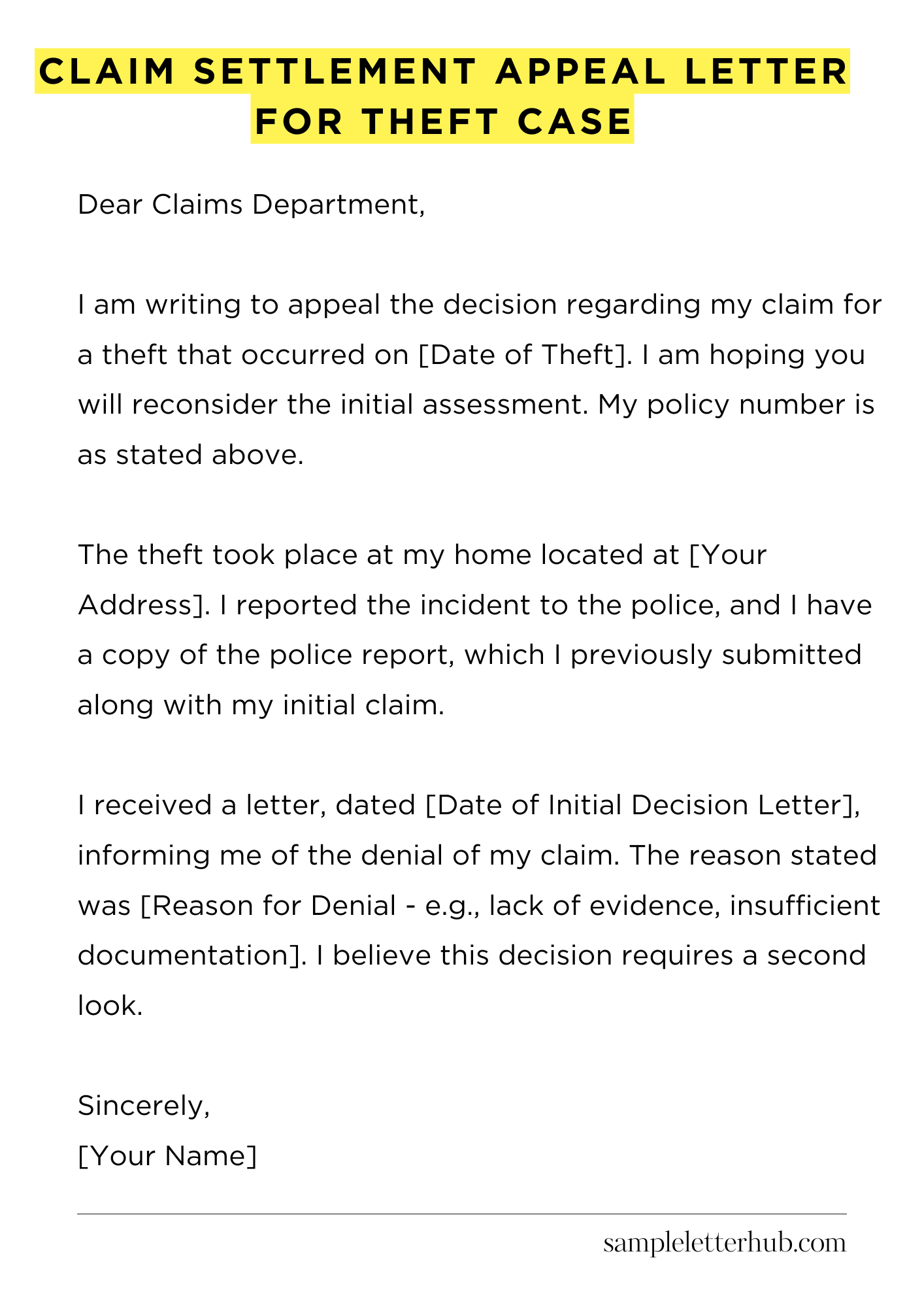
Dear Claims Department,
I am writing to appeal the decision regarding my claim for a theft that occurred on [Date of Theft]. I am hoping you will reconsider the initial assessment. My policy number is as stated above.
The theft took place at my home located at [Your Address]. I reported the incident to the police, and I have a copy of the police report, which I previously submitted along with my initial claim. The report clearly details the items stolen. These include a [Item 1 Description], a [Item 2 Description], and a [Item 3 Description].
I received a letter, dated [Date of Initial Decision Letter], informing me of the denial of my claim. The reason stated was [Reason for Denial – e.g., lack of evidence, insufficient documentation]. I believe this decision requires a second look.
Regarding the lack of evidence, I would like to clarify that [Explain why you believe the evidence is sufficient or explain any new evidence]. For instance, I can provide [Specific additional evidence you can provide, e.g., receipts, photos, witness statements]. This additional information will, I hope, offer more clarity.
The estimated value of the stolen items, as detailed in my initial claim, totaled [Dollar Amount]. This figure reflects the fair market value of the goods at the time of the theft. The loss has significantly impacted me.
I have attached [List any additional documents you are attaching, e.g., updated receipts, additional photos, witness statements]. These extra documents will, I trust, support my claim further. I am confident that upon reviewing this new information, you will reconsider your decision.
Thank you for your time and attention to this matter. I look forward to hearing from you soon regarding a favorable resolution. I appreciate you taking this seriously.
Sincerely,
[Your Name]
How to Write Claim Settlement Appeal Letter for Theft Case
The unwelcome experience of theft necessitates navigating the often-complex landscape of claim settlements. When initial claim determinations fall short, the right appeal letter becomes your crucial instrument. Let’s delve into the mechanics of crafting a persuasive and effective appeal.
1. Initiate with Formality and Precision
Begin your letter with the customary business letter format. At the upper left, enumerate your full name, address, and contact details.
Then, on the right, include the date and the recipient’s information: the claims adjuster’s name (if known), the insurance company’s name, and their address.
Use a formal salutation like “Dear Mr./Ms. [Adjuster’s Last Name]” or a generic but polite “To Whom It May Concern.” This establishes a professional tone from the outset.
2. The Subject Line: A Beacon of Clarity
Your subject line should be succinct, direct, and unambiguous. Something like “Appeal of Claim Denial – Policy Number: [Your Policy Number] – Theft of [Specific Item]” will suffice. This immediate clarity allows the reader to quickly understand the letter’s purpose, streamlining the process.
3. Recapitulate the Facts: A Concise Narrative
Provide a brief, factual summary of the theft incident. Be specific, mentioning the date, location, and a concise description of what was stolen. Avoid florid language; stick to the core details. This section should serve as a factual foundation, a clear recapitulation of the antecedent event.
4. Identify the Basis for Your Appeal: Addressing the Rejection
This is where you directly address the insurance company’s denial or unsatisfactory settlement. Clearly state why you disagree with their decision. Did they undervalue the stolen items?
Were they missing crucial information? Were their assumptions flawed? If they cited a specific policy clause as the basis for denial, provide a countervailing interpretation, or evidence demonstrating the inapplicability of said clause. Engage in critical analysis; this is the core of your argument.
5. Present Supporting Evidence: Fortifying Your Position
Bolster your claims with concrete evidence. This could include police reports, receipts, photographs of the stolen items, appraisals, or witness statements.
Make copies, retain the originals, and explicitly reference each piece of evidence within your letter. For example, “As demonstrated in the attached police report, reference number [Number], the theft was officially recorded.” Meticulous presentation is key.
6. Articulate Your Desired Outcome: A Specific Request
Clearly state what you are seeking from the insurance company. Do you want a reassessment of the claim, a specific amount of compensation, or a review of their decision?
Be direct and unequivocal. For example, “Therefore, I request that the insurance company reconsider its initial assessment and issue a claim settlement of [Dollar Amount] to cover the replacement costs of the stolen items, as specified in my policy.” Leave no room for ambiguity.
7. Conclusion and Closing: Professional Demeanor
Conclude with a polite but firm closing statement. Reiterate your belief in the validity of your claim and your willingness to cooperate further. Include your contact information again and express your hope for a favorable resolution. Use a formal closing, such as “Sincerely” or “Respectfully,” followed by your full name. Proofread meticulously before sending your letter.
Careful composition and meticulous presentation significantly amplify the persuasive force of your appeal.
FAQs about Claim Settlement Appeal Letter for Theft Case
What is a claim settlement appeal letter for a theft case, and why is it necessary?
A claim settlement appeal letter for a theft case is a formal document you write to your insurance company when you are dissatisfied with the initial claim settlement for a theft-related loss.
It’s necessary because it provides an opportunity to formally challenge the insurer’s decision, request a review of your claim, and potentially receive a more favorable outcome, such as increased compensation for your stolen property or coverage denied.
What information should be included in a claim settlement appeal letter for a theft case?
A comprehensive claim settlement appeal letter should include your policy number, the date of the theft, a clear explanation of why you disagree with the insurer’s decision, supporting evidence (such as police reports, receipts, appraisals, photos), specific details about the disputed items and their value.
What is the timeframe for submitting a claim settlement appeal letter?
The timeframe for submitting an appeal letter varies depending on the insurance policy and the laws of your jurisdiction. It’s crucial to review your policy documents to determine the deadline for filing an appeal. Generally, you have a limited time, often within 30 to 60 days of receiving the initial claim settlement decision.
Missing the deadline may result in the denial of your appeal, so prompt action is essential.
What happens after I submit a claim settlement appeal letter?
After submitting your appeal letter, the insurance company will typically review your case, including the original claim, your appeal letter, and any supporting documentation.
They may contact you for additional information or clarification. The insurer will then make a decision regarding your appeal. They may uphold the original decision, offer a revised settlement, or request further investigation. You will receive a written response outlining their final decision.
What are my options if my claim settlement appeal is denied?
If your claim settlement appeal is denied, you may have several options. These options may include filing a complaint with your state’s insurance regulatory agency, seeking mediation or arbitration to resolve the dispute, or even pursuing legal action.
The specific steps available to you will depend on the specifics of your policy, the laws of your state, and the nature of the denial.
Related:
Resignation letter due to rude boss
Resignation letter moving to another state
Resignation letter due to illness of family member
Resignation letter due to study