

Dealing with a canceled trip? Life happens. Sometimes, you have to cancel travel plans. A Claim Request Letter for Travel Cancellation is your key. Its purpose? To formally ask for compensation. You’re asking for a refund for a trip you couldn’t take.
Don’t worry about starting from scratch. We’ve got you covered. This article offers Claim Request Letter for Travel Cancellation templates. We’ve included several examples. Each sample letter is tailored for various situations. Use these Claim Request Letter for Travel Cancellation examples to craft your own.
Our goal? To simplify the process. We aim to make it easier for you to write your letter. With these sample letters, writing a Claim Request Letter for Travel Cancellation becomes straightforward. Let us help you get what you deserve. Get ready to write a solid Claim Request Letter for Travel Cancellation!
[Your Name]
[Your Address]
[Your Phone Number]
[Your Email Address]
[Date]
[Insurance Company Name/Travel Agency Name]
[Insurance Company/Travel Agency Address]
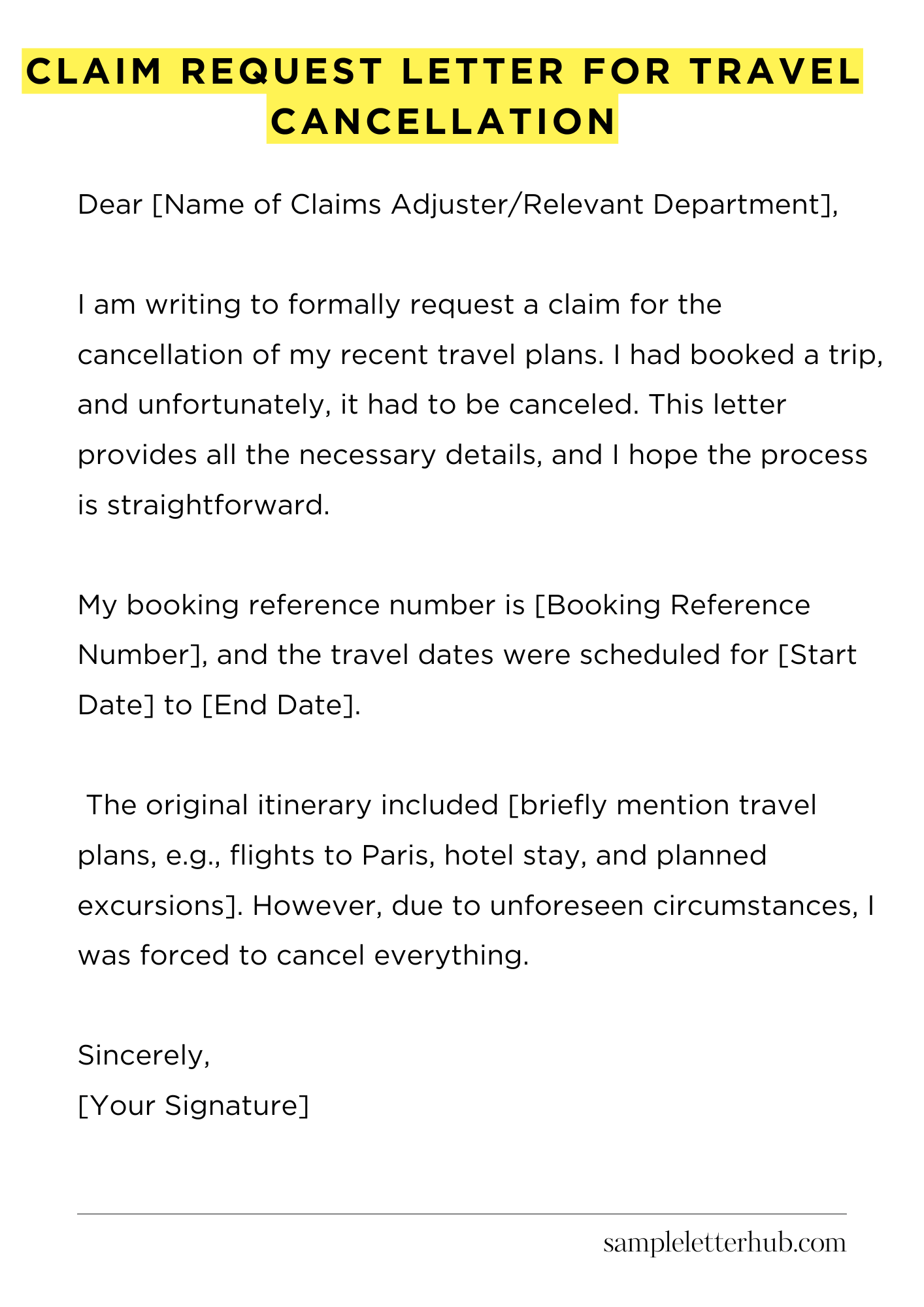
Dear [Name of Claims Adjuster/Relevant Department],
I am writing to formally request a claim for the cancellation of my recent travel plans. I had booked a trip, and unfortunately, it had to be canceled. This letter provides all the necessary details, and I hope the process is straightforward.
My booking reference number is [Booking Reference Number], and the travel dates were scheduled for [Start Date] to [End Date]. The original itinerary included [briefly mention travel plans, e.g., flights to Paris, hotel stay, and planned excursions]. However, due to unforeseen circumstances, I was forced to cancel everything.
The reason for the cancellation was [clearly state the reason for cancellation – be concise, e.g., a sudden illness, a family emergency, etc.].
I have attached copies of the following documents to support my claim: [List all attached documents, e.g., booking confirmation, cancellation confirmation from the airline/hotel, doctor’s note (if applicable), proof of payment, etc.].
These documents provide proof of my original booking, the cancellation, and the reason for that cancellation. Please review them carefully.
I am seeking reimbursement for the costs associated with the cancelled trip. The total amount I am claiming is [State the total amount in currency] based on [briefly explain how the amount was calculated – e.g., flight costs, hotel costs, etc.]. I have tried to be very clear.
I would appreciate it if you could process my claim as quickly as possible. Please let me know if you require any further information from my side. You can contact me by phone or email. Thank you for your time and attention to this matter. I am hopeful about a positive outcome.
Sincerely,
[Your Signature]
How to Write Claim Request Letter for Travel Cancellation
Cancellations can be a real drag, especially when they involve travel plans. Unexpected circumstances may crop up, leaving you in a lurch. But don’t despair! You can often recoup some of your losses. Your key to recovery is crafting a compelling claim request letter. Follow these steps to maximize your chances of a successful reimbursement.
1. Commence with Clarity: The Salutation and Introductory Cadence
Start your missive with a formal salutation. Address the appropriate entity: the airline, travel agency, or insurance provider. Include the recipient’s name and title, if known, to personalize your communication. In your opening paragraph, unequivocally state your purpose: to claim compensation for a cancelled travel arrangement.
Briefly outline the basic details of your reservation, including the booking reference number, dates of travel, and destination. Keep it concise, but convey your intent with unwavering assurance.
2. Detail the Debacle: Narrating the Circumstances of Cancellation
Now, it’s time to delve into the nitty-gritty. Provide a detailed account of the events leading to the cancellation. Specify the date the cancellation occurred and the reasons for it. Be precise.
Substantiate your claims with supporting evidence, like a doctor’s note, death certificate, or official documentation pertaining to the event. For example, if your flight was cancelled due to a volcanic eruption, furnish any official notices from the airline or airport. Be as thorough as possible.
3. Itemize Your Losses: The Catalogue of Compensable Costs
Here’s where you account for your pecuniary losses. Compile a comprehensive list of all expenses incurred due to the cancellation. This might encompass flight tickets, hotel reservations, pre-booked tours, and non-refundable deposits.
Include the corresponding amounts, along with the currency. Maintain an audit trail; keep all receipts, invoices, and booking confirmations. If you’ve incurred additional costs (e.g., alternative transportation), document them, too. Every piece of documentation adds weight to your claim.
4. Cite Your Entitlements: Referencing the Governing Regulations
Familiarize yourself with the terms and conditions outlined by the travel provider or your insurance policy. If you are eligible for compensation, explicitly cite the relevant clauses or sections that support your claim.
For instance, if you are protected under EU Regulation 261/2004, state this explicitly and clarify the level of compensation you’re seeking. This demonstrates that you are well-versed in your rights and strengthens your position.
5. Propose a Resolution: The Claim’s Explicit Demands
Clearly articulate the resolution you’re seeking. State the precise amount of compensation you desire, based on your documented losses. Specify the mode of payment you prefer (e.g., bank transfer, check).
Provide the necessary details for payment, such as your bank account information. Be direct and unambiguous. If you have any specific requests, such as a refund for travel credits, list them separately.
6. Assemble the Arsenal: Attachments and Supporting Evidence
This is where you amass your supporting documentation. Make a list of all attachments, like copies of your tickets, receipts, medical certificates, and any correspondence related to the cancellation.
Ensure these are easily readable and clearly labeled. Always retain copies of all documents for your records. The more evidence you can provide, the stronger your claim will be.
7. Conclude with Conviction: Closing and Final Affirmations
Conclude your letter with a formal closing and your full name. Include your contact information (phone number, email address, and postal address). Reiterate your request for compensation and express your hope for a swift resolution. Sign the letter, if sending a physical copy.
Consider a brief statement, thanking the recipient for their time and attention. A polite but firm tone is best. Proofread your letter meticulously before sending it.
FAQs about Claim Request Letter for Travel Cancellation
What is a claim request letter for travel cancellation, and when is it necessary?
A claim request letter for travel cancellation is a formal document you send to an insurance provider or travel supplier to request reimbursement for costs incurred due to a canceled trip.
It becomes necessary when unforeseen circumstances, covered by your policy or the supplier’s terms, force you to cancel your travel plans, such as illness, injury, severe weather, or other covered events. The letter initiates the claims process and provides the necessary information for a review and potential payout.
What information should be included in a claim request letter for travel cancellation?
A well-written claim request letter should include the following: your contact information (name, address, phone number, email); the policy or booking reference number; the travel dates and destination; a clear explanation of the reason for cancellation, supported by relevant documentation (e.g., doctor’s note, police report).
What supporting documentation is typically required when submitting a claim?
The specific documentation required will depend on the reason for cancellation and the terms of your insurance policy or booking agreement.
Common documents include: a copy of your travel insurance policy or booking confirmation; proof of payment for the canceled trip expenses; documentation supporting the reason for cancellation (e.g., medical records, death certificate, police report, weather advisory).
How and when should I submit the claim request letter?
Submit your claim request letter as soon as possible after the cancellation. Follow the instructions provided by your insurance provider or travel supplier, typically by mail or through an online claims portal.
Ensure you adhere to any deadlines specified in your policy or booking terms, as late submissions may result in claim denial. Keep copies of the letter and all supporting documentation for your records.
What can I do if my claim is denied?
If your claim is denied, carefully review the reasons for denial provided by the insurer or supplier. Gather any additional information or documentation that might address the denial reasons.
Contact the insurer or supplier to discuss the denial and provide any additional information. If you are still not satisfied with the decision, you may have the option to appeal the decision through their internal appeals process or seek assistance from an external dispute resolution service or ombudsman, depending on the terms of your policy or booking.
Related:
Resignation letter due to rude boss
Resignation letter moving to another state
Resignation letter due to illness of family member
Resignation letter due to study