

Dealing with a stolen vehicle is stressful. A claim request letter for a stolen vehicle helps. It’s a formal document. Its purpose is to notify your insurance company. You are informing them about your car theft. It initiates the claims process.
We understand it’s hard to know what to write. Claim request letters need specific information. Don’t worry! We will share helpful claim request letter templates. These are sample letters you can use. Adapt them for your situation.
Writing a letter for a stolen vehicle claim doesn’t have to be hard. We offer easy-to-follow letter examples. They will help you craft your own stolen car claim letter. We will make it straightforward. Your claims process will be easier.
[Your Name]
[Your Address]
[Your Phone Number]
[Your Email Address]
[Date]
[Insurance Company Name]
[Insurance Company Address]
Subject: Claim Request for Stolen Vehicle – [Vehicle Make and Model] – Policy Number: [Your Policy Number]
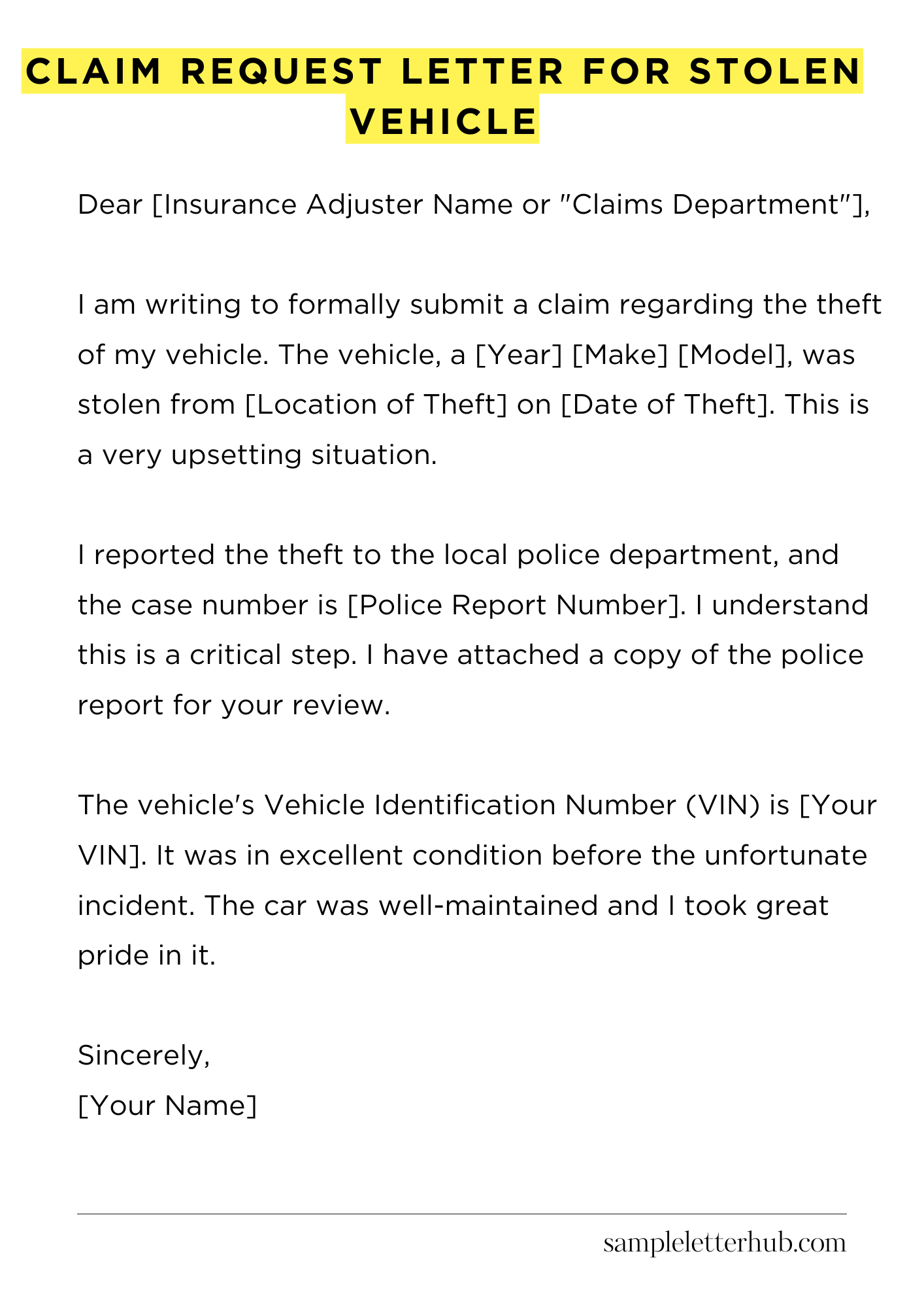
Dear [Insurance Adjuster Name or “Claims Department”],
I am writing to formally submit a claim regarding the theft of my vehicle. The vehicle, a [Year] [Make] [Model], was stolen from [Location of Theft] on [Date of Theft]. This is a very upsetting situation.
I reported the theft to the local police department, and the case number is [Police Report Number]. I understand this is a critical step. I have attached a copy of the police report for your review.
The vehicle’s Vehicle Identification Number (VIN) is [Your VIN]. It was in excellent condition before the unfortunate incident. The car was well-maintained and I took great pride in it.
I have also included copies of the following documents: a copy of my driver’s license, the vehicle registration, and any relevant maintenance records. Please review these as soon as possible. I want to assist in any way I can.
I am requesting coverage for the loss of my vehicle under the terms of my insurance policy, Policy Number [Your Policy Number]. I have maintained this policy for quite some time.
I would appreciate it if you could begin processing my claim as quickly as possible. Please let me know what further information or documentation you may require from me.
I am readily available to answer any questions you might have. You can reach me by phone at [Your Phone Number] or by email at [Your Email Address]. I am expecting your prompt attention to this matter. Thank you for your time and assistance.
Sincerely,
[Your Name]
How to Write Claim Request Letter for Stolen Vehicle
The theft of a vehicle is a calamitous event. You are understandably in a state of distress. However, swift action and a meticulously crafted claim request letter are crucial for recouping your losses. Here’s a comprehensive guide to navigate this process.
1. Initiate Immediate Action
First and foremost, immediately report the theft to the local police department. Obtain a police report number, as this is the cornerstone of your insurance claim.
This document is indispensable evidence, therefore keep it safe. Then, promptly contact your insurance provider and apprise them of the situation. Their specific instructions should be followed diligently. Time is of the essence; promptness can significantly expedite the claims process.
2. Crafting the Salutation
Begin your letter with a formal and professional salutation. Address it to the relevant claims adjuster or department. If you have the adjuster’s name, utilize it.
For instance, “Dear Mr./Ms. [Last Name]”. Otherwise, use a general salutation like “To Whom It May Concern,”. Accuracy in this preliminary step establishes a professional tone from the outset.
3. Provide Comprehensive Identification
The core of your letter should detail the specifics of the stolen vehicle. Be explicit. Include the vehicle identification number (VIN), make, model, year, and color.
Furthermore, provide information about any distinctive features, aftermarket modifications, or damage present before the theft. This comprehensive identification helps the insurer in their investigations. The more granular the details, the better.
4. Recount the Circumstances
Next, provide a factual and concise narrative of the theft. Explain when and where the vehicle was last seen and when you discovered it was missing. Mention the conditions, if known, surrounding the theft. Avoid speculation; stick to verifiable facts. Include the date and time you reported the theft to the police and the police report number. Clarity is paramount.
5. Documentation is the Sine Qua Non
This is where you amass supporting documentation. Include a copy of the police report, the vehicle’s registration, proof of ownership (title), and any relevant purchase or lease agreements.
Also, gather any documents pertaining to added options or modifications. If you had comprehensive coverage, provide any evidence supporting this. Remember, the insurer needs to substantiate the claim, hence documentation is critical. Make copies and retain the originals.
6. The Formal Request and Valuation
In a clear and direct manner, state your claim for the loss of your vehicle. Specifically request compensation under the terms of your insurance policy. Include your policy number.
Research the fair market value (FMV) of your vehicle before the theft, using sources like Kelley Blue Book or Edmunds. Include the FMV estimate to substantiate your claim. You are providing the basis for their settlement.
7. Concluding and Subsequent Action
Conclude the letter with a professional closing, such as “Sincerely,” or “Respectfully,” followed by your full name, address, phone number, and email address.
Sign the letter, if mailing it. Send the letter via certified mail with a return receipt requested. This provides proof of delivery and ensures you have a record of the correspondence.
Maintain copies of everything. Following up with your insurance company after a reasonable timeframe is prudent. Remember, persistence and thoroughness are vital to a successful claim.
FAQs about Claim Request Letter for Stolen Vehicle
What information should I include in a claim request letter for a stolen vehicle?
Your claim request letter should include: your name and contact information, the date, the insurance company’s name and address, the policy number, the vehicle’s make, model, year, and VIN (Vehicle Identification Number), the date and location the vehicle was stolen, a detailed description of the theft, a police report number, and any additional relevant information.
When should I submit a claim request letter after my vehicle is stolen?
You should submit the claim request letter as soon as possible after reporting the theft to the police.
Most insurance policies have a specific timeframe within which you must file a claim (typically within a few days or weeks), so prompt action is important to avoid any potential denial of your claim. Contact your insurance provider immediately to understand their specific requirements and deadlines.
What supporting documents do I need to include with my claim request letter?
Common supporting documents include a copy of the police report, your insurance policy documents, proof of vehicle ownership (title or registration), any applicable financing agreements if the vehicle had a loan, and proof of any modifications or upgrades you made to the vehicle. Gather these documents and provide them to your insurance company with your letter.
What happens after I submit the claim request letter?
After you submit the letter and supporting documents, the insurance company will investigate the claim. They may contact you for additional information, inspect the vehicle (if recovered), or interview witnesses.
The insurer will assess the claim, determine if the theft is covered under your policy, and calculate the value of the vehicle. If the claim is approved, you will receive compensation.
How is the value of my stolen vehicle determined for insurance purposes?
The value of your stolen vehicle is typically determined by the insurance company based on the actual cash value (ACV) of the vehicle at the time of the theft.
The ACV is usually based on the vehicle’s market value, which factors in depreciation, the vehicle’s condition, mileage, and any added features. The insurance company may use resources like Kelley Blue Book or other valuation tools to arrive at the vehicle’s ACV.
Related:
Resignation letter due to rude boss
Resignation letter moving to another state
Resignation letter due to illness of family member
Resignation letter due to study