

Dealing with a partial payment can be frustrating. A claim request letter for partial payment issue addresses this problem. Its purpose? To formally request the remaining amount owed. This letter is a crucial tool for debt recovery. It ensures your invoice is settled correctly.
Are you struggling to write the perfect claim request letter? Don’t worry! We’ve got you covered. We’ll be sharing various sample letters here. These templates make the process simple. They guide you through the letter writing process.
This article is your guide to creating effective partial payment claim letters. We provide examples for different scenarios. Use these samples to craft your own claim letter. Make the process straightforward and effective. Get your money!
[Your Name/Company Name]
[Your Address]
[Your Phone Number]
[Your Email Address]
[Date]
[Recipient’s Name/Company Name]
[Recipient’s Address]
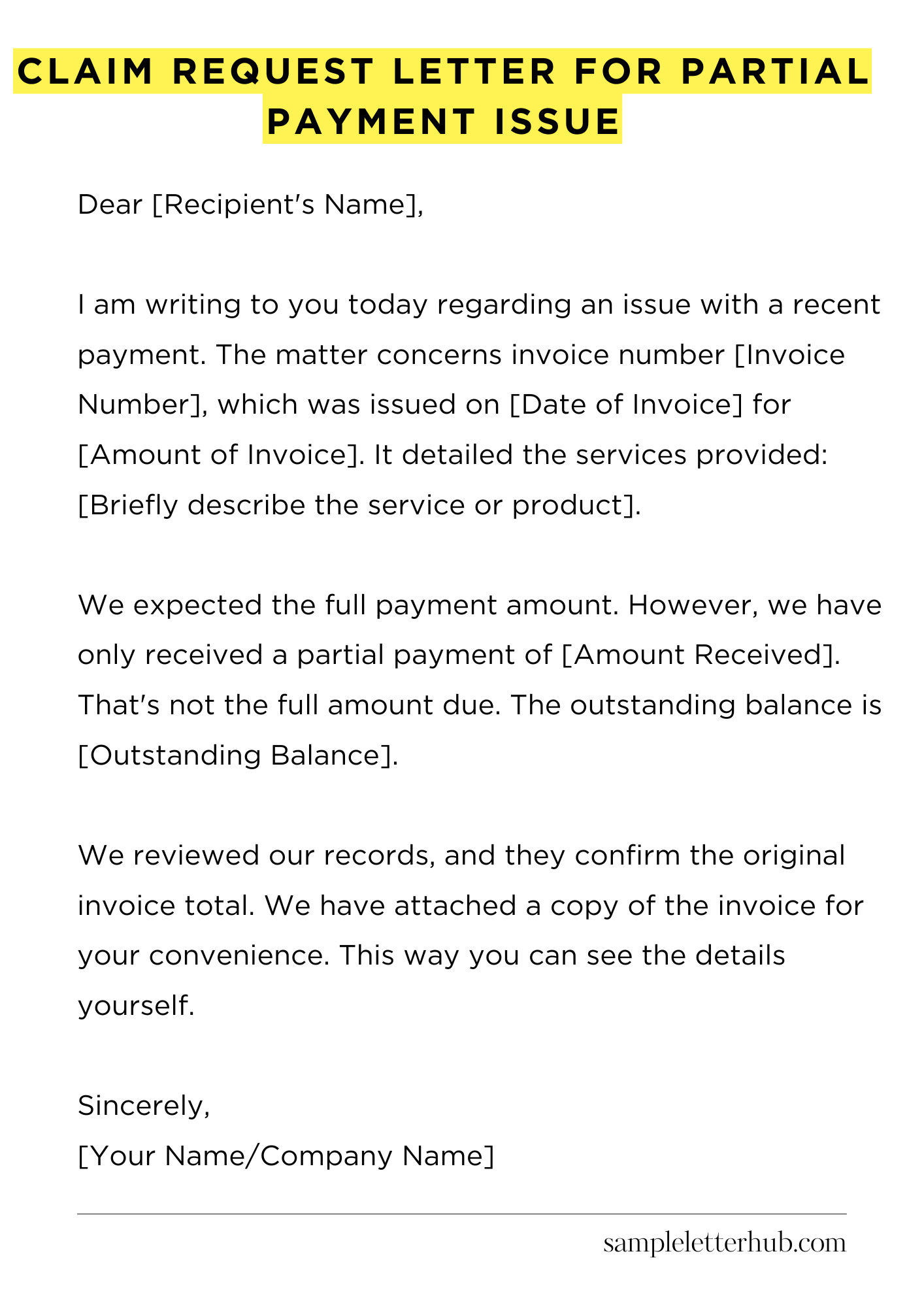
Dear [Recipient’s Name],
I am writing to you today regarding an issue with a recent payment. The matter concerns invoice number [Invoice Number], which was issued on [Date of Invoice] for [Amount of Invoice]. It detailed the services provided: [Briefly describe the service or product].
We expected the full payment amount. However, we have only received a partial payment of [Amount Received]. That’s not the full amount due. The outstanding balance is [Outstanding Balance].
We reviewed our records, and they confirm the original invoice total. We have attached a copy of the invoice for your convenience. This way you can see the details yourself. We believe the remaining amount is still outstanding and should be paid.
We would appreciate it if you could investigate this matter further. Please let us know if there was a reason for the partial payment. We would also like to understand when we can expect the remaining balance. Prompt resolution of this issue is important.
We value your business and hope to resolve this quickly. Please feel free to contact us if you require any clarification or have further questions. We look forward to hearing from you soon regarding this.
Sincerely,
[Your Name/Company Name]
How to Write Claim Request Letter for Partial Payment Issue
Receiving incomplete remuneration for services rendered or goods delivered can be incredibly frustrating. It is crucial to address these discrepancies promptly and professionally. A well-crafted claim request letter is your first line of defense. Here’s a structured approach to navigate this process efficiently.
1. Initiate with Decorum: The Salutation and Recipient
Commence your missive with a formal salutation. Employ “Dear [Recipient’s Name]” if you know it, otherwise, use “Dear Sir/Madam.” Always address the letter to the appropriate individual or department. Remember, a courteous tone sets the stage for a more receptive response.
Ensure the recipient’s information, including title and contact details, is accurate to avoid any misdirection.
2. The Premise: Explicitly State Your Purpose
Immediately declare the intent of your communication. Clearly state that you are writing to claim the outstanding balance owed to you. Be forthright, mentioning the specific invoice number, date, and amount.
Concisely articulate the reason for the claim, namely the partial payment. Brevity is the soul of wit; get to the point without verbose pronouncements.
3. Data-Driven Justification: Providing Substantiating Documentation
This is where you marshal your evidence. Thoroughly document the claim by listing all relevant details. Attach copies of the invoice, contract, and any other pertinent correspondence that substantiates your claim.
This may include proof of delivery, work completion reports, or agreements related to the financial transaction. Meticulously detailing all these facets will help your case.
4. Analyze the Debacle: Explain the Discrepancy
Provide a clear and concise explanation of the discrepancy between the agreed-upon payment and the partial payment received. Detail what services were rendered or the goods supplied.
Clearly state the original amount due, the amount paid, and the outstanding balance. Be specific, providing dates, quantities, and any other relevant contextual information that illustrates why the full payment is owed.
5. The Imperative: State Your Demand and Expectations
Explicitly state the action you expect the recipient to take. Demand payment of the outstanding balance within a specified timeframe. This should be a reasonable time frame, usually between 7 to 14 days, dependent on the nature of the issue and payment terms.
This also acts as a notice of intent to escalate further if the issue is not resolved. Provide instructions on how to remit the payment. Include banking details or other preferred payment methods.
6. The Concluding Admonition: Professional Closing and Follow-up
Conclude the letter with a professional closing. Use phrases like “Sincerely,” “Respectfully,” or “Yours faithfully” (if you began with “Dear Sir/Madam”). Reiterate your contact information for any clarifications.
State your intention to follow up if you do not receive a response within the stipulated timeframe. This conveys a sense of seriousness and reinforces the importance of your claim.
7. Final Review and Disbursement: Proofreading and Dispatch
Before submitting, meticulously proofread the entire letter. Check for grammatical errors, spelling mistakes, and factual inaccuracies. Ensure all attachments are included and legible.
Consider sending the letter via certified mail or another method that provides proof of delivery. This is a critical step in preserving your legal rights. Keep a copy of the sent letter and all supporting documentation for your records; these will be crucial in case of any future disputes.
FAQs about Claim Request Letter for Partial Payment Issue
What is a claim request letter for a partial payment issue, and when is it necessary?
A claim request letter for a partial payment issue is a formal document used to request the remaining balance owed for goods or services when only a portion of the agreed-upon payment has been received.
This letter is necessary when there’s a discrepancy between the invoiced amount and the amount actually paid, often due to disagreements about the quality of work, the completion of services, or interpretations of the original agreement. It’s a key step in resolving payment disputes and can lay the groundwork for legal action if needed.
What key information should I include in a claim request letter for a partial payment issue?
Your claim request letter should include: your contact information, the date, the recipient’s contact information, a clear statement of the partial payment issue, a detailed description of the goods or services provided, the original invoice number and date, the total amount due, the amount already paid.
How do I write a compelling claim request letter that increases the chances of getting paid?
To write a compelling letter, be polite but firm. Clearly state the facts without emotional language. Use precise language and be professional in tone.
Back up your claims with supporting evidence such as copies of invoices, contracts, and any proof of completed work or delivery. Set a reasonable deadline for payment and include your payment instructions. Finally, make sure the letter is well-organized, easy to read, and free of grammatical errors.
What are the potential consequences of not sending a claim request letter?
Failing to send a claim request letter can lead to several negative consequences. You might miss the opportunity to have the client pay the remaining balance voluntarily. It can weaken your legal position if you later need to pursue legal action, as it may appear you did not actively attempt to resolve the issue.
Further, not sending a claim request letter could cause the loss of funds due and damage your business relationship with the client. Therefore, it is important to send a claim request letter so the client is aware of the situation.
Can a claim request letter for partial payment be used to avoid legal action?
Yes, a well-written claim request letter can often resolve the issue without resorting to legal action. It opens the lines of communication with the debtor and provides an opportunity for them to understand the nature of the issue and reconsider their decision.
The letter can facilitate a discussion, negotiation, and hopefully, a resolution, and if the client understands the seriousness of the issue they may be more likely to pay. Ultimately, this can save both parties time, money, and stress associated with litigation.
Related:
Resignation letter due to rude boss
Resignation letter moving to another state
Resignation letter due to illness of family member
Resignation letter due to study