

Ever been charged too much on a bill? It happens! A claim request letter for an overcharged bill is your formal way of disputing the incorrect amount. Its purpose? To demand a correction and get your money back. This letter is your first step in resolving the issue. It’s important to document everything.
We understand writing these letters can be tricky. That’s why we’re here to help! We’ve prepared several claim request letter templates. These samples will cover various scenarios. They are designed to make it super easy for you to craft your own overcharged bill dispute.
Need a template for a phone bill overcharge? Maybe a utility bill dispute? Whatever the case, we’ve got you covered. These claim letter examples are ready to be customized. Get ready to reclaim your money!
[Your Name]
[Your Address]
[Your Phone Number]
[Your Email Address]
[Date]
[Name of Company]
[Company Address]
Subject: Claim Request for Overcharged Bill – Account Number [Your Account Number]
Dear [Name of Billing Department/Customer Service],
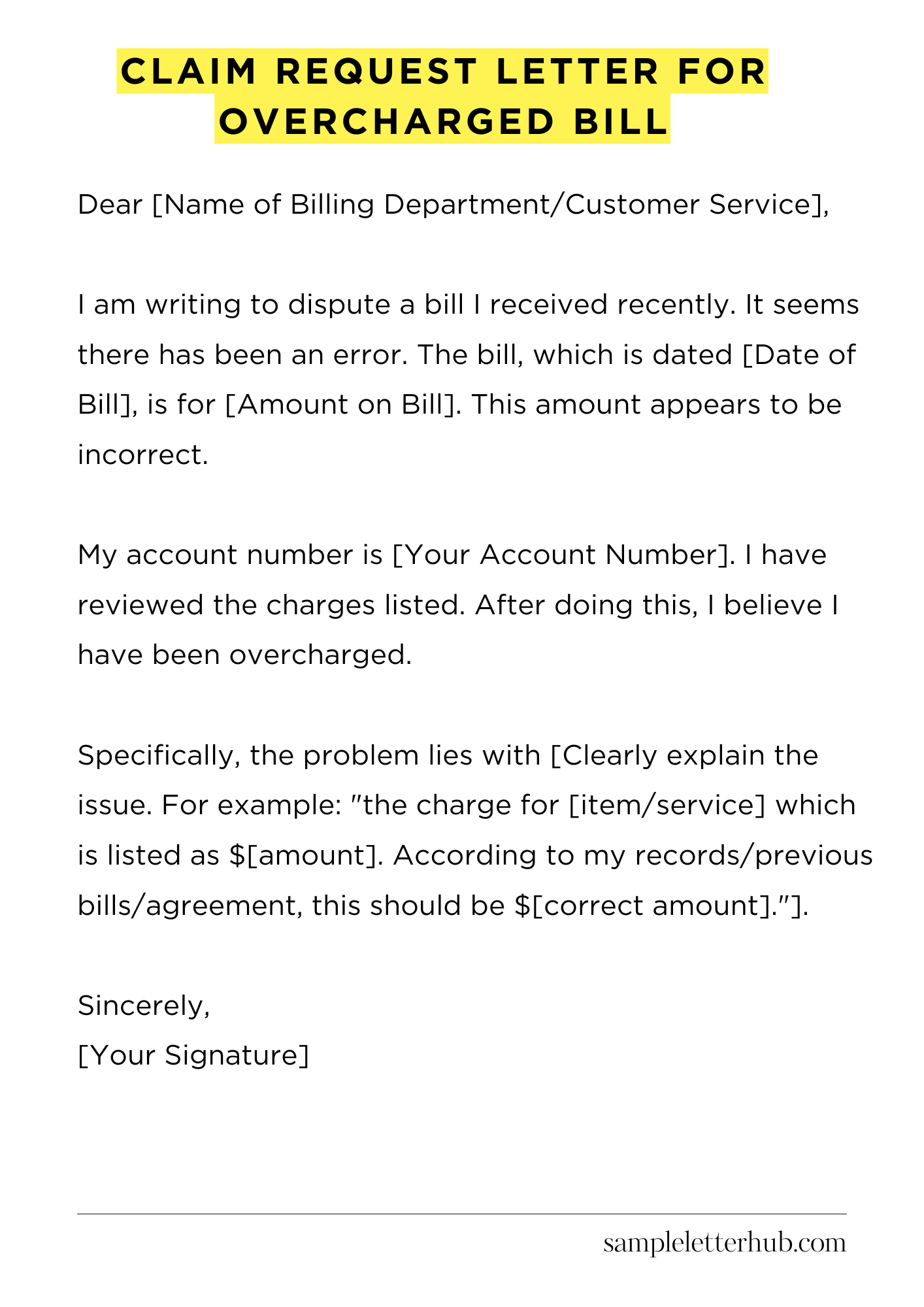
I am writing to dispute a bill I received recently. It seems there has been an error. The bill, which is dated [Date of Bill], is for [Amount on Bill]. This amount appears to be incorrect.
My account number is [Your Account Number]. I have reviewed the charges listed. After doing this, I believe I have been overcharged.
Specifically, the problem lies with [Clearly explain the issue. For example: “the charge for [item/service] which is listed as $[amount]. According to my records/previous bills/agreement, this should be $[correct amount].”].
I have attached [Mention what you are attaching, e.g., “a copy of my previous bill” or “supporting documentation showing the correct price”]. This should help you understand the situation better. I believe the overcharge amounts to [Calculate the overcharge amount].
I would appreciate it if you could investigate this matter promptly. Please correct my bill accordingly. I would like to receive a corrected bill as soon as possible.
I look forward to your response and a resolution to this issue within [Suggest a reasonable timeframe, e.g., “14 business days”]. You can reach me at the phone number or email address listed above if you need any further information from me. Thank you for your time and attention to this.
Sincerely,
[Your Signature]
How to Write Claim Request Letter for Overcharged Bill
1. Initiate Your Correspondence with Clarity
Commencing your letter is of utmost importance. Start with your full name, address, and contact information. Then, meticulously include the date.
Directly beneath this, provide the billing entity’s name and its relevant address. This structured approach ensures effortless identification and facilitates a smooth process. You want them to know precisely who you are and where to reach you.
2. The Salutation: A Formal Greeting
Employ a formal salutation to commence. A simple “Dear Sir/Madam” suffices, especially when you are unsure of the specific recipient. If a contact person is known, then utilize “Dear Mr./Ms. [Last Name]”. Avoid informal greetings at all costs. This establishes a professional tone from the outset.
3. Subject Line: Unveiling the Letter’s Purpose
Craft a succinct and compelling subject line. It should instantly communicate the intent of your missive. Examples include “Claim for Overcharged Bill – Account [Account Number]” or “Discrepancy in Billing Statement.” A clear subject line is critical. It aids in efficient handling and expedites a response.
4. The Body: Detailing the Contention
The body of your letter is where you articulate your claim. Open with a brief and unambiguous statement of your reason for writing. The subsequent sentences should provide the specifics of the overcharge.
Include the date of the bill, the amount, the original charges, and the inflated charge. Substantiate your claims with supporting documents; copies of previous bills, receipts, or any other pertinent documentation should be included as *exhibits*. The more you provide evidence, the stronger your case will be.
5. Supporting Evidence: Solidifying Your Argument
Attach all supporting documentation, as alluded to earlier. This could be any documentation that supports your claim. This is essential to underpin your assertions. Ensure each document is easily legible and clearly labeled. Failure to do so could weaken your position and possibly lead to a delayed resolution.
6. The Call to Action: Defining the Desired Outcome
Clearly state your desired outcome. Do you want a refund? A corrected bill? A detailed explanation of the charges? Specify the steps you expect the billing entity to take. Set a reasonable timeframe for a response, perhaps 14 to 30 days. This gives them a clear directive and provides an outline for you to follow up with.
7. Closing and Submission: Finalizing the Process
Conclude your letter professionally. “Sincerely,” or “Yours faithfully” are suitable choices. Always print your name and sign above your name. Keep a copy of the letter and all supporting documents for your records.
Consider sending the letter via certified mail with return receipt requested. This provides proof of delivery and acknowledgement, both safeguarding your interests. Following these steps diligently will increase your odds of a successful resolution.
FAQs about Claim Request Letter for Overcharged Bill
What is a claim request letter for an overcharged bill?
A claim request letter for an overcharged bill is a formal written communication sent to a service provider (e.g., utility company, phone company, internet provider) to dispute a bill you believe is incorrect. It outlines the specific reasons for the dispute, provides supporting evidence, and requests a correction or refund.
What information should I include in a claim request letter?
Your claim request letter should include: your account information (name, account number, service address), the billing period in question, a clear explanation of why you believe the bill is incorrect (e.g., incorrect usage, double billing, unauthorized charges), specific details about the error, any supporting documentation (e.g., meter readings, previous bills, photos).
What supporting documents should I attach to my claim request letter?
Supporting documents depend on the nature of the overcharge. Common examples include: copies of previous bills, meter readings, photos of the meter, any relevant contracts or agreements, records of your own usage or transactions, and any communication you’ve had with the service provider regarding the bill. Providing as much evidence as possible strengthens your claim.
How should I send a claim request letter for an overcharged bill?
It’s generally recommended to send your claim request letter via certified mail with return receipt requested.
This provides proof that the provider received the letter. You can also send a copy via email or through the provider’s online portal, if available, but ensure you keep records of these submissions. Always retain a copy of the letter and all supporting documentation for your records.
What should I do if the service provider doesn’t respond to my claim request letter?
If you don’t receive a response within the timeframe specified in their terms of service or a reasonable period (e.g., 30-60 days), follow up with the service provider, preferably in writing.
You can escalate the issue by contacting a customer service representative or supervisor, or you can consider filing a complaint with a relevant regulatory agency or consumer protection organization if the issue remains unresolved. Keep detailed records of all communication.
Related:
Resignation letter due to rude boss
Resignation letter moving to another state
Resignation letter due to illness of family member
Resignation letter due to study