


Dealing with damaged machinery can be a headache. A claim request letter for machinery damage is your official way to seek compensation. Its purpose? To formally inform the responsible party about the damage. You also outline the repair costs or replacement needs. This letter serves as your initial step in the machinery damage claim process.
Need help crafting the perfect letter? You’re in the right place. We’ll provide you with various claim request letter for machinery damage samples. These examples cover different scenarios. Whether it’s machinery damage from an accident, warranty claim for machinery damage, or insurance claim for machinery repair, we have you covered.
Our goal is to make it easy. We offer ready-to-use templates. You can adapt them to your specific situation. This way, you can clearly and effectively communicate the damage and your request. Get ready to streamline your claim process for damaged machinery!
[Your Name/Company Name]
[Your Address]
[Your Phone Number]
[Your Email Address]
[Date]
[Insurance Company Name]
[Insurance Company Address]
Subject: Claim Request for Machinery Damage – Policy Number [Your Policy Number]
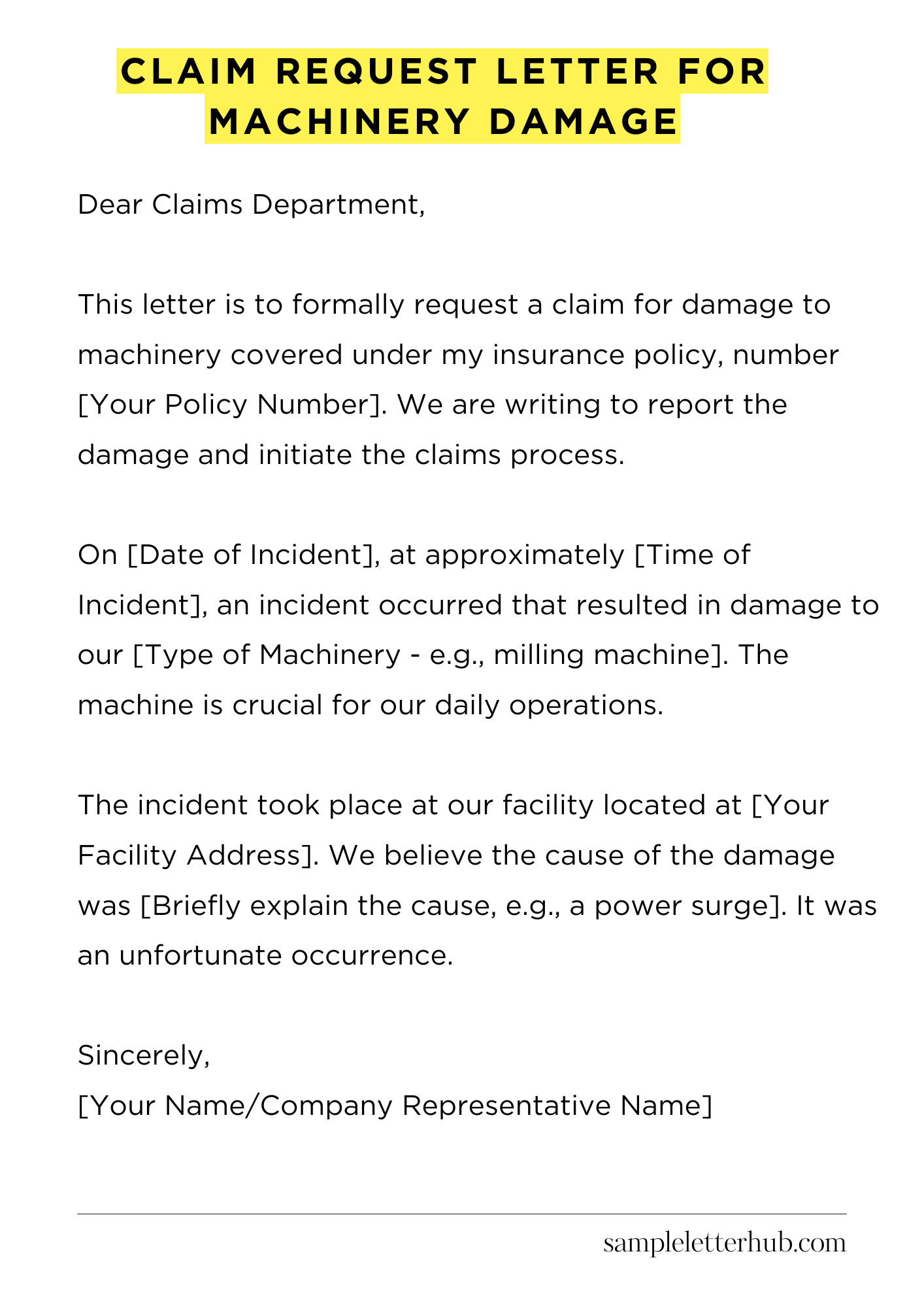
Dear Claims Department,
This letter is to formally request a claim for damage to machinery covered under my insurance policy, number [Your Policy Number]. We are writing to report the damage and initiate the claims process.
On [Date of Incident], at approximately [Time of Incident], an incident occurred that resulted in damage to our [Type of Machinery – e.g., milling machine]. The machine is crucial for our daily operations. The damage specifically involves [Detailed description of the damage – e.g., a broken spindle and associated internal components].
The incident took place at our facility located at [Your Facility Address]. We believe the cause of the damage was [Briefly explain the cause, e.g., a power surge]. It was an unfortunate occurrence.
We have already taken steps to secure the damaged machinery and prevent further harm. We also have pictures of the damaged parts. We would greatly appreciate it if you could send us a copy of the claim documents.
We are attaching the following supporting documentation to this letter: [List of attached documents – e.g., photographs of the damage, repair estimates, purchase invoice]. These documents provide further details. We hope these will help in your assessment.
We anticipate that this damage will result in significant downtime and operational disruptions. The machine is essential for our business. We are keen to get the machinery fixed as quickly as possible.
We would appreciate it if you could process this claim as quickly as possible. Please let us know what further information you require. We are available to answer any questions you may have. You can reach us at the phone number or email address provided above. Thank you for your time and attention to this matter. We look forward to hearing from you soon.
Sincerely,
[Your Name/Company Representative Name]
How to Write Claim Request Letter for Machinery Damage
Experiencing machinery damage can be a distressing ordeal. However, a well-crafted claim request letter is your first line of defense. It’s a formal declaration, meticulously detailing the incident and the requested compensation.
This document is a critical instrument in navigating the claims process and securing a favorable resolution. This guide will provide you with the essential steps to compose a compelling claim request letter.
1. Commence with a Formal Salutation and Identification
Begin by addressing the letter to the appropriate entity. This could be your insurance provider, the manufacturer, or the responsible party. Use their correct title and department. A formal salutation is non-negotiable.
“Dear Sir/Madam” is acceptable if the specific contact is unknown, but if possible, research and find the appropriate person. Include your full name, address, contact information, and policy or reference number. This initial segment establishes your identity and provides the recipient with crucial contextual details.
2. Provide a Concise Incident Summary
Immediately after your salutation, furnish a succinct account of the incident. Avoid unnecessary embellishment or conjecture. Stick to the salient facts: what happened, when it occurred, and where the damage transpired.
Precision is paramount here; vagueness will only serve to undermine your credibility. The chronology should be presented clearly and logically. Every detail must be relevant.
3. Describe the Machinery Damage in Detail
This section demands thoroughness. Expound upon the nature and extent of the damage. Be meticulous in your observations. Indicate the specific components affected, the observed malfunctions, and any evidence you have collected. Accompany your description with supporting evidence.
This could include photographs, videos, or any other tangible artifacts. The more comprehensive your description, the stronger your case will be.
4. Enumerate the Financial Repercussions
Transparency regarding the financial implications of the damage is paramount. Itemize all costs associated with the incident. This should encompass repair expenses, replacement costs, potential loss of income due to downtime, and any other pertinent monetary burdens.
Present these costs with supporting documentation, such as invoices, estimates, and receipts. Ensure all figures are accurate and clearly delineated. Remember, substantiation is key.
5. State Your Claim and Desired Remedy
Clearly articulate your claim. Specify the compensation you are seeking. This could be in the form of repairs, replacement, or monetary remuneration. Be specific and unambiguous in your request. State the desired timeframe for resolution, if applicable. A well-defined claim leaves no room for ambiguity. Avoid any ambiguity.
6. Include Supporting Documentation
Your letter is only as strong as the evidence that supports it. Append all pertinent documentation to your letter. This includes, but is not limited to: photographs of the damage, repair estimates, purchase receipts, maintenance records, and any relevant warranties.
Properly cited documents lend gravitas to your claims and reinforce their validity. This section is extremely critical for proving your claim.
7. Conclude with a Professional Closing
Conclude your letter with a professional closing. Expressions such as “Sincerely” or “Respectfully” are perfectly acceptable. Reiterate your contact information.
Express your willingness to cooperate further and provide any additional information required. A concise and courteous closing leaves a lasting impression. Do not forget to sign the letter to acknowledge its authenticity.
FAQs about Claim Request Letter for Machinery Damage
What information should be included in a claim request letter for machinery damage?
A claim request letter for machinery damage should include: the date of the incident, a clear description of the damaged machinery, a detailed account of how the damage occurred, the estimated or actual repair costs (supported by quotes or invoices), the policy number, contact information, and any supporting documentation such as photographs, videos, or police reports.
It should also clearly state the request for compensation.
Who should I send the claim request letter to?
The claim request letter should be sent to the insurance provider or the party responsible for the damage. Ensure you address the letter to the appropriate department or individual within the insurance company, such as the claims department, and include the correct mailing address or email address as specified in your insurance policy or contract.
What supporting documents are typically required with a claim request?
Supporting documents usually include photographs or videos of the damage, repair estimates or invoices, proof of ownership (e.g., purchase receipts, maintenance records), a police report if applicable, and any witness statements. Providing thorough documentation strengthens the claim and helps expedite the process.
What is the typical timeframe for filing a claim request letter?
The timeframe for filing a claim request letter varies based on the insurance policy or contract terms. Generally, it’s crucial to file the claim as soon as possible after the damage occurs. Review your policy for specific deadlines, as failure to adhere to these deadlines may result in claim denial. If no deadline is specified, filing within a reasonable time frame is advisable.
What should I do if my claim is denied?
If your claim is denied, carefully review the denial letter to understand the reason for the denial. Contact your insurance provider for clarification, and if you believe the denial is incorrect, gather additional supporting documentation to appeal the decision.
You may need to follow the appeals process outlined in your policy, which might involve a written appeal and, potentially, further negotiation or legal action.
Related:
Resignation letter due to rude boss
Resignation letter moving to another state
Resignation letter due to illness of family member
Resignation letter due to study