

Dealing with the loss of livestock is tough. A “Claim Request Letter for Livestock Insurance Claim” helps get things sorted. This letter officially requests financial help from your insurance company. It’s the first step in getting compensated for your loss.
Writing this letter can feel daunting. But don’t worry! We’ve got you covered. We’re providing claim request letter samples and templates. These examples make writing your own letter easier. You can easily create your own livestock claim request with these.
We aim to simplify the process. Use these livestock insurance claim letter templates. Claim request letter examples are here to help. Get the livestock insurance claim you deserve. Write your letter fast.
[Your Name/Company Name]
[Your Address]
[Your Phone Number]
[Your Email Address]
[Date]
[Insurance Company Name]
[Insurance Company Address]
Subject: Livestock Insurance Claim – [Policy Number]
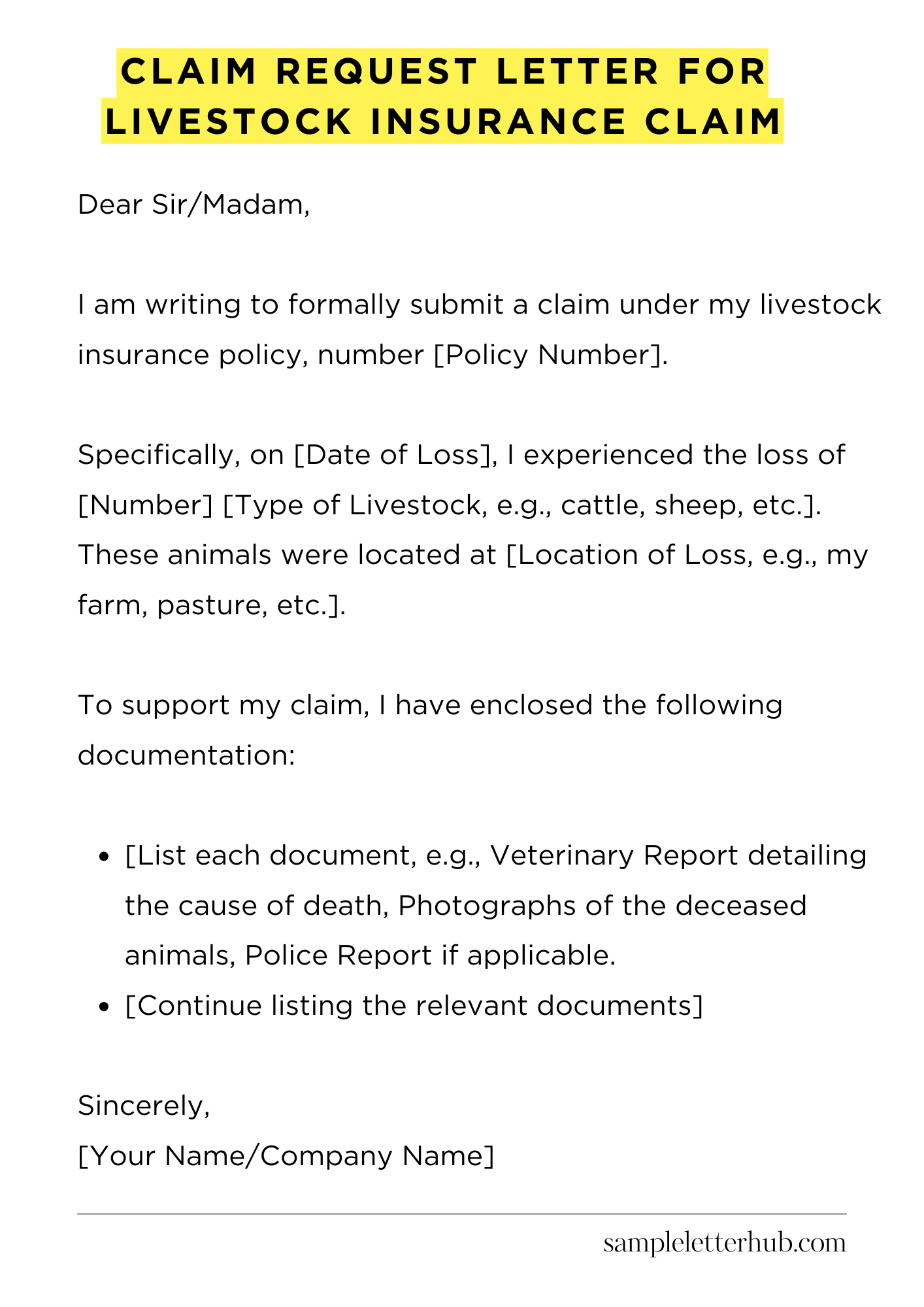
Dear Sir/Madam,
I am writing to formally submit a claim under my livestock insurance policy, number [Policy Number]. This policy covers my livestock against various perils. I believe the unfortunate event that transpired falls within the policy’s coverage.
Specifically, on [Date of Loss], I experienced the loss of [Number] [Type of Livestock, e.g., cattle, sheep, etc.]. These animals were located at [Location of Loss, e.g., my farm, pasture, etc.]. The loss occurred as a result of [Briefly explain the cause of loss, e.g., a lightning strike, a sudden illness, etc.]. It was a devastating moment.
To support my claim, I have enclosed the following documentation:
- [List each document, e.g., Veterinary Report detailing the cause of death, Photographs of the deceased animals, Police Report if applicable, Purchase Records for the animals]
- [Continue listing the relevant documents]
These documents should provide further clarification on the situation.
I kindly request that you review my claim and process it as quickly as possible. I understand that the process takes time, however, I would appreciate a prompt response.
Please let me know if you require any additional information or have any questions. I am happy to provide further clarification if needed. You can reach me at the phone number or email address provided above.
Thank you for your time and attention to this important matter.
Sincerely,
[Your Name/Company Name]
How to Write Claim Request Letter for Livestock Insurance Claim
A livestock insurance claim letter is a crucial document when you need to recover losses from insured animals. This process, while seemingly straightforward, requires meticulous attention to detail to ensure a successful outcome. Here’s a pragmatic guide to help you navigate the intricacies of crafting a compelling claim request.
1. Identifying the Insurer and Policy Details
The foremost step is to pinpoint the exact insurance provider and your specific policy particulars. This is where you lay the bedrock for your missive.
Scrutinize your insurance documentation for the insurer’s official address, policy number, and any dedicated claim submission points. Accuracy is paramount; a misdirected letter can lead to unfortunate delays. Always have this information at your disposal.
2. Composing the Salutation and Introductory Paragraph
Commence your letter with a formal salutation. Employ “Dear [Insurance Company Name] Claims Department” or, if a specific contact is known, “Dear Mr./Ms. [Last Name]”.
The introductory paragraph should unequivocally state the purpose of your letter: to file a claim. Concisely mention the policy number and the nature of the loss. Be direct and avoid circumlocution; clarity is key.
3. Detailing the Loss Incident
This section demands precision and a comprehensive account of events. Begin by specifying the date and time of the incident that resulted in the animal’s demise or other covered loss.
Furnish a lucid description of what transpired. Explain the circumstances, including any contributing factors. Be certain to include the breed, age, and any identifying marks of the affected livestock. Supporting documentation is essential.
4. Providing Supporting Documentation and Evidence
This is where you fortify your claim with concrete evidence. Attach copies of all pertinent documents. This may encompass veterinary reports, post-mortem examinations, photographs of the animal and the scene, and any other evidence that bolsters your claim.
The more evidence you can provide, the stronger your position becomes. Remember, each piece of evidence buttresses your case. Consider organizing documents logically.
5. Specifying the Claim Amount and Desired Action
Clearly state the amount you are claiming, itemizing any individual losses. This includes the animal’s monetary worth (as per the policy terms), any related veterinary expenses, and potentially, loss of income from the animal.
After laying the financials, specify the action you wish the insurance company to take; typically, this is a request for claim settlement. Present your demands clearly.
6. Concluding the Letter and Ensuring Professionalism
Conclude your letter with a polite and professional closing, such as “Sincerely” or “Respectfully”. Reiterate your contact information, including your full name, address, phone number, and email address.
Proofread the entire letter meticulously for any typographical errors or grammatical blunders. This final check is crucial; accuracy demonstrates seriousness. Consider reviewing the letter several times to make sure everything is in place.
7. Submission and Follow-up
Once you’ve finalized your letter, dispatch it via certified mail with return receipt requested. This ensures that the insurer receives it and provides proof of delivery.
Keep a copy of the letter and all attached documents for your records. If you haven’t received a response within a reasonable timeframe (as defined by your policy), follow up with the insurance company by phone or email. Persistent follow-up can occasionally expedite the process and ensures your claim does not languish.
FAQs about Claim Request Letter for Livestock Insurance Claim
What information should I include in the claim request letter for my livestock insurance claim?
Your claim request letter should include: your policy number, the date of the loss (death, injury, etc.), a detailed description of the event that caused the loss, the type and number of livestock affected, the estimated value of the loss, supporting documentation (e.g., veterinary reports, death certificates, purchase records).
It’s crucial to be as accurate and thorough as possible to expedite the claims process.
What supporting documents are typically required when submitting a livestock insurance claim?
Commonly required supporting documents include: veterinary reports detailing the illness, injury, or cause of death, death certificates for deceased animals, proof of ownership (e.g., registration papers, purchase receipts), photographs or videos of the affected livestock, any relevant police reports if applicable, and any previous medical records.
The specific documents needed can vary depending on your insurance policy and the nature of the loss.
How do I determine the actual cash value or market value of my livestock for the claim?
The actual cash value (ACV) or market value of your livestock is often determined by the insurance company based on factors such as the animal’s age, breed, health, and market conditions at the time of the loss.
Review your insurance policy to understand how the value is calculated. You may need to provide documentation, such as appraisals or sales records, to support your claim. In some cases, the policy may specify a predetermined value for certain types of livestock.
What is the typical timeframe for processing a livestock insurance claim?
The timeframe for processing a livestock insurance claim can vary depending on the insurance company, the complexity of the claim, and the completeness of the documentation provided.
Generally, it can take anywhere from a few weeks to several months. Factors that can impact the processing time include the need for investigation, verification of the loss, and the volume of claims the insurer is handling. Inquire with your insurance provider for an estimated timeframe.
How can I ensure my claim request letter is effective and increases the likelihood of a successful claim?
To enhance the effectiveness of your claim request letter, be clear, concise, and provide all necessary information in an organized manner. Use a professional tone, and ensure your letter is easy to read. Attach all supporting documentation to your letter or submit it electronically as requested by your insurance provider.
Keeping a copy of the letter and all supporting documents is also advisable. Following up with the insurance company to confirm receipt and check on the status of your claim can also be beneficial.
Related:
Resignation letter due to rude boss
Resignation letter moving to another state
Resignation letter due to illness of family member
Resignation letter due to study