

You’ve undergone medical treatment. Now, you need reimbursement. A Claim Request Letter for Health Treatment Reimbursement is the key. It’s a formal request. Its purpose is to get your money back. Your insurance company or employer processes it.
Writing this letter can feel daunting. Don’t worry, we’re here to help. This article provides Claim Request Letter samples. These examples simplify the process. Use them to craft your own Health Treatment Reimbursement letters.
We’ll share various letter templates. You can adapt them to your specific needs. From common scenarios to unique situations, we’ve got you covered. Get ready to easily claim your medical expense reimbursement!
[Your Name]
[Your Address]
[Your Phone Number]
[Your Email Address]
[Date]
[Insurance Company Name]
[Insurance Company Address]
Subject: Claim Request for Health Treatment Reimbursement
Dear [Insurance Company Representative Name, or “Claims Department”],
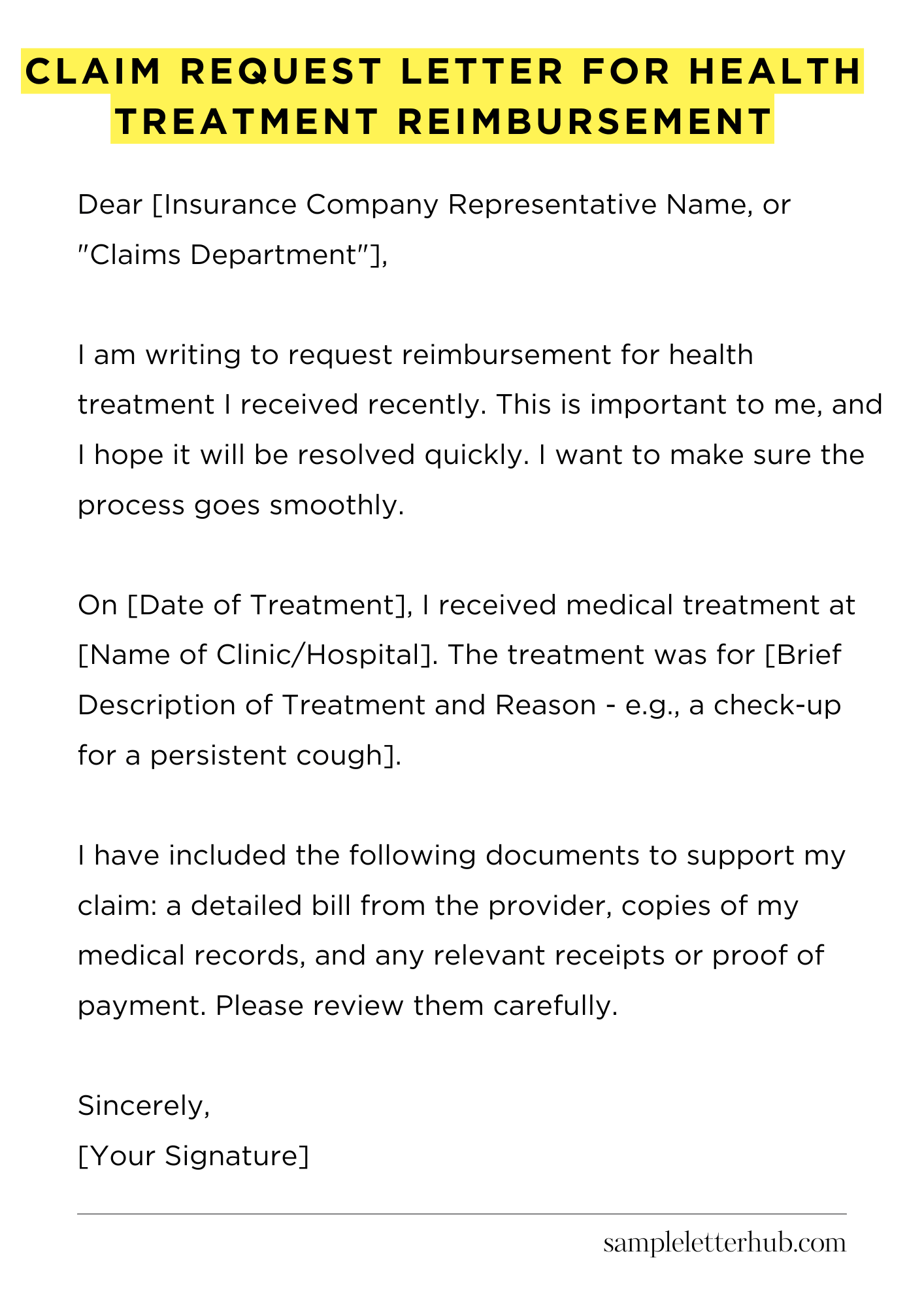
I am writing to request reimbursement for health treatment I received recently. This is important to me, and I hope it will be resolved quickly. I want to make sure the process goes smoothly.
On [Date of Treatment], I received medical treatment at [Name of Clinic/Hospital]. The treatment was for [Brief Description of Treatment and Reason – e.g., a check-up for a persistent cough]. The attached documents will show everything you need.
I have included the following documents to support my claim: a detailed bill from the provider, copies of my medical records, and any relevant receipts or proof of payment. Please review them carefully. These are all the necessary items for the processing of my claim.
My insurance policy number is [Your Policy Number]. I believe the treatment I received is covered under my policy. I have reviewed the policy details.
I would appreciate it if you could process my claim as soon as possible. Prompt processing is very much appreciated. Please let me know if you require any further information from me.
Thank you for your time and attention to this matter. I look forward to hearing from you soon regarding the status of my claim.
Sincerely,
[Your Signature]
How to Write Claim Request Letter for Health Treatment Reimbursement
1. Grasping the Preliminaries: Your Foundation
Before you even contemplate penning a single syllable, you must establish the *sine qua non* – the fundamental prerequisites. Determine the specific requirements stipulated by your insurance provider.
Delve into the fine print of your policy. Understand the stipulated timelines for submission; procrastination can be your nemesis. Verify the precise documentation needed.
Gather all the necessary paperwork, including medical bills, receipts, diagnostic reports, and any correspondence related to your medical treatment. This initial rigor sets the stage for a seamless reimbursement process.
2. The Salutation: A Formal Overture
Your letter should commence with a formal salutation. Employ a standard salutation such as “Dear Claims Department,” or if you have a specific contact person, “Dear Mr./Ms. [Last Name]”.
Avoid informal greetings, which might be perceived as unprofessional. Be certain that your salutation aligns with the insurance provider’s established protocols for clarity.
3. Subject Line: Clarity in a Nutshell
The subject line is your concise declaration. It serves as a telegraph of your intentions. Craft a succinct and explicit subject line. Examples include: “Claim for Medical Reimbursement – [Policy Number]” or “Request for Reimbursement – Treatment for [Medical Condition]”. A well-defined subject line accelerates the processing of your claim. This is a crucial element.
4. Body of the Letter: Articulating Your Plaint
The body of the letter is where you articulate your request. Begin with a clear statement of your intent: You are writing to request reimbursement for medical expenses. Provide a concise chronological account of the medical treatment.
Include the dates of service, the nature of the treatment received, and the names of the healthcare providers involved. Be precise and detail-oriented. State the total amount you are seeking to be reimbursed for.
Explicitly mention your policy number and any other identifying information required by your insurer. A disorganized letter can lead to the rejection of the claim.
5. Supporting Documentation: The Corroborative Evidence
This section outlines the essential documentation you are including. Explicitly list each document enclosed with your letter. This might include medical bills, detailed invoices, Explanation of Benefits (EOB) statements, and any relevant medical reports.
For instance: “Enclosed, please find: (1) Medical bill from [Provider Name], dated [Date]; (2) Diagnostic report from [Provider Name]; (3) Receipt for medication from [Pharmacy].” This level of detail ensures the claims department can readily verify your claim.
6. The Closure: Courteous Conclusion
Conclude your letter with a polite closing. Express your expectation for a prompt review and reimbursement. Include a sentence like: “I kindly request that you process my claim as expeditiously as possible.”
Provide your contact information, including your full name, address, phone number, and email address. Offer any further clarification or documentation if needed. A gracious closing leaves a positive impression.
7. Polishing and Submission: The Final Touches
Prior to dispatching your letter, meticulously proofread it for any typographical errors or grammatical lapses. Ensure all the information is accurate and complete. Make a copy of the letter and all the supporting documents for your records. Send the letter via certified mail with a return receipt requested.
This provides proof of delivery and ensures a paper trail. Keep a diligent record of your claim, including the date of submission and any subsequent correspondence. This thorough process will maximize the likelihood of a successful reimbursement.
Here are some frequently asked questions regarding claim request letters for health treatment reimbursement:
FAQs about Claim Request Letter for Health Treatment Reimbursement
What is a claim request letter for health treatment reimbursement, and why is it necessary?
A claim request letter for health treatment reimbursement is a formal document submitted to an insurance provider to request payment for medical expenses incurred.
It’s necessary because it provides the insurance company with the required information to process the claim, including details of the treatment, the associated costs, and supporting documentation. Without a proper request, reimbursement is unlikely.
What information should be included in a claim request letter?
A claim request letter should include the patient’s full name, policy number, and contact information. It must also include the date of service, detailed descriptions of medical services received, itemized bills or invoices, and any other relevant supporting documentation, such as medical reports or prescriptions. The letter should clearly state the reimbursement amount requested.
What supporting documents are typically required with a claim request letter?
Commonly required supporting documents include itemized bills from healthcare providers, which break down the charges for each service rendered. Also, receipts for payments made, medical reports or doctor’s notes, prescriptions, and any other documentation that supports the medical necessity of the treatment.
The specific requirements can vary depending on the insurance plan.
How should the claim request letter be submitted to the insurance provider?
The submission method depends on the insurance provider. Options typically include mail, online portals, or email. The letter should be sent to the address or through the channel specified by the insurance company. It’s essential to retain a copy of the letter and all supporting documents for your records, along with proof of submission, such as a tracking number if mailed.
What should be done if a claim is denied or the reimbursement amount is incorrect?
If a claim is denied or the reimbursement amount is incorrect, review the denial letter for the reason. Gather any additional supporting documentation that might address the insurer’s concerns.
Then, file an appeal within the timeframe specified by the insurance company. Clearly state the reasons for the appeal and provide any additional information to support your claim. Contact the insurance provider’s customer service for clarification and assistance if needed.
Related:
Resignation letter due to rude boss
Resignation letter moving to another state
Resignation letter due to illness of family member
Resignation letter due to study