


Ever had an insurance claim denied? It’s frustrating, right? A “Claim Request Letter for Denied Insurance Claim (Reconsideration)” is your official appeal. Its purpose is to ask the insurance company to review its decision. You’re basically saying, “Hey, take another look!” and providing additional information.
Feeling overwhelmed by the thought of writing such a letter? Don’t worry, we got you. This article is your guide. We will provide samples of “Claim Request Letters for Denied Insurance Claim (Reconsideration).” We are giving you the tools to write a strong appeal letter.
Think of it like this: We have the blueprints. You just need to follow the design. These templates will give you a head start. Get ready to write a letter that gets results. Let’s make this easier, and you’ll soon be able to write the best *claim request letter for denied insurance claim (reconsideration).*
[Your Name]
[Your Address]
[Your Phone Number]
[Your Email Address]
[Date]
[Insurance Company Name]
[Insurance Company Address]
Subject: Claim Reconsideration Request – Policy Number [Your Policy Number] – Claim Number [Your Claim Number]
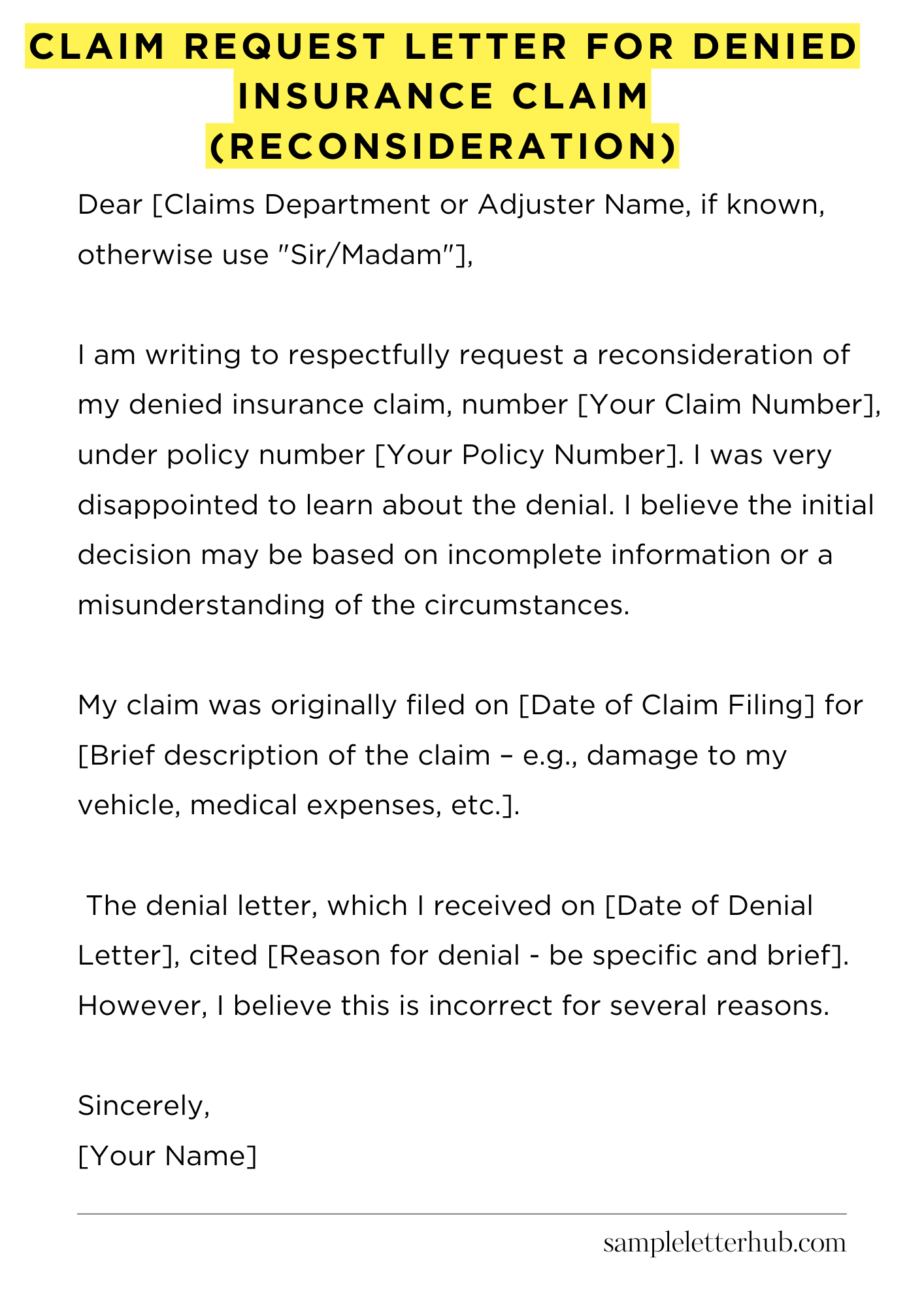
Dear [Claims Department or Adjuster Name, if known, otherwise use “Sir/Madam”],
I am writing to respectfully request a reconsideration of my denied insurance claim, number [Your Claim Number], under policy number [Your Policy Number]. I was very disappointed to learn about the denial. I believe the initial decision may be based on incomplete information or a misunderstanding of the circumstances.
My claim was originally filed on [Date of Claim Filing] for [Brief description of the claim – e.g., damage to my vehicle, medical expenses, etc.]. The denial letter, which I received on [Date of Denial Letter], cited [Reason for denial – be specific and brief]. However, I believe this is incorrect for several reasons.
Firstly, [Explain your first reason for disagreement, using clear and concise language. Support it with facts or evidence. Keep this short]. For example, the denial stated the damage was pre-existing, but the incident happened on [Date of incident]. Secondly, [Explain your second reason for disagreement.
Provide further clarity and proof if necessary. Use details]. I have also attached [List any documents you are including – e.g., repair estimates, medical records, police report]. The attached documents further support my claim. They clearly show [Brief explanation of what the documents prove].
I understand that insurance claims can be complex, and I appreciate the time and effort your team puts into reviewing them. I hope you will give my claim another look. It is important to me, and I would appreciate a positive outcome. I am available to provide any further information or documentation that you may require.
Thank you very much for your time and attention to this matter. I eagerly await your response and a resolution to this issue.
Sincerely,
[Your Name]
How to Write Claim Request Letter for Denied Insurance Claim (Reconsideration)
A denied insurance claim can be a frustrating experience. It is important to know that you are not powerless. You have the right to request a reconsideration. Crafting a persuasive and meticulously formatted claim request letter is your potent weapon in this scenario. Let’s delve into the crucial steps to compose a compelling appeal.
1. Commence with Precise Identification
Your letter must commence with unambiguous identification. Begin with your full legal name, address, phone number, and policy number.
This initial segment establishes your identity and provides the insurer with vital information for retrieval of your records. Then, include the date of the letter and the recipient’s name, title, and address. Make it easily accessible for them.
2. Clearly State the Purpose of Your Correspondence
The opening paragraph should clearly delineate the letter’s purpose: to appeal the denial of your insurance claim. Explicitly reference the claim number, date of the denial letter, and the specific service or item that was denied.
This instant declaration saves the reader time, providing the context they need to fully grasp the information being presented. State your intentions clearly.
3. Substantiate Your Claim with Concrete Evidence
This is where your case truly solidifies. Construct a powerful argument supporting your claim by providing compelling evidence. Include any documentation supporting your claim.
Medical records, receipts, photographs, expert opinions, and any relevant correspondence should be meticulously compiled and included as attachments or referenced within the body of your letter. Ensure the evidence directly contradicts the insurer’s rationale for denial.
4. Analyze the Denial Reason and Counter with Persuasion
Carefully analyze the denial letter. Identify the reasons provided for the denial. Then, in a new section, directly address each reason and offer a counter-argument backed by your evidence.
If the denial cites a specific policy exclusion, demonstrate how your situation does not fall within that exclusion. If the denial cites lack of medical necessity, provide documentation to prove otherwise. Be logical and convincing in your arguments. Use persuasive language throughout the appeal.
5. Cite Policy Provisions and Relevant Statutes
To bolster your argument, familiarize yourself with your insurance policy. Scrutinize the language of your policy regarding the specific type of service or item.
Quote relevant clauses that support your claim. Additionally, you may cite any applicable state or federal laws and regulations that may strengthen your position. This demonstrates that you have gone above and beyond to prepare the appeal, bolstering your credibility.
6. Request Reconsideration and Set a Deadline
Reiterate your request for reconsideration in a clear and concise closing paragraph. Restate the specific claim you are appealing and emphasize your belief that it should be approved based on the evidence presented. It is judicious to request a specific response timeframe (e.g., within 30 days).
This establishes a sense of urgency and ensures that the insurer prioritizes your appeal. Provide all information to enable a seamless process.
7. Conclude with a Professional Closing and Contact Information
Conclude your letter with a professional closing, such as “Sincerely” or “Respectfully.” Sign the letter and print your full name below your signature. Provide your phone number and email address again for ease of contact. This ensures the insurer can easily reach you with any questions or clarifications.
FAQs about Claim Request Letter for Denied Insurance Claim (Reconsideration)
What is the primary purpose of a claim request letter for a denied insurance claim?
The primary purpose of a claim request letter, when dealing with a denied insurance claim, is to formally request the insurance provider to reconsider their initial decision.
This letter serves as a means to present additional information, clarify discrepancies, or provide further supporting documentation to justify the original claim. It aims to persuade the insurer to reverse their denial and provide the coverage initially sought.
What specific information should be included in a claim request letter for a denied claim?
A comprehensive claim request letter should include the following: the policyholder’s full name and policy number, the claim number, a clear explanation of the denial reason(s) provided by the insurer, a concise restatement of the original claim details, any new or additional supporting documentation (medical records, bills, etc.)
What types of documentation are typically needed to support a claim reconsideration?
The types of supporting documentation required vary based on the reason for the denial.
Common examples include: detailed medical records (physician notes, diagnostic reports), itemized bills and receipts, photographs, witness statements, copies of relevant policy provisions, and any documentation demonstrating compliance with policy requirements. The specific documents needed should directly address the insurer’s reason for denying the claim.
What are the key elements of a well-written reconsideration letter that increase its chances of success?
A successful reconsideration letter is characterized by: clarity, conciseness, and accuracy. It should be well-organized, with a clear introduction, body, and conclusion.
It should directly address the reasons for denial, referencing the specific language of the policy and the insurer’s explanation. It must be polite, yet assertive, and include all necessary supporting documentation. It’s often helpful to include a brief summary of the reasons why the claim should be approved.
What are the typical timeframes for submitting and receiving a response to a claim reconsideration request?
The timeframe for submitting a reconsideration request depends on the specific policy and state regulations. Typically, there’s a deadline, which should be included in the original denial letter.
The time frame for the insurer to respond also varies, but it’s usually between 30 to 60 days. It’s crucial to adhere to the submission deadlines and document all communications with the insurer, including the date of submission and any acknowledgement of receipt.
Related:
Resignation letter due to rude boss
Resignation letter moving to another state
Resignation letter due to illness of family member
Resignation letter due to study