

Ever received a package that looked like it went through a war zone? That’s where a claim request letter for damaged shipment comes in. It’s a formal way to notify the shipper about the damage. The goal is simple: get compensated for the damaged goods.
Dealing with damaged shipments can be frustrating. We get it! Writing the perfect claim letter can be tricky. Don’t worry!
We’ve got you covered. This article offers several claim request letter for damaged shipment samples. These templates will help you draft a clear and effective letter.
[Your Name/Company Name]
[Your Address]
[Your Phone Number]
[Your Email Address]
[Date]
[Shipping Company Name]
[Shipping Company Address]
Subject: Claim Request for Damaged Shipment – Tracking Number [Tracking Number]
Dear [Shipping Company Representative Name or “To Whom It May Concern”],
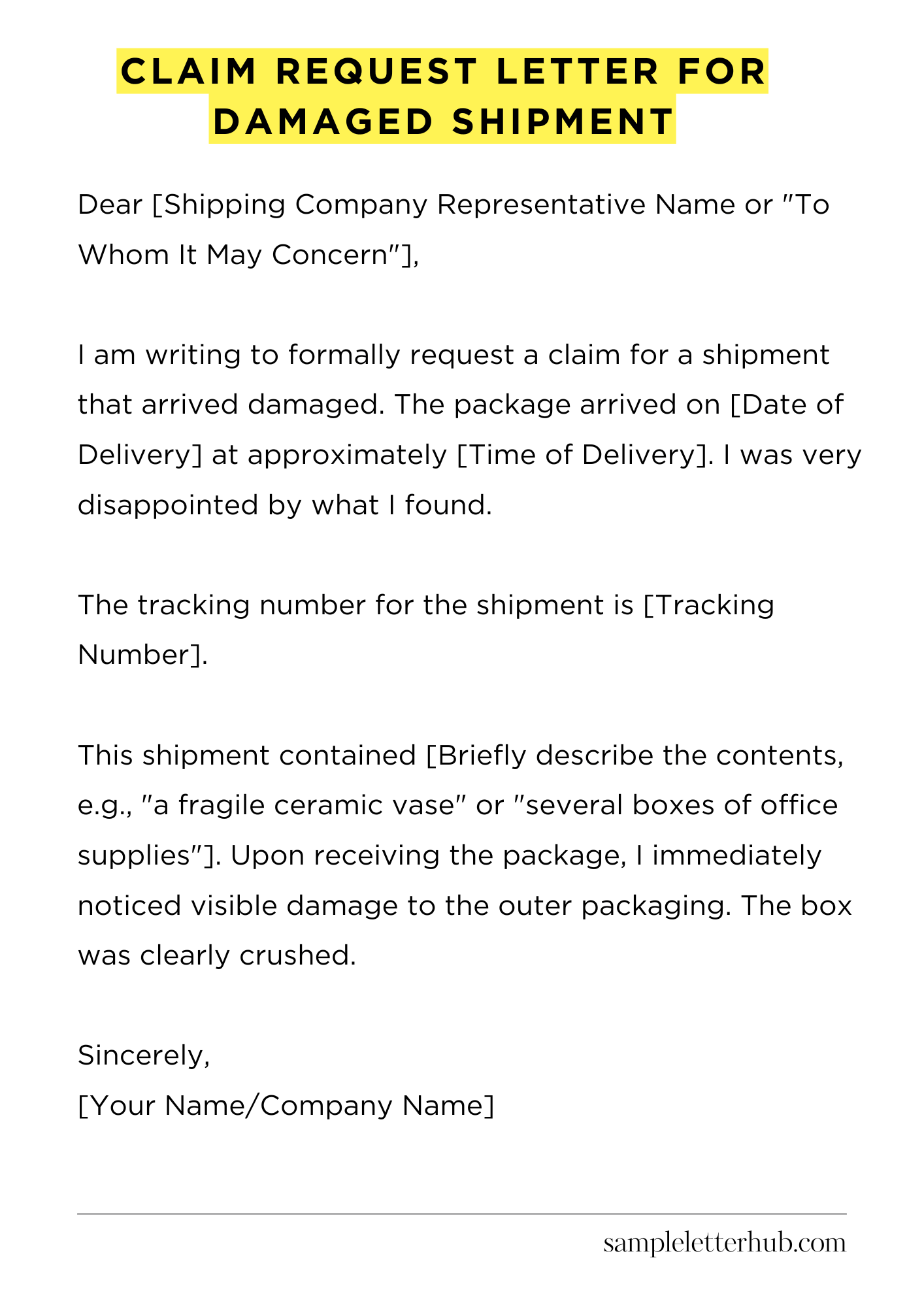
I am writing to formally request a claim for a shipment that arrived damaged. The package arrived on [Date of Delivery] at approximately [Time of Delivery]. I was very disappointed by what I found.
The tracking number for the shipment is [Tracking Number].
This shipment contained [Briefly describe the contents, e.g., “a fragile ceramic vase” or “several boxes of office supplies”]. Upon receiving the package, I immediately noticed visible damage to the outer packaging. The box was clearly crushed.
When I opened the package, I discovered that the contents were also damaged. [Clearly describe the damage to the items.
Be specific, e.g., “The vase was shattered,” or “The office supplies were water-damaged and unusable”]. This damage has rendered the items [State the impact of the damage, e.g., “unusable” or “unsaleable”]. I would appreciate the opportunity to have this matter resolved as soon as possible.
I have attached [Mention what you are attaching, e.g., “photographs” or “copies of the invoice”]. These attachments clearly demonstrate the extent of the damage. I hope the evidence provided helps to provide clear insight into the situation.
Please advise me on the necessary steps to file a claim and the documentation required. I would like to know about the process to get the items replaced, or the refund process, if available. I look forward to your prompt response and a resolution to this issue. Please contact me at your earliest convenience to discuss this further.
Thank you for your time and attention to this matter.
Sincerely,
[Your Name/Company Name]
How to Write Claim Request Letter for Damaged Shipment
Receiving a damaged shipment can be a genuinely frustrating experience. It disrupts your operations and can cause financial losses. Fortunately, a well-crafted claim request letter is your potent instrument to rectify the situation. Following these seven pivotal steps will significantly amplify your chances of a favorable resolution.
1. Identify the Culprit – Pinpointing the Responsible Party
Before putting pen to paper (or fingers to keyboard), you must definitively ascertain who is liable for the damage. Was it the carrier? The shipper? Your internal handling procedures?
Scrutinize the documentation, including the bill of lading, packing slips, and any photographic evidence you have. This initial reconnaissance is crucial; it determines who will ultimately receive your claim.
2. Gather Your Ammunition – Assembling Supporting Documentation
A compelling claim hinges on the strength of your evidence. Assemble every piece of supporting documentation you possess. This typically encompasses the bill of lading (proof of contract of carriage), the commercial invoice (detailing the value of the goods), packing lists (confirming the contents of the shipment).
3. Master the Salutation – Crafting the Initial Greeting
Your salutation sets the tone. Use a formal and professional greeting, such as “Dear [Recipient’s Name/Title],” or “To Whom It May Concern.” Clearly state the purpose of your letter in the opening sentence.
For example: “This letter constitutes a formal claim for the damage sustained to shipment tracking number [Tracking Number], received on [Date of Receipt].” This immediate transparency ensures the recipient understands the document’s import.
4. Paint the Picture – Describing the Damage Precisely
This is where you bring the situation to life. Provide a detailed, unambiguous description of the damage. Be specific. State what was damaged, the extent of the damage (broken, dented, crushed, etc.), and where the damage was located on the item. Avoid vague language.
For instance, instead of saying, “The box was damaged,” write, “The carton arrived with a large tear on the top right corner, exposing the contents.” Use precise descriptors; clarity is your ally.
5. Declare Your Demands – Specifying Your Desired Resolution
Clearly state what you seek as recompense for the damage. Are you requesting a full refund, a partial refund, a replacement of the damaged items, or perhaps repair of the goods?
Quantify your claim. If you’re seeking a monetary remedy, explicitly state the amount and how it was calculated. If a replacement is your preference, specify the replacement details. This forthrightness prevents ambiguity and facilitates a swift resolution.
6. Reinforce Your Position – Summarizing and Restating Your Key Arguments
Conclude your letter by succinctly summarizing your claim. Restate the key points: the tracking number, the nature of the damage, the supporting documentation provided, and your requested resolution.
Reiterate any deadlines or timeframes related to your claim. A strong concluding paragraph reiterates the urgency and ensures the recipient understands your unwavering commitment to a resolution.
7. Seal the Deal – Formal Closing and Contact Information
Use a professional closing such as “Sincerely,” “Respectfully,” or “Yours faithfully.” Beneath the closing, type your full name, title (if applicable), company name, address, phone number, and email address.
Providing complete contact information makes it exceedingly simple for the recipient to reply and initiate the process of damage redressal. Ensure a professional appearance by proofreading meticulously before dispatching the letter, lest a simple error undermine your otherwise flawless correspondence.
FAQs about Claim Request Letter for Damaged Shipment
What is a claim request letter for a damaged shipment, and why is it important?
A claim request letter for a damaged shipment is a formal document sent to the shipping company or seller to report damage to goods received during transit. It’s crucial because it officially documents the damage, initiates the claims process, and provides the necessary evidence to support your request for compensation, replacement, or repair of the damaged items.
What information should be included in a claim request letter for a damaged shipment?
A comprehensive claim request letter should include: your contact information, the shipper’s or seller’s details, the order or tracking number, a clear description of the damaged items, a detailed account of the damage (including photos if possible), the date of delivery.
How do I determine who to send the claim request letter to?
The recipient of the letter depends on the circumstances. If the damage is due to the carrier’s handling, send the letter to the shipping company (e.g., FedEx, UPS, USPS).
If the damage occurred before shipping or is covered under a seller’s warranty, you should send the letter to the seller or the company you purchased the product from.
What supporting documentation should I include with my claim request letter?
Supporting documentation significantly strengthens your claim. This includes: photos of the damaged items and packaging (both inside and out), the original invoice or proof of purchase, the packing slip (if available), the tracking information showing the delivery date, and any other relevant documentation that supports your claim such as an itemized list of damages and estimated repair costs.
What happens after I send a claim request letter for a damaged shipment?
After sending the letter, the shipping company or seller will typically acknowledge receipt and begin an investigation. This may involve requesting additional information, inspecting the damaged goods (potentially requiring you to retain them), and assessing the validity of your claim.
They will then notify you of their decision, which could result in a refund, replacement, repair, or denial of the claim. Keep all communication and documents for your records.
Related:
Resignation letter due to rude boss
Resignation letter moving to another state
Resignation letter due to illness of family member
Resignation letter due to study