

Dealing with crop damage can be devastating for farmers. A Claim Request Letter for Crop Damage Claim is a formal document. It is used to request compensation. The letter is sent to an insurance company or relevant authority. The goal is to receive financial assistance. This helps cover losses caused by damage to your crops.
Writing these letters can feel tricky. Don’t worry, you are not alone. We understand the challenges. This article provides Claim Request Letter for Crop Damage Claim templates. We will also include several samples and examples. They can guide you step-by-step. Use them to craft your own effective claim letters.
Our goal is to make it easy for you. The crop damage claim letter process can be made easier. You can modify these templates and samples. Use them to suit your specific situation. This guide will help you get started writing your letter quickly. We are confident we can help you with your crop damage claim.
[Your Name/Farm Name]
[Your Address]
[Your Phone Number]
[Your Email Address]
[Date]
[Insurance Company Name]
[Insurance Company Address]
Subject: Crop Damage Claim – [Policy Number]
Dear [Claims Adjuster Name or “Claims Department”],
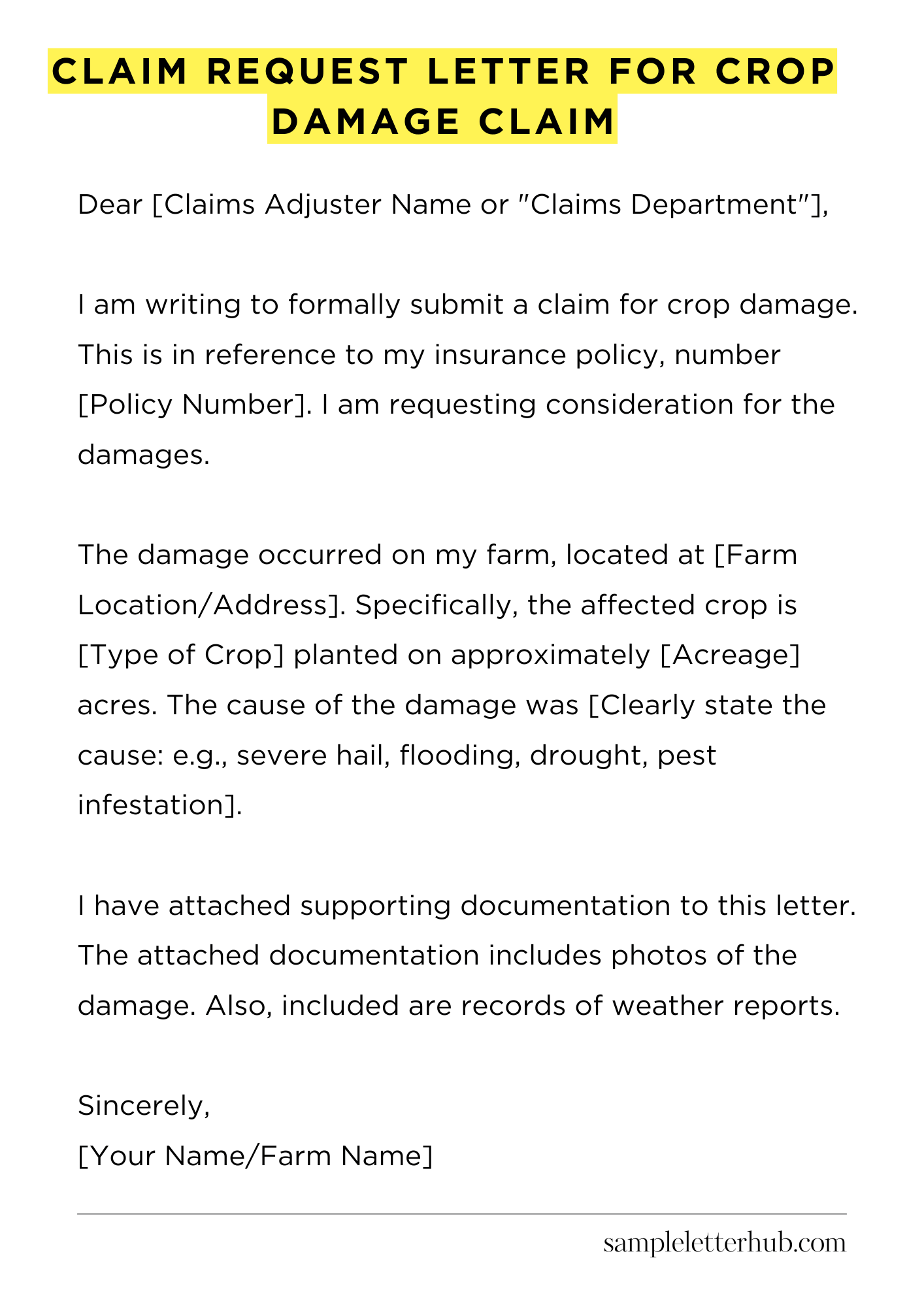
I am writing to formally submit a claim for crop damage. This is in reference to my insurance policy, number [Policy Number]. I am requesting consideration for the damages.
The damage occurred on my farm, located at [Farm Location/Address]. Specifically, the affected crop is [Type of Crop] planted on approximately [Acreage] acres. The cause of the damage was [Clearly state the cause: e.g., severe hail, flooding, drought, pest infestation]. This event took place between [Start Date] and [End Date]. Significant loss has been observed.
I have attached supporting documentation to this letter. The attached documentation includes photos of the damage. Also, included are records of weather reports. There is also information on the planting, harvest, and other relevant expenses associated with this crop.
The estimated loss, based on my assessment and the attached documentation, is [Dollar Amount]. I understand that a field inspection might be required. I would be happy to accommodate this inspection at your earliest convenience. Please contact me to schedule a suitable time.
I would appreciate it if you would process this claim as quickly as possible. The impact of this damage is considerable. Prompt attention to this matter is greatly appreciated.
Thank you for your time and consideration.
Sincerely,
[Your Name/Farm Name]
How to Write Claim Request Letter for Crop Damage Claim
Agricultural losses, whether due to pestilence or the vicissitudes of inclement weather, can be devastating. When your livelihood is threatened by crop damage, a well-crafted claim request letter is your first line of defense.
This communication is not merely a formality; it is a critical document that can influence the outcome of your claim. Let’s delve into the intricacies of composing a compelling and effective claim letter.
1. Identify the Addressee: The Initial Salutation
Your missive’s journey begins with identifying the appropriate recipient. Research your insurance policy or any governing regulations. Find out the correct name and title of the person you need to address this letter to.
This demonstrates professionalism. The salutation, such as “Dear Claims Adjuster” or “To Whom It May Concern,” sets the tone. Use it appropriately.
2. Subject Line: Clarity and Conciseness
The subject line is the beacon that guides the reader. It should immediately convey the purpose of your letter. A succinct subject line such as “Crop Damage Claim – [Your Policy Number]” or “Claim for Damages to [Specific Crop] due to [Cause]” ensures your communication is immediately understood. Accuracy is key; therefore, the subject line ensures your letter is prioritized.
3. Detailed Account: The Body of Your Argument
The body of your letter is where you build your case. Begin by clearly stating your policy number and the date of the damage. Provide a chronological narrative of the events leading to the crop damage.
Include specific dates, times, and locations of the damage. Describe the extent of the damage with as much detail as possible. Use descriptive language to paint a vivid picture of the impact on your crops.
4. Quantification: Substantiating Your Losses
Precise quantification is paramount. Document the type of crops affected and the acreage damaged. Offer an estimation of the pre-damage yield and the post-damage yield. Include any estimates of market value.
If available, annex pertinent supporting documentation, such as photographs, videos, and professional assessments. Include any receipts for mitigation efforts. The more information provided, the more weight your claim will hold.
5. Supporting Documentation: Strengthening Your Case
Robust documentation strengthens your claim considerably. Gather and include all relevant documents. This may include photographs, videos, weather reports, pesticide application records, and any assessments from agricultural experts.
Any documentation should be attached or referenced in the letter and listed. Organize this supporting information logically and ensure it is easily accessible for review.
6. The Formal Closing: Finalizing the Letter
The closing is your final opportunity to make an impression. Use a professional closing such as “Sincerely,” or “Respectfully,” followed by your full name and contact information. Be sure to include your phone number, email address, and mailing address.
It is also good to reiterate your policy number. Consider adding a sentence such as, “I look forward to your prompt response and resolution to this matter.”
7. Proofreading and Submission: The Final Iteration
Prior to submission, meticulously proofread your letter. Check for grammatical errors, spelling mistakes, and factual inaccuracies. Ensure that your language is clear, concise, and professional.
Once you are satisfied with the content and format, submit the letter according to the instructions provided by your insurance company. Keep a copy of the letter and all attached documentation for your records.
FAQs about Claim Request Letter for Crop Damage Claim
What is the primary purpose of a claim request letter for crop damage?
The primary purpose of a claim request letter for crop damage is to formally notify an insurance provider or responsible party about damage to crops, detail the extent of the damage, and request compensation for the financial losses incurred as a result of that damage. It serves as an official record of the incident and initiates the claims process.
What specific information needs to be included in a crop damage claim letter?
A comprehensive crop damage claim letter should include: the date of the damage, the location of the affected crops (including field identification), a detailed description of the damage (e.g., type of damage, affected acreage, severity), the cause of the damage (e.g., weather event, pest infestation).
What supporting documentation should be submitted with a crop damage claim letter?
Supporting documentation is crucial for validating a crop damage claim.
This typically includes: photographs or videos of the damage, weather reports or documentation of the causative event, crop yield records (before and after damage), receipts for expenses incurred due to the damage (e.g., replanting costs, pest control), and any relevant expert assessments or reports.
How should the financial losses be calculated and presented in the claim letter?
Financial losses should be calculated using a clear and transparent methodology. This typically involves estimating the difference between the expected yield and the actual yield after the damage.
Factors such as the market value of the crop, production costs, and any salvage value of the damaged crop should be considered. Present the calculations in a clear, itemized format, supported by relevant data and documentation.
What is the typical timeframe for submitting a crop damage claim letter and what should I do if the deadline is approaching?
The timeframe for submitting a claim letter varies depending on the insurance policy or contractual agreement. Generally, it’s crucial to submit the letter as soon as possible after the damage is discovered. If the deadline is approaching, review the policy or contract for the exact timeframe and submit the letter within that period.
If unsure or if more time is needed, contacting the insurer or responsible party immediately to request an extension is advisable and document all communication.
Related:
Resignation letter due to rude boss
Resignation letter moving to another state
Resignation letter due to illness of family member
Resignation letter due to study