

Navigating credit card insurance can feel tricky. A “Claim Request Letter for Credit Card Insurance Claim” is your key. It’s a formal document. Its purpose is to request your insurance company for a payout. This happens when you have an eligible credit card insurance claim.
Need to file a credit card insurance claim? We understand it can be overwhelming. We’re here to help! We’ll give you claim request letter templates. These are ready-to-use sample letters. You can customize them for your specific situation.
Think of these claim letter examples as your personal guides. They simplify the process. They make writing credit card claim letters a breeze. Save time and reduce stress with our easy-to-follow samples. Let’s get started on your claim request!
[Your Name/Company Name]
[Your Address]
[Your Phone Number]
[Your Email Address]
[Date]
[Credit Card Company Name]
[Credit Card Company Address]
Subject: Claim Request for Credit Card Insurance
Dear Sir/Madam,
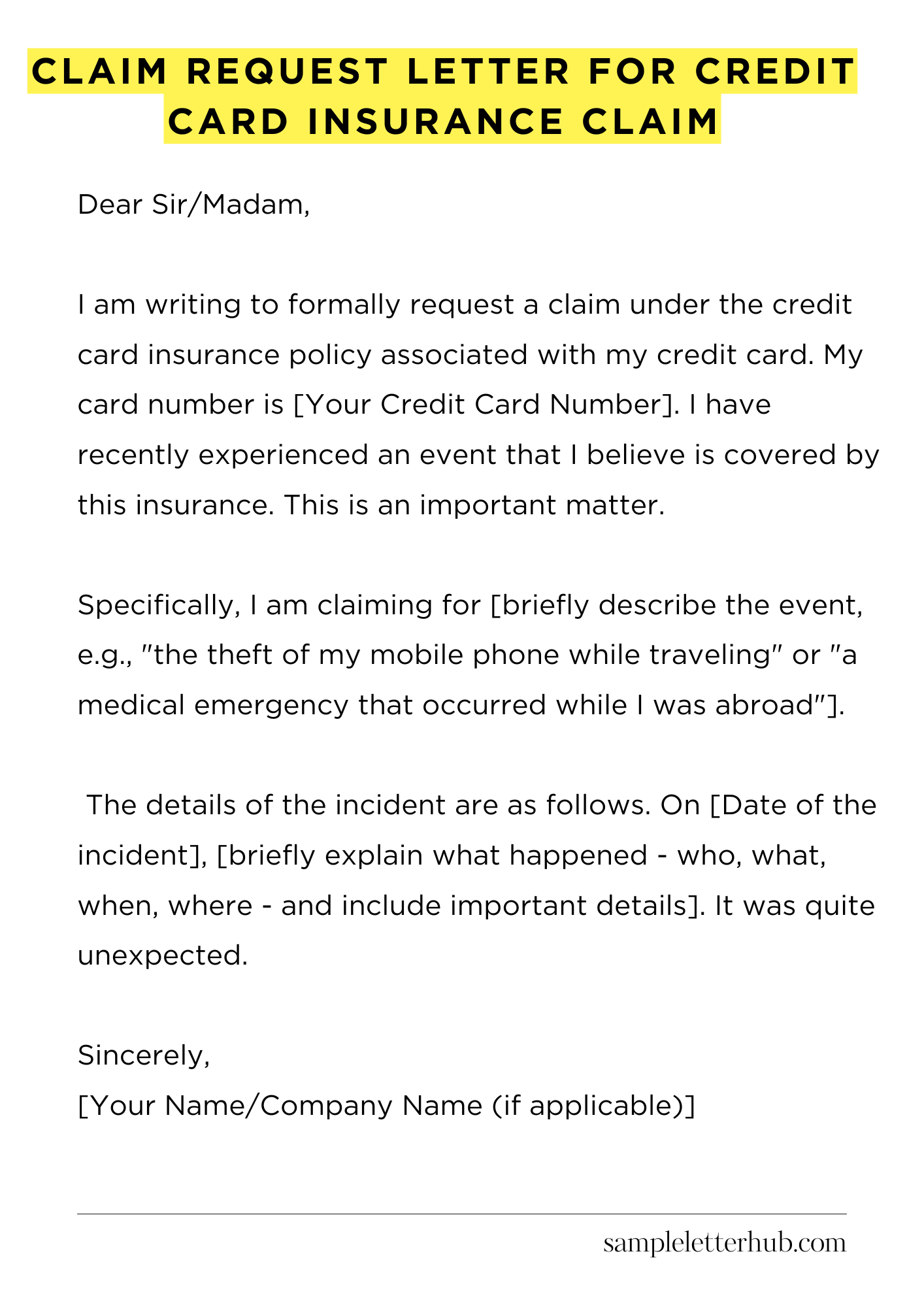
I am writing to formally request a claim under the credit card insurance policy associated with my credit card. My card number is [Your Credit Card Number]. I have recently experienced an event that I believe is covered by this insurance. This is an important matter.
Specifically, I am claiming for [briefly describe the event, e.g., “the theft of my mobile phone while traveling” or “a medical emergency that occurred while I was abroad”]. The details of the incident are as follows. On [Date of the incident], [briefly explain what happened – who, what, when, where – and include important details]. It was quite unexpected.
I have attached all supporting documentation as requested in the policy terms. These documents include: [List each document, e.g., “a copy of the police report,” “medical bills,” “a copy of my travel itinerary,” “proof of purchase for the stolen item”]. Please find everything enclosed with this letter.
I kindly request that you review my claim and process it as quickly as possible. Time is of the essence in this case. I would appreciate it if you could inform me of the outcome of my claim within [state a reasonable timeframe, e.g., “fourteen business days”]. I am hopeful for a favorable response.
You can contact me at the above address or phone number if you require any further information. I am happy to assist in any way I can.
Thank you for your time and consideration.
Sincerely,
[Your Name/Company Name (if applicable)]
How to Write Claim Request Letter for Credit Card Insurance Claim
Navigating the aftermath of a credit card mishap can be daunting. The first critical step in recovering your losses is crafting a compelling claim request letter. This missive serves as your formal petition for reimbursement, and its efficacy hinges on precision and clarity. Let’s delineate the essential components for a persuasive communication.
1. Unveiling the Salutation – The Initial Courtesies
Begin your letter with a professional salutation. The standard is “Dear [Insurance Company Name] Claims Department” or if you have a specific contact, “Dear Mr./Ms./Mx. [Last Name]”. Avoid informal greetings; a tone of formal respect sets the stage. Ensure the correct spelling and address of the intended recipient. A misaddressed letter could lead to unnecessary delays.
2. The Subject Line – A Concise Declarative
Your subject line functions as a concise summary of the letter’s purpose. Phrases like “Credit Card Insurance Claim – Policy Number [Your Policy Number]” are ideal. This allows the recipient to immediately ascertain the nature of your correspondence, streamlining the processing workflow. The subject line should be clear and concise.
3. Detailing the Incident – Chronicle of Events
The body of your letter is where you articulate the circumstances precipitating your claim. Provide a meticulously documented narrative of the event. Include specifics such as the date, time, and location of the incident. Describe the nature of the loss or damage with precise language. Was it fraud, theft, or perhaps unauthorized charges?
Be scrupulous in recounting facts, and abstain from speculation or emotional embellishment. Remember, credibility is paramount.
4. Documentation – Evidence is Key
Claims necessitate substantiating documentation. Carefully enumerate all supporting materials attached to your letter. This could encompass copies of police reports, credit card statements demonstrating the disputed charges, receipts, photographs of damaged property, or any other pertinent evidence. Ensure all copies are legible, as unclear documentation can impede the evaluation process.
5. Specifics of the Claim – Quantifying Your Loss
Clearly state the amount of reimbursement you are seeking. Itemize the damages or losses with supporting calculations. If the claim involves fraudulent transactions, specify the precise amount of each unauthorized charge. If applicable, note the policy’s deductible and any other relevant financial particulars. This allows the insurer to initiate the reimbursement process.
6. The Call to Action – A Directive and Request
Conclude your letter with a succinct and assertive call to action. For instance, “I request that you review my claim and process the reimbursement for [Dollar Amount] as per the terms and conditions outlined in my credit card insurance policy.” Include your contact information (phone number, email address, mailing address) for any necessary follow-up communications.
A definitive close fosters efficient processing.
7. Closing and Formalities – Finalizing the Submission
End your letter with a professional closing, such as “Sincerely” or “Respectfully”. Sign your name above your typed name. If sending by mail, keep a copy for your records, along with tracking information if it is available. Proofread the entire letter meticulously before submission to identify and rectify any errors.
Meticulous attention to detail ensures your claim letter is both persuasive and effective.
FAQs about Claim Request Letter for Credit Card Insurance Claim
What is a credit card insurance claim request letter, and why is it important?
A credit card insurance claim request letter is a formal document you submit to your credit card provider or the insurance company associated with your card. It serves as your official notice of a loss or incident covered by your credit card’s insurance policy, such as travel insurance, purchase protection, or extended warranty.
It is important because it initiates the claims process, providing the necessary information and supporting documentation to assess your claim and determine your eligibility for compensation or benefits.
What information should be included in a credit card insurance claim request letter?
A well-written claim request letter should include the following information: your full name and contact details, your credit card details (card number, etc.), the date and description of the incident or loss, details of the specific insurance coverage you are claiming under (e.g., travel insurance, purchase protection).
It is best to also include the date, a reference to your card provider, and a formal closing such as “Sincerely”.
What types of documentation are typically required to support a credit card insurance claim?
The required documentation will vary depending on the type of claim.
However, common documents include: receipts or invoices for the items or services in question, police reports (for theft or damage), medical reports (for travel medical claims), travel itineraries, proof of purchase, and any other evidence that supports your claim. Always refer to your credit card’s insurance policy for a comprehensive list of required documents.
How should the claim request letter be submitted, and what is the expected timeframe for a response?
The submission method for your claim request letter will depend on your credit card provider or insurance company. Typically, you can submit the letter via mail, email, or an online claims portal.
Check your credit card’s policy for instructions. The timeframe for a response also varies, but you can typically expect a response within a few weeks to a few months. It’s often best practice to make a call to your provider or insurer if you have not heard anything after 1-2 months.
What are some common reasons a credit card insurance claim might be denied?
A credit card insurance claim can be denied for several reasons, including: failure to meet the policy’s eligibility criteria, providing insufficient or inaccurate documentation, exceeding claim deadlines, the incident not being covered by the policy, pre-existing conditions (if applicable), or misrepresenting facts.
It is crucial to carefully review the terms and conditions of your credit card insurance policy before submitting a claim to understand the coverage and potential exclusions.
Related:
Resignation letter due to rude boss
Resignation letter moving to another state
Resignation letter due to illness of family member
Resignation letter due to study