

Ever feel like your insurance company charged you too much for your deductible? A claim dispute letter for overcharged deductible is your tool. It’s a formal way to tell your insurer you disagree. The goal? To get them to review and correct the mistake.
We’ve got you covered. This article offers claim dispute letter samples. You can use these templates and examples. We’ll make it easier to write your own letter for an overcharged deductible.
Need to draft a claim dispute letter? No problem. We’ll show you how. These examples can help you communicate with your insurance company. You can fight the overcharge yourself.
[Your Name]
[Your Address]
[Your Phone Number]
[Your Email Address]
[Date]
[Insurance Company Name]
[Insurance Company Address]
Subject: Claim Dispute for Overcharged Deductible – Policy Number: [Your Policy Number]
Dear [Claims Department/Adjuster Name, if known, otherwise use title],
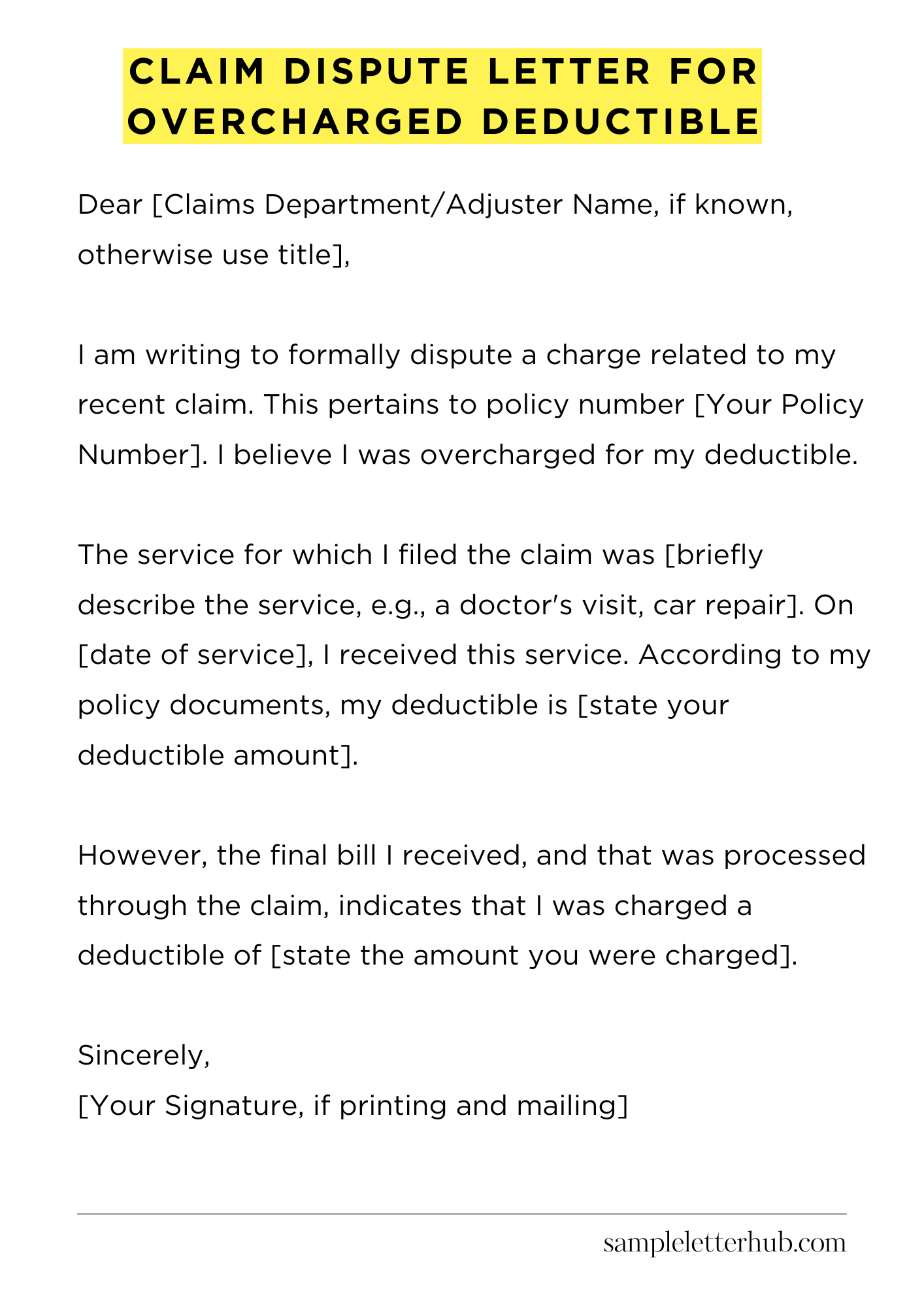
I am writing to formally dispute a charge related to my recent claim. This pertains to policy number [Your Policy Number]. I believe I was overcharged for my deductible.
The service for which I filed the claim was [briefly describe the service, e.g., a doctor’s visit, car repair]. On [date of service], I received this service. According to my policy documents, my deductible is [state your deductible amount].
However, the final bill I received, and that was processed through the claim, indicates that I was charged a deductible of [state the amount you were charged]. This is different from the deductible amount I understand is outlined in my policy. It seems like something went wrong.
I have attached copies of [list any supporting documents you are including, e.g., your policy document pages, the original bill, explanation of benefits]. These documents should clearly show the correct deductible amount. I hope that they will help your investigation.
I kindly request that you review my claim and correct the deductible charge. Please adjust my account to reflect the accurate deductible as specified in my policy. Prompt resolution of this matter would be greatly appreciated. It is important to me to have this issue settled correctly.
Please let me know if you require any further information from me to resolve this dispute. You may contact me by phone or email. I look forward to your response and a resolution to this issue within [suggest a reasonable timeframe, e.g., thirty days].
Sincerely,
[Your Signature, if printing and mailing]
How to Write Claim Dispute Letter for Overcharged Deductible
Receiving an unexpected bill? You’re not alone. Navigating the labyrinthine world of insurance and medical billing can often feel like deciphering an ancient scroll.
A critical step in safeguarding your finances is composing a cogent claim dispute letter. This guide will walk you through the process, equipping you to challenge an overcharged deductible and potentially recover your hard-earned money.
1. Commence with Meticulous Documentation
Before you even begin to formulate your letter, gather your arsenal of evidence. Compilation of essential documents is paramount. This includes your Explanation of Benefits (EOB), itemized bills from the healthcare provider, your insurance policy details, and any previous correspondence. Photocopying or digital scanning is often the wisest path.
Organize these documents meticulously; a disorganized case is a weakened case. Ensure that all the documentation is comprehensive and easily accessible.
2. Identify the Culprit: Pinpointing the Discrepancy
Carefully scrutinize the bills and EOBs. The crux of your claim dispute lies in identifying the exact area where the overcharge occurred. Is the deductible miscalculated? Are you being billed for services not rendered?
Is a procedure coded incorrectly, leading to an inflated charge? Pay particular attention to the nuances of each charge and its corresponding description. Scrutinize every line item. Be absolutely sure.
3. Crafting the Salutation and the Formal Introduction
Begin your letter with a formal salutation. Address it to the billing department or the specific claims adjuster assigned to your case. A simple “Dear Sir/Madam” will suffice if the recipient’s name is unknown, or “To Whom It May Concern.”
State the purpose of your letter succinctly in the first paragraph. Clearly mention the account number, the date of service, and the specific amount you are disputing. Clearly and concisely set the stage for your argument.
4. The Body: Detailing Your Grievance
This is where you present your case. This is where you bring the data. In one or two paragraphs, provide a precise, detailed explanation of the overcharge.
Clearly and respectfully articulate why you believe the bill is incorrect. Refer specifically to the documentation you’ve compiled. Cite relevant policy provisions, billing codes, or any other pertinent information that supports your claim. A strong narrative is key.
5. Presenting Your Supporting Evidence (Exhibit A, B, and so on)
This is where your meticulous documentation shines. In the body of your letter, clearly state which documents you are including as evidence.
For instance, “Attached as Exhibit A is a copy of my EOB, which indicates that the deductible amount should be X, not Y.” or “Refer to Exhibit B, the itemized bill, to verify the incorrect coding.” Number your exhibits for easy reference and to prevent confusion. This will strengthen your case and enable a smooth review.
6. The Concluding Plea: Requesting Resolution
In a final, concise paragraph, clearly state what you want the billing department or the insurance company to do. Do you want them to adjust the bill? Are you seeking a refund?
State the desired outcome with unambiguous language. Include a deadline for their response – typically 30 days is a reasonable timeframe. Always end with a professional closing, such as “Sincerely,” or “Respectfully,” followed by your full name, address, phone number, and any other relevant contact information.
7. Delivery and Follow-Up: The Post-Submission Process
Send your letter via certified mail, return receipt requested. This provides proof of delivery and ensures that you have a record of when the insurance company received your claim dispute.
Keep a copy of the letter and all supporting documentation for your records. If you do not receive a response within the specified timeframe, follow up with a phone call or a subsequent letter.
Persistence often pays off in resolving billing disputes. Remember, a well-written letter, backed by solid evidence, significantly increases your chances of a favorable outcome. Good luck in your pursuit of financial justice.
FAQs about Claim Dispute Letter for Overcharged Deductible
What is a claim dispute letter for an overcharged deductible, and why is it necessary?
A claim dispute letter for an overcharged deductible is a formal written communication sent to your insurance provider or healthcare facility contesting the amount you were billed for your deductible. It’s necessary when you believe you’ve been charged an incorrect amount, potentially due to errors in billing, misapplication of your insurance policy, or other discrepancies.
This letter initiates a process to correct the billing error and potentially recover the overcharged amount.
What information should be included in a claim dispute letter for an overcharged deductible?
The letter should include your personal information (name, address, policy number), the date of service, the amount you believe you were overcharged, a clear explanation of why you believe the charge is incorrect (e.g., policy details, previous payments, explanations of benefits), copies of supporting documentation (bills, EOBs, payment confirmations).
How do I know if I’ve been overcharged for my deductible?
You can determine if you’ve been overcharged by carefully reviewing your Explanation of Benefits (EOB) from your insurance provider and comparing it to the bills you’ve received. Look for discrepancies in the amount charged, the services covered, and the application of your deductible.
Ensure the deductible amount aligns with your policy details. Also, compare bills to any previous payments you may have made.
What happens after I send a claim dispute letter?
After sending the letter, the insurance provider or healthcare facility should investigate the issue. They may contact you for further information or documentation.
The timeline for a response can vary, but generally, they are required to respond within a reasonable timeframe, as defined by state regulations or your policy. The outcome could be a corrected bill, a denial of the dispute (with an explanation), or a request for additional information.
What if my claim dispute is denied? What are my options?
If your claim dispute is denied, carefully review the reasons provided. You have several options: You can appeal the decision with the insurance company, providing additional documentation or arguments.
If the insurance company upholds its denial, you might consider contacting your state’s insurance commissioner, who can investigate your claim. You could also explore mediation or, as a last resort, seek legal advice to explore options such as small claims court. Consider all options available to ensure the best possible resolution for the dispute.
Related:
Resignation letter due to rude boss
Resignation letter moving to another state
Resignation letter due to illness of family member
Resignation letter due to study