

A CIO resignation letter is a formal document. It announces a Chief Information Officer’s departure from a company. Its primary purpose is to officially notify the employer. It also often includes details about the last day of employment.
Writing this letter can seem daunting. We understand. That’s why we’re here to help. We’ve compiled various templates. We’ll share several examples.
These samples will guide you. They’ll give you a starting point. Feel free to adapt them. Customize them to fit your specific situation.
Cio Resignation Letter
Below is a sample of a Cio Resignation Letter:
[Your Name]
[Your Address]
[Your Phone Number]
[Your Email Address]
[Date]
[Recipient Name] (If known, otherwise use title)
[Recipient Title]
[Company Name]
[Company Address]
Dear [Mr./Ms./Mx. Last Name or To Whom It May Concern],
Please accept this letter as formal notification that I am resigning from my position as Chief Information Officer (CIO) at [Company Name]. My last day of employment will be [Date – usually two weeks from the date of the letter, or as per your employment agreement].
I have enjoyed my time at [Company Name] and I am grateful for the opportunities I have been given. I am proud of the contributions I have made to the company during my tenure, including [briefly mention 1-2 key accomplishments, e.g., “leading the successful implementation of the new CRM system” or “improving data security protocols”].
I am committed to ensuring a smooth transition during my departure. I am happy to assist in the handover of my responsibilities and to train my replacement, as needed. Please let me know how I can best support this process.
I wish [Company Name] continued success in the future.
Sincerely,
[Your Signature]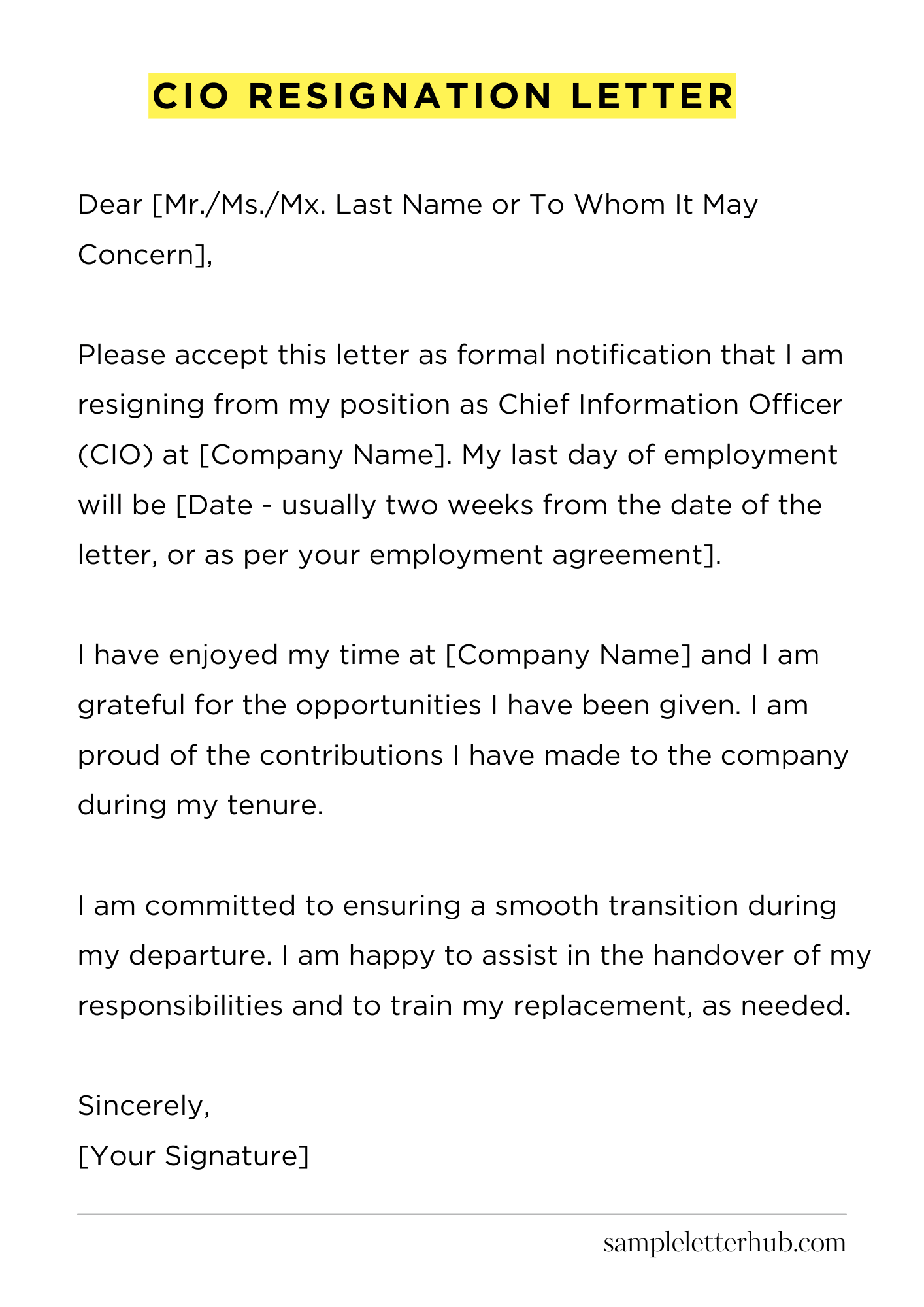
How to Write a CIO Resignation Letter
Know Your Audience and Purpose First
Before you put pen to paper (or fingers to keyboard), take a moment. Understand this: your resignation letter is a formal document. It serves a specific, vital purpose. You’re communicating your intention to leave your role as Chief Information Officer (CIO).
Think about who will read it. This likely includes your direct supervisor, the CEO, and perhaps even members of the board. The goal is clear: to inform them professionally. You want to leave on a positive note, preserving your professional reputation. Think about it: bridges are important.
Your letter should be respectful, concise, and to the point. Avoid negativity or excessive detail about why you’re leaving.
Crafting the Core Elements
Okay, let’s get down to the basics. Every effective resignation letter needs these core components.
- Formal Salutation: Begin with a proper greeting. “Dear [Recipient’s Name]” is standard. Avoid casual language.
- Clear Statement of Intent: State your resignation clearly. Something like, “Please accept this letter as formal notification that I am resigning from my position as Chief Information Officer, effective [Your Last Day of Employment].”
- Effective Date of Departure: Be explicit about your last day. This is critical for planning the transition.
- Brief Gratitude: Express your appreciation for the opportunity. This shows professionalism. A simple “I have enjoyed my time at [Company Name]” is often sufficient.
- Offer of Assistance: Offer to help with the transition of your duties. This shows you are a team player. You could say, “I am committed to ensuring a smooth transition and am happy to assist in any way possible to support the handover of my responsibilities.”
- Professional Closing: End with a professional closing, such as “Sincerely” or “Regards,” followed by your full name.
Stick to these basic elements and you’re already doing well.
What to Include (and What to Leave Out)
The content is key. Keep it focused and professional. Remember the goal of this letter.
What to include: Your basic information, reason for your exit and offers of assistance. Consider a very brief mention of any accomplishments you are proud of. Keep this short, however. A concise sentence or two is sufficient. Avoid a long, boastful list.
What to leave out: Avoid negative comments about the company, your colleagues, or your reasons for leaving. Do not use this as a platform for complaints. Do not delve into specific, intricate details about future plans. Keep it simple and direct.
Remember that your letter is a public document.
Structuring for Maximum Impact
The structure of your letter is important. You want it to be easy to read and understand.
A typical structure is as follows:
- Start with a polite salutation.
- Clearly state your intention to resign.
- State your last day of employment.
- Express gratitude for the opportunity.
- Offer assistance with the transition.
- Include a professional closing and your name.
Keep the tone formal and respectful throughout. Proofread it carefully before sending it!
Finalizing and Delivering Your Letter
Almost there. You have done the hard work. You’ve written the letter, and now it is time to make sure it looks good.
Proofread! Proofread! Proofread! Check for grammatical errors, typos, and spelling mistakes. Ask a trusted colleague or friend to review it as well. A second pair of eyes is always useful.
Consider the delivery method. Most companies will prefer an email. Attach your resignation letter as a PDF to ensure proper formatting.
Be prepared for the response. Your supervisor or the CEO might want to discuss your decision. Be ready to answer questions professionally and politely. You’ve done your part; now you are off to bigger and better opportunities.
FAQs about CIO Resignation Letter
What are the essential components of a CIO resignation letter?
A comprehensive CIO resignation letter should include: the formal announcement of resignation, the effective date of departure, a brief statement of gratitude for the opportunity, any information regarding the handover process (e.g., willingness to assist with the transition), and a professional closing.
It’s also advisable to mention any obligations related to non-disclosure agreements or other contractual terms.
How much notice should a CIO give when resigning?
The standard notice period for a CIO typically ranges from four to eight weeks, though this can vary depending on the employment contract, company policy, and the complexity of the organization’s IT infrastructure. It’s crucial to consult the employment agreement to determine the exact notice period required.
What should a CIO do regarding the handover process in their resignation letter?
The CIO should outline their willingness to assist with the transition of responsibilities in the resignation letter. This includes offering to train their replacement, documenting key processes, and ensuring critical projects continue smoothly. Specifying the availability to answer questions and provide support can ease the transition process for both the company and the incoming CIO.
What kind of tone should a CIO maintain in a resignation letter?
The tone of the resignation letter should be professional, respectful, and positive. Avoid including any negative comments or criticisms about the company or its leadership. Expressing gratitude for the opportunities provided and a willingness to help with the transition promotes goodwill and protects professional reputation.
Are there any legal considerations CIOs should include in their resignation letter?
CIOs should be aware of and mention any relevant legal considerations in the resignation letter, particularly those related to non-disclosure agreements (NDAs), intellectual property, and non-compete clauses.
Reviewing these agreements before writing the letter is essential to ensure compliance and avoid any potential legal issues. It’s also prudent to consider seeking legal advice to fully understand these implications.
Related:
Resignation letter due to rude boss
Resignation letter moving to another state
Resignation letter due to illness of family member
Resignation letter due to study