

A Chief Officer resignation letter is a formal document. It announces your decision to leave a company. This letter serves as official notification of your departure. It usually includes your last day of employment.
Writing a resignation letter can be tricky. You want to be clear and professional. We’re here to help! This article provides examples and templates. Use them to craft your own perfect letter.
These samples cover various situations. You can adapt them to your specific needs. Say goodbye with confidence. Make your transition smoother and stress-free.
Chief Officer Resignation Letter
Below is a sample of a Chief Officer Resignation Letter:
[Your Name/Address]
[Your Phone Number]
[Your Email Address]
[Date]
[Chief Officer’s Name]
[Chief Officer’s Title]
[Company Name]
[Company Address]
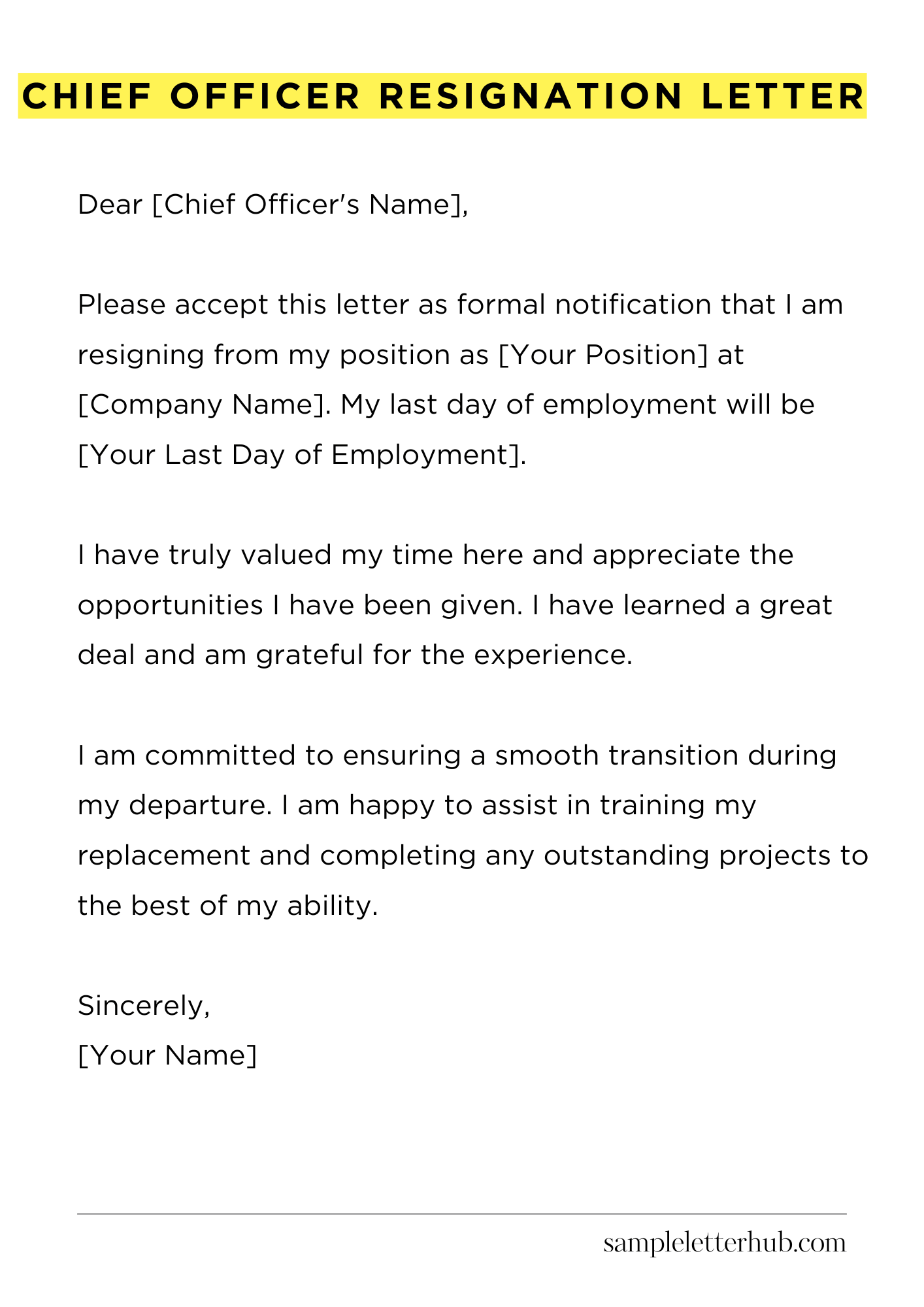
Dear [Chief Officer’s Name],
Please accept this letter as formal notification that I am resigning from my position as [Your Position] at [Company Name]. My last day of employment will be [Your Last Day of Employment].
I have truly valued my time here and appreciate the opportunities I have been given. I have learned a great deal and am grateful for the experience.
I am committed to ensuring a smooth transition during my departure. I am happy to assist in training my replacement and completing any outstanding projects to the best of my ability.
I wish you and the company continued success in the future.
Sincerely,
[Your Name]
How to Write a Chief Officer Resignation Letter
Know the Why and When
Resigning from a Chief Officer position is a big deal, no question. Before you even think about putting pen to paper (or fingers to keyboard), you need to be crystal clear on why you’re leaving. This will make writing the letter easier and ensure you’re communicating your reasons effectively.
Maybe you’ve secured a better opportunity? Or perhaps you’re seeking a different work-life balance? Once you’ve figured that out, consider the timing. Always adhere to your employment contract’s stipulations regarding notice periods. Generally, this timeframe is between 30 to 90 days, depending on your company’s policy and your specific role.
Formatting is Your Friend
Let’s talk structure. Your resignation letter needs to be professional and easy to read. Start with your contact information (name, address, phone number, email) and the date.
Next, include the recipient’s information – likely the CEO, your direct supervisor, or HR. This helps in case there is any confusion on who to address the letter to. After the formal greetings (Dear Mr./Ms. [Last Name] or Dear [Department Name]), jump right into the purpose of the letter: your resignation. This clarity makes the intent immediately known.
State the Facts: The Core Content
The meat of your letter focuses on the essentials. Begin by clearly stating your resignation, including your official last day of employment. For example: “Please accept this letter as formal notification that I am resigning from my position as Chief Officer, effective [Date].” Keep it concise and direct.
Then, briefly and professionally state your reason(s) for leaving. You don’t need to overshare, but providing a brief explanation (e.g., “to pursue another opportunity” or “to focus on personal endeavors”) can be helpful. Keep in mind that you don’t have to include *every* single detail.
Avoid negativity and focus on the positive aspects of your experience, if any.
Expressing Gratitude and Offering Assistance
While this is your goodbye letter, it’s also your chance to leave a positive lasting impression. Express your gratitude for the opportunity to have worked in the organization. You could write something like, “I am grateful for the opportunities I’ve been given during my time here, and I have learned a lot.”
Expressing thanks is a polite move. Then, offer to help with the transition. Offer assistance with training your replacement or transferring knowledge. Even a simple “I am happy to assist in any way possible during the transition period” can go a long way. This is a common courtesy and shows professionalism.
The Finishing Touches and Next Steps
Finish your letter with a professional closing, such as “Sincerely,” or “Respectfully,” followed by your typed name. Sign the letter by hand if you’re sending a hard copy (highly recommended) and keep a copy for your records. Consider sending the letter via certified mail or another method that provides proof of delivery.
Finally, if there is a company-wide exit interview, prepare for it, and prepare yourself mentally for your last day. Remember to be professional and maintain a positive attitude until your final day of employment. Good luck!
FAQs about Chief Officer Resignation Letter
What are the essential elements to include in a Chief Officer resignation letter?
A comprehensive Chief Officer resignation letter typically includes: a clear statement of resignation, the effective date of departure, a brief statement of the reason for leaving (optional but often included), expressions of gratitude for the opportunity, mention of any outstanding responsibilities or handover plans, and a professional closing with your signature.
It should be concise, professional, and respectful.
How much notice should a Chief Officer provide when resigning?
The required notice period for a Chief Officer can vary depending on their employment contract, company policy, and local labor laws. Generally, a Chief Officer should provide at least 30 to 90 days’ notice.
Review the employment agreement and company handbook for the specific requirements. Always aim to provide the maximum notice possible to allow for a smooth transition.
What is the appropriate tone and language for a Chief Officer resignation letter?
The tone of the resignation letter should be professional, respectful, and positive. Avoid negativity or criticism of the company or colleagues. Use formal and polite language. Express gratitude for the opportunities provided and a willingness to assist with the transition. Maintain a tone that reflects your position and ensures a positive departure.
Should a Chief Officer explain the reason for leaving in their resignation letter?
While not always mandatory, including a brief, neutral explanation for leaving is often advisable. This could be to pursue another opportunity, for personal reasons, or simply a desire for a change. Keep the explanation concise and professional.
Avoid detailing negative aspects of the current employment unless absolutely necessary. Be truthful, but also mindful of maintaining a positive professional image.
How should a Chief Officer handle the handover of responsibilities after resigning?
The Chief Officer should work collaboratively with the company to ensure a smooth transition. This involves clearly documenting ongoing projects and responsibilities, training the incoming individual or team, and being available for questions during the transition period.
A well-prepared handover demonstrates professionalism and commitment, even when departing.
Related:
Resignation letter due to rude boss
Resignation letter moving to another state
Resignation letter due to illness of family member
Resignation letter due to study