

A Chief Medical Officer (CMO) resignation letter is a formal document. It is written by a CMO to inform their employer of their decision to leave their position. The letter serves as an official record of the resignation. It outlines the departure date and any other relevant details.
Writing a CMO resignation letter can seem daunting. Where do you even begin? We understand. That’s why we’ve created this guide. It offers various templates and examples. These examples will help you draft your own resignation letter.
Whether you’re looking for a simple, straightforward letter or something more detailed, we’ve got you covered. Consider this your starting point. You can adapt these samples to fit your specific circumstances. Let’s get started.
Chief Medical Officer Resignation Letter
Below is a sample of a Chief Medical Officer Resignation Letter:
[Your Name/Address]
[Your Phone Number]
[Your Email Address]
[Date]
[Chief Medical Officer’s Name]
[Hospital Name]
[Hospital Address]
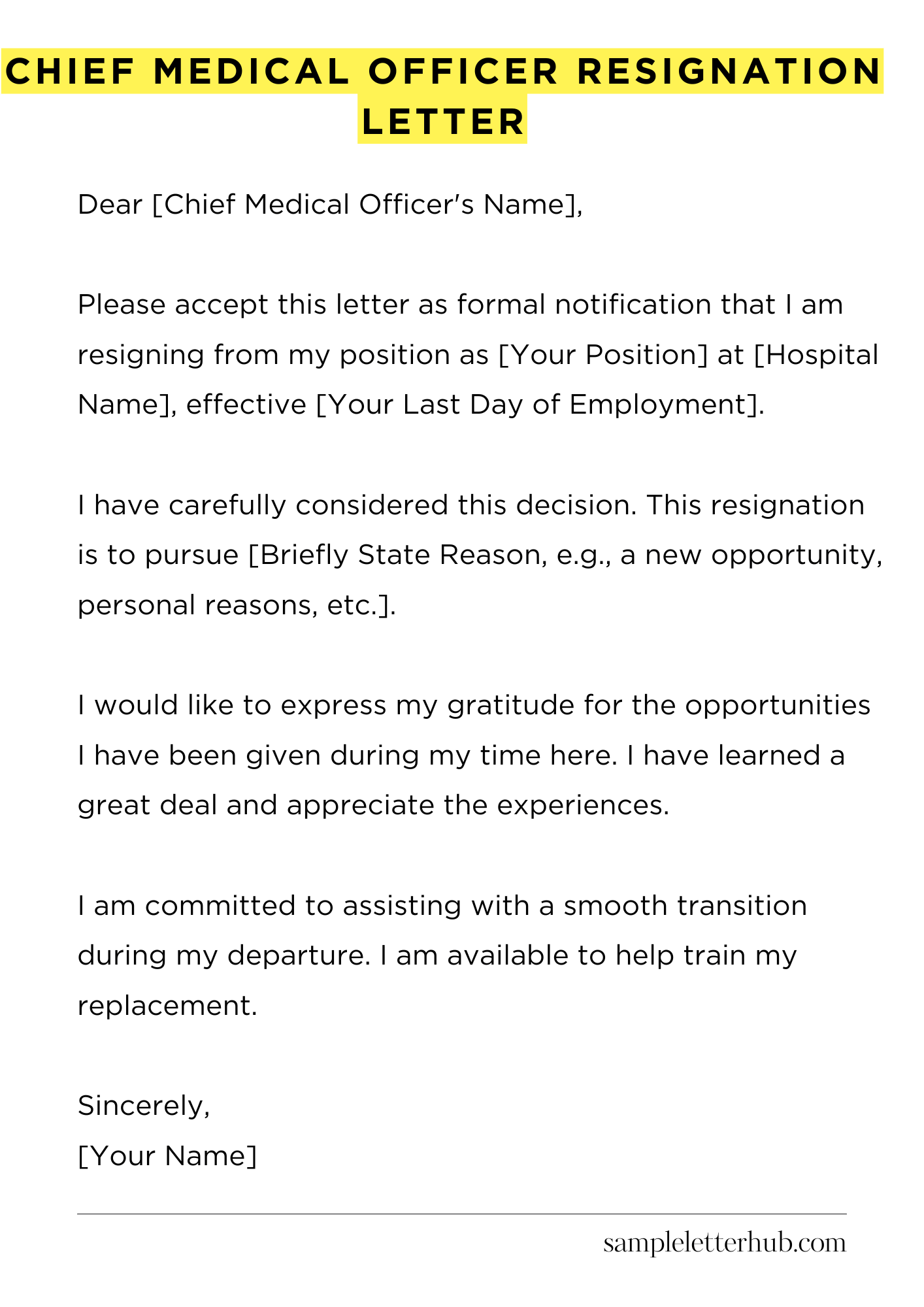
Dear [Chief Medical Officer’s Name],
Please accept this letter as formal notification that I am resigning from my position as [Your Position] at [Hospital Name], effective [Your Last Day of Employment].
I have carefully considered this decision. This resignation is to pursue [Briefly State Reason, e.g., a new opportunity, personal reasons, etc.].
I would like to express my gratitude for the opportunities I have been given during my time here. I have learned a great deal and appreciate the experiences I have gained while working with the team.
I am committed to assisting with a smooth transition during my departure. I am available to help train my replacement and complete any handover tasks as needed. Please let me know how I can best support the organization during this time.
I wish [Hospital Name] continued success in the future.
Sincerely,
[Your Name]
How to Write a Chief Medical Officer Resignation Letter
1. Preparation is Key: Understanding the Landscape
Resigning from your position as Chief Medical Officer (CMO) is a significant move. You’ve likely dedicated years to your organization. Before you even think about putting pen to paper (or fingers to keyboard), take some time to reflect.
Consider why you’re leaving. Is it for a better opportunity, personal reasons, or something else entirely? Think about the impact your departure will have. This clarity will help you craft a professional and thoughtful letter.
Also, familiarize yourself with your employment contract and any company policies regarding resignation. Knowing the required notice period is crucial. Ensure you comply to avoid any potential legal or professional complications. Planning ahead eases the whole process.
2. Crafting the Core: Essential Components
Your resignation letter, even for such a senior role, should be straightforward. Start with a clear and concise statement of your intention to resign. State your position, and the effective date of your resignation.
For example: “Please accept this letter as formal notification that I am resigning from my position as Chief Medical Officer, effective [Date].” Don’t beat around the bush; get straight to the point.
Express gratitude. Acknowledge the opportunity you’ve been given. Mention specific positive experiences you’ve had. This demonstrates professionalism and leaves a good impression.
For example, “I am grateful for the opportunity to have served as CMO for the past [Number] years. I have truly valued my time here and appreciate the experiences I’ve gained.”
3. The Details Matter: Providing Support and Guidance
The CMO role is critical. Offer your support during the transition period. This shows your commitment to the organization’s continued success, even after you leave. You might offer to assist in the recruitment of your replacement. Additionally, you may also offer to help with the transfer of responsibilities.
Be prepared to provide necessary handover documents. Outline any outstanding projects or important tasks. Ensure your team and the organization can continue operating effectively. This demonstrates a high level of professionalism and integrity.
4. Keeping it Professional: Tone and Delivery
Maintain a respectful and professional tone throughout the letter. Avoid any negative comments or criticisms about the organization or its leadership. Even if your departure is due to disagreements, keep your letter focused on the positive aspects and the future. Focus on moving on.
Proofread carefully. Typos or grammatical errors can undermine your credibility. It’s always a good idea to have a trusted colleague or friend review the letter before you send it. This ensures you’re conveying the right message clearly and concisely.
5. After the Letter: The Next Steps
Once you’ve finalized and sent your letter, be prepared for a response. Your supervisor or HR may want to meet with you to discuss your resignation. Be prepared to answer any questions or provide additional information. Always remain professional and cooperative during this process.
Finally, prepare for the transition. Start compiling documents, training materials, and any other relevant information needed for the handover. This will allow for a smoother transition for all involved. You are setting up your successor for success.
FAQs about Chief Medical Officer resignation letter
Why is a Chief Medical Officer resigning?
There are several reasons why a Chief Medical Officer (CMO) might resign. Common factors include seeking new career opportunities for professional development, dissatisfaction with the current role or organizational leadership, personal reasons such as family commitments, retirement, or burnout, and conflicts with the board, medical staff, or other stakeholders.
Changes in the healthcare landscape, such as mergers, acquisitions, or shifts in strategic direction, can also prompt a CMO to seek alternative employment.
What should be included in a Chief Medical Officer resignation letter?
A well-crafted resignation letter from a CMO typically includes a formal statement of resignation, the effective date of departure, a brief expression of gratitude for the opportunity to have served in the role, and a concise explanation (if the CMO chooses to provide one) of the reason for leaving.
It should also detail plans for the handover of responsibilities, including cooperation in the transition of duties and a willingness to assist in the recruitment of a successor. Contact information for future communications is also considered standard.
How much notice should a Chief Medical Officer give when resigning?
The appropriate amount of notice for a CMO resignation depends on the terms of their employment contract, organizational policies, and the complexity of the healthcare organization.
Typically, a CMO is expected to provide a minimum of 30 to 90 days’ notice, or longer, to allow sufficient time for a smooth transition, the recruitment of a replacement, and the completion of ongoing projects or initiatives. The specific timeframe should be clarified in the employment contract or relevant organizational guidelines.
What are the legal considerations when a Chief Medical Officer resigns?
Legal considerations for a CMO’s resignation may involve reviewing the employment contract for any non-compete clauses, confidentiality agreements, or intellectual property rights.
Additionally, the departing CMO and the organization should ensure compliance with relevant employment laws and regulations. Legal counsel may be consulted to navigate these considerations and address any potential disputes that may arise during the resignation process.
What is the impact of a Chief Medical Officer’s resignation on an organization?
A CMO’s resignation can have a significant impact on a healthcare organization. It can disrupt strategic planning, clinical operations, and the implementation of healthcare policies.
The organization may experience a temporary leadership vacuum until a new CMO is appointed, which could affect staff morale, patient care, and relationships with external stakeholders.
The departure also necessitates a recruitment process, which can be costly and time-consuming. Careful planning, effective communication, and a well-managed transition are crucial to minimize negative effects.
Related:
Resignation letter due to rude boss
Resignation letter moving to another state
Resignation letter due to illness of family member
Resignation letter due to study