

A Chief Compliance Officer (CCO) resignation letter is a formal document. It is written by a CCO to officially announce their departure from a company. This letter serves to inform the employer of the resignation. It typically includes the effective date of leaving and a brief reason.
Crafting the perfect resignation letter can be tricky. We understand. That’s why we’ve gathered a collection of helpful resources. We’re here to make things easier for you.
You’ll find various templates and examples. These are designed to guide you. Use these samples to create your own effective CCO resignation letter. Write with confidence.
Chief Compliance Officer Resignation Letter
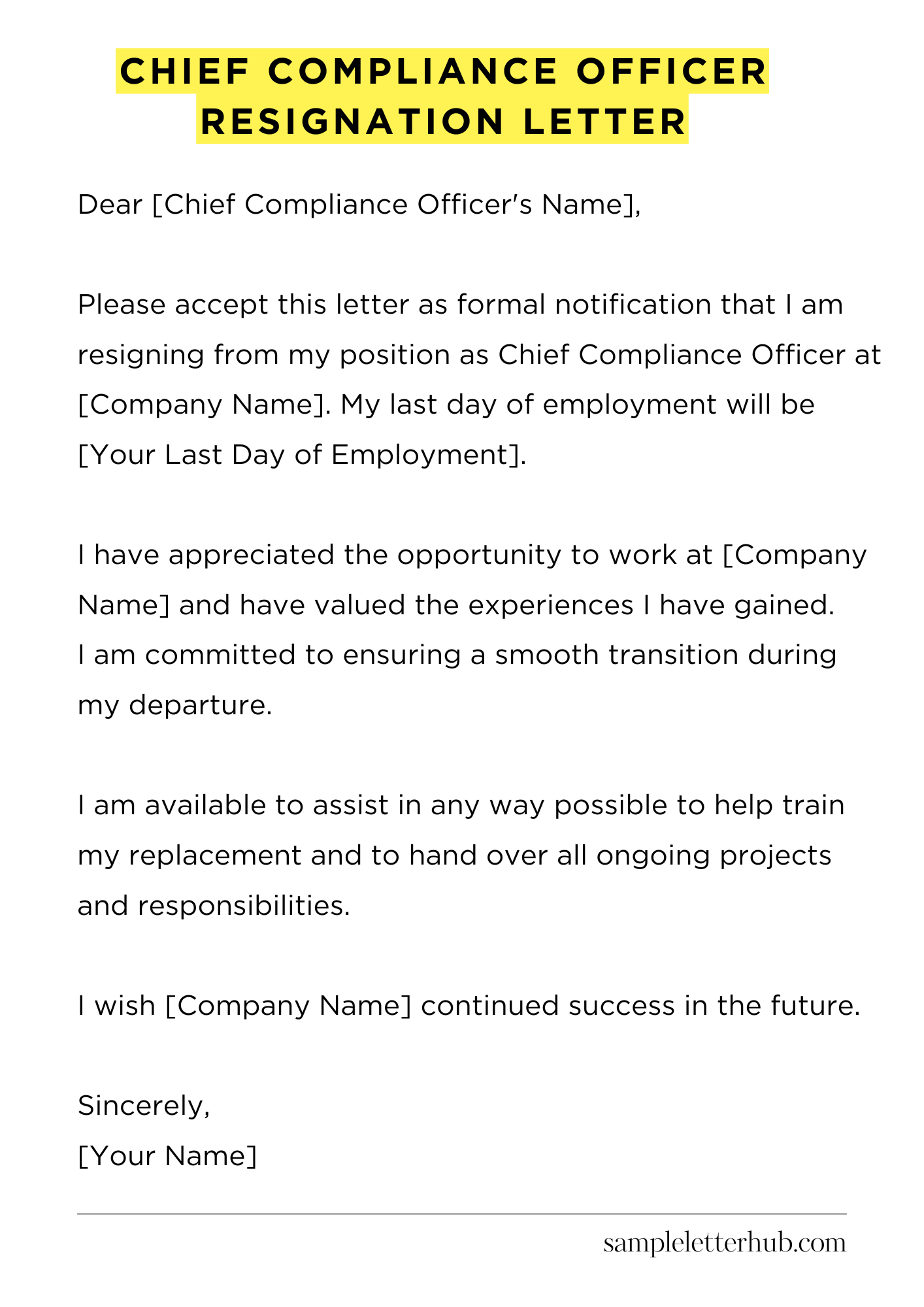
Below is a sample of a Chief Compliance Officer Resignation Letter:
[Your Name]
[Your Address]
[Your Phone Number]
[Your Email Address]
[Date]
[Chief Compliance Officer’s Name]
[Company Name]
[Company Address]
Dear [Chief Compliance Officer’s Name],
Please accept this letter as formal notification that I am resigning from my position as Chief Compliance Officer at [Company Name]. My last day of employment will be [Your Last Day of Employment].
I have appreciated the opportunity to work at [Company Name] and have valued the experiences I have gained.
I am committed to ensuring a smooth transition during my departure. I am available to assist in any way possible to help train my replacement and to hand over all ongoing projects and responsibilities. I am happy to meet with you and relevant teams to discuss the transition plan.
I wish [Company Name] continued success in the future.
Sincerely,
[Your Name]
How to Write a Chief Compliance Officer Resignation Letter
Resigning from any high-level position is a big deal, and the role of Chief Compliance Officer (CCO) is certainly no exception. This role carries significant responsibility, overseeing an organization’s adherence to legal and ethical standards. Therefore, your resignation needs to be handled with professionalism and precision.
A well-crafted resignation letter is critical, not just for ending your employment gracefully, but also for protecting your future career prospects.
1. Getting Started: The Basic Essentials
Before putting pen to paper (or fingers to keyboard), you’ll need a few fundamental pieces of information. First, confirm your resignation date. This is crucial for avoiding any misunderstandings.
Double-check your employment contract or company policies for any required notice periods. Typically, CCOs are expected to give more notice than other employees, often 30-90 days, so this is paramount.
Next, gather the names of the individuals to whom you must submit the letter. Commonly, this will be your direct supervisor (e.g., the CEO) and possibly the Board of Directors or a designated HR representative. Including their titles helps to ensure it reaches the right people. Once these details are in place, you can start with the letter’s structure.
2. The Opening: State Your Intent Clearly
The first paragraph is where you state your intention: to resign. It needs to be direct and unambiguous. Avoid any ambiguity. A simple, professional opening is always best.
For example: “Please accept this letter as formal notification that I am resigning from my position as Chief Compliance Officer, effective [Your Resignation Date].” Keeping it simple avoids any confusion. Remember this is a formal legal document; clarity is key.
Following this opening, you might briefly mention the reason for your resignation, if you choose to. This could be due to personal reasons, a better opportunity, or a change in career goals. However, you are not obliged to give extensive details, especially if the situation is complex or sensitive. Brevity is often your friend.
3. Expressing Gratitude and Providing Context
Regardless of your reasons for leaving, it’s always wise to express gratitude for the opportunities you’ve received during your time in the organization. This shows professionalism and leaves a positive impression.
You might mention specific accomplishments or positive experiences. For example, “I am grateful for the opportunity to have served as CCO, and I am proud of the compliance program we have built.” This helps set a positive tone.
You should also include a brief overview of the ongoing projects or critical tasks you are currently handling. This allows you to give context. This shows your commitment to a smooth transition.
Consider offering assistance during the handover period. Something like: “I am committed to ensuring a smooth transition and am available to assist in any way possible to ensure continuity of the compliance program.” It can be as simple as this.
4. Preparing for the Handover: The Smooth Transition
Your resignation letter should outline your commitment to the smooth handover. This might involve training your replacement, providing documentation, or answering any questions. Identify key processes and the individuals responsible for them. This level of detail shows you are truly committed.
Consider the compliance risks the organization faces, and identify which of these may be disrupted by your departure. This may be useful to note, but do so carefully and cautiously. Offer to collaborate during the transition period. Providing a list of essential documents, logins, or other relevant materials is very helpful. Be clear and available for consultation as needed.
5. Closing and Formalities
The closing paragraph is where you formally conclude the letter. Reiterate your appreciation, if desired, and again offer assistance during the transition. Use a professional closing. “Sincerely,” or “Respectfully,” are both suitable options. Include your full name, title, and contact information (phone number and email address) for follow-up purposes.
Before submitting, proofread the letter carefully. Check for any grammatical errors, typos, or inconsistencies. Have a trusted colleague or advisor review the letter for feedback. Once you are satisfied, print the letter (if that is your company’s policy) and obtain a signed copy for your records.
Consider sending a digital copy via email as well. This final step helps to ensure that your resignation is properly documented and that you leave the organization in a positive light.
FAQs about Chief Compliance Officer resignation letter
What information should be included in a Chief Compliance Officer (CCO) resignation letter?
A CCO resignation letter should include your formal resignation, the effective date of your departure, a brief statement of the reason for your resignation (optional, but often included), and a concise expression of gratitude for the opportunity to have served in the role.
Additionally, it should indicate your willingness to assist with the transition process and provide contact information for any follow-up questions.
How much notice should a Chief Compliance Officer give when resigning?
The notice period should align with your employment contract or any company policy. Typically, CCOs are expected to provide a longer notice period than other employees, often ranging from 30 to 90 days. It is critical to adhere to the agreed-upon timeframe to ensure a smooth transition and fulfill any contractual obligations.
Is it necessary for a Chief Compliance Officer to explain the reason for resigning in the letter?
While not mandatory, it is often beneficial to include a brief, professional statement explaining the reason for resignation. This can be a simple sentence such as “due to a desire for new career opportunities” or “to pursue other interests.” Avoid overly detailed explanations or negative commentary about the company or its employees.
What should a Chief Compliance Officer do to prepare for their departure after submitting their resignation?
Following the submission of a resignation, a CCO should prioritize the transition of their responsibilities. This includes identifying and training a successor, documenting processes and procedures, and ensuring key compliance-related information is readily accessible.
Additionally, they should cooperate with the company during the transition period and respond to any inquiries promptly and professionally. Furthermore, a thorough review of ongoing compliance matters to ensure continuity is critical.
What are the legal considerations a Chief Compliance Officer should be aware of when resigning?
A CCO needs to be aware of any non-compete clauses, confidentiality agreements, or other contractual obligations. They should also be mindful of their responsibilities under relevant laws and regulations. It is often prudent to review these documents with legal counsel to fully understand the implications of the resignation and ensure compliance with all applicable legal requirements.
Related:
Resignation letter due to rude boss
Resignation letter moving to another state
Resignation letter due to illness of family member
Resignation letter due to study