

So, you’re ready to move on from your role as a case manager. A case manager resignation letter is a formal document. It informs your employer of your decision to leave. The letter also states your last day of employment.
Writing this letter can feel tricky. Don’t worry, we’re here to help. We’ll share several templates. These templates will provide you with different styles. They offer a range of professional examples.
Need to keep things simple? Looking for something more specific? We have a letter to fit your needs. Writing a resignation letter just got easier.
Case Manager Resignation Letter
Below is a sample of a Case Manager Resignation Letter:
[Your Name]
[Your Address]
[Your Phone Number]
[Your Email Address]
[Date]
[Hiring Manager Name] (If known, otherwise use title)
[Hiring Manager Title]
[Company Name]
[Company Address]
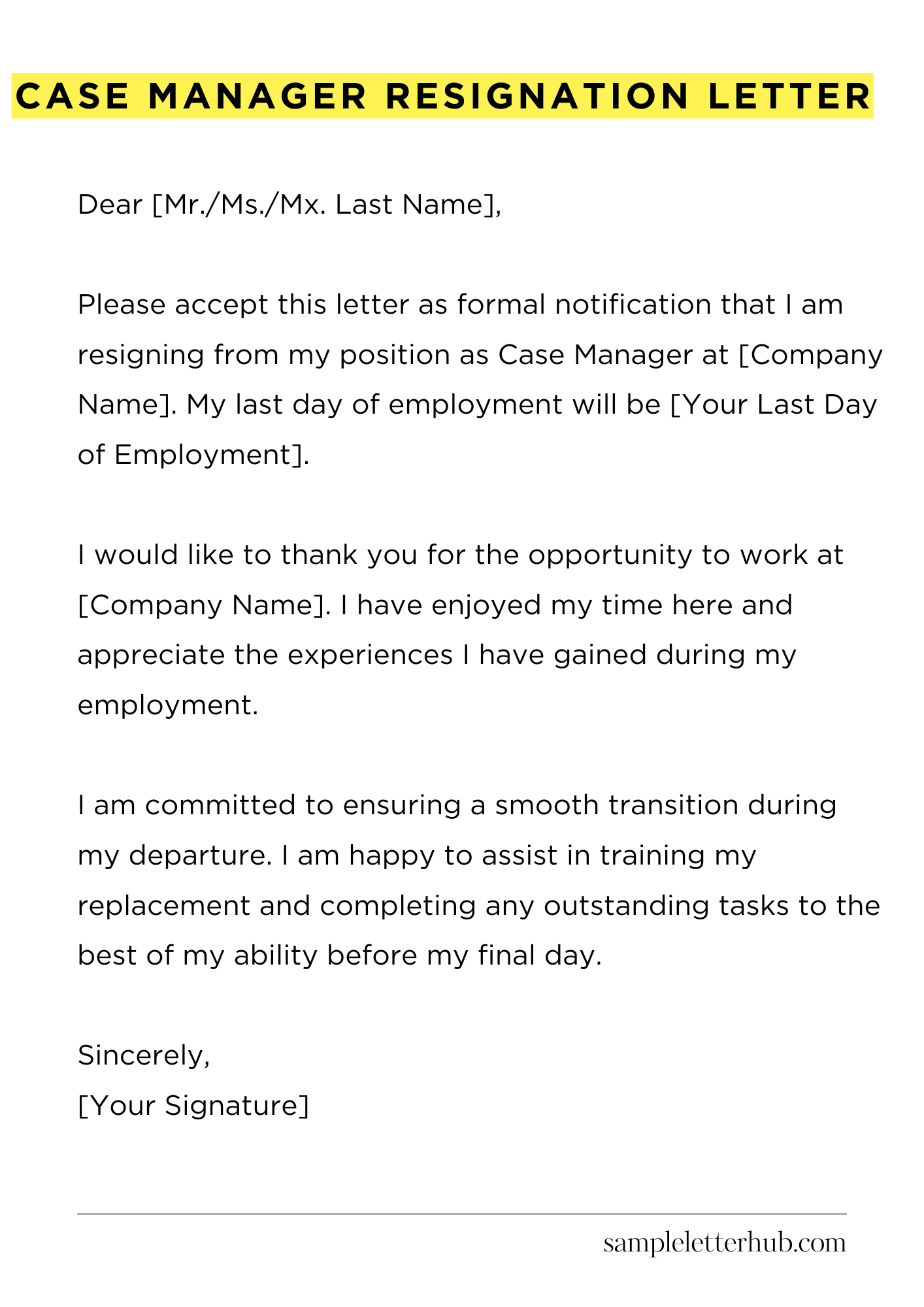
Dear [Mr./Ms./Mx. Last Name],
Please accept this letter as formal notification that I am resigning from my position as Case Manager at [Company Name]. My last day of employment will be [Your Last Day of Employment].
I would like to thank you for the opportunity to work at [Company Name]. I have enjoyed my time here and appreciate the experiences I have gained during my employment.
I am committed to ensuring a smooth transition during my departure. I am happy to assist in training my replacement and completing any outstanding tasks to the best of my ability before my final day.
I wish you and [Company Name] all the best in the future.
Sincerely,
[Your Signature]
How to Write a Case Manager Resignation Letter
Leaving a job, even one you may not love, can feel tricky. Resigning as a Case Manager is no exception. It is important to leave on good terms. You’ll need a well-written resignation letter. This is your professional farewell, the last impression you’ll make. So, let’s make it count. Here’s how to craft a winning case manager resignation letter.
1. Start with the Basics: Your Contact Information and Date
Every professional letter, including a resignation, needs a proper header. Your goal here is clarity. At the top left, list your full name, address, phone number, and email. Beneath that, on the right side of the page, include the current date. This information ensures the letter is easily identifiable and properly dated.
Consider this a simple formality, but a necessary one.
2. The Salutation: Address It Correctly
Address your letter to your direct supervisor or the appropriate HR representative. Do a bit of research, if you must. Use their formal title and last name. For example, “Dear Ms. Smith” or “Dear Mr. Jones.” Never use a casual greeting like “Hey,” or “Hi.”
This shows respect and professionalism from the start. This makes an excellent first impression.
3. State Your Intent: The Core of the Matter
This is where you clearly state your intention to resign. Keep it direct and to the point. State your position and the effective date of your resignation. For instance: “Please accept this letter as formal notification that I am resigning from my position as Case Manager, effective two weeks from today.” This eliminates any ambiguity.
Make it easy for them to understand. This sets the stage.
4. Express Gratitude (and Optional Explanation): Keeping it Positive
It’s always a good idea to express gratitude for the opportunity. Briefly acknowledge the experience you’ve gained or the relationships you’ve built. Something like, “I am grateful for the opportunities I’ve had during my time at [Company Name]” works well. A short, positive sentiment can leave a lasting, good impression.
You can briefly explain your reason for leaving, if you want. Keep it concise and professional. You don’t have to provide excessive detail. Simple explanations, such as “pursuing other opportunities,” are usually sufficient.
This section is your opportunity to maintain professionalism and build bridges.
5. The Closing and Next Steps
In the closing paragraph, reiterate your commitment to assisting with a smooth transition. Offer to help with training a replacement or completing ongoing tasks, if possible.
This is not mandatory, but it demonstrates your commitment to the company. End with a polite closing, such as “Sincerely,” or “Respectfully,” followed by your full name. Provide your signature above your typed name. This is crucial for formal documents.
Review the letter for typos and grammatical errors. Make a final check. Deliver the letter to the appropriate person and keep a copy for your records. Following these steps will help you write a professional resignation letter. It protects your reputation and helps you leave on the right note.
FAQs about Case Manager resignation letter
How much notice should a Case Manager give when resigning?
The standard practice is to provide two weeks’ notice. However, the exact timeframe may vary depending on the company’s policies, employment contract, and local labor laws. Reviewing the employment agreement is crucial to determine the required notice period. If no specific notice period is mentioned, two weeks is generally considered the accepted standard.
What should be included in a Case Manager resignation letter?
A Case Manager’s resignation letter should include: a formal statement of resignation, the effective date of resignation, a brief and professional statement of intent (e.g., pursuing other opportunities or personal reasons), appreciation for the opportunity, and a willingness to assist with the transition, if possible. Avoid negativity or providing excessive personal details.
Can a Case Manager resign without giving notice?
While possible, resigning without notice is generally not advisable. It can damage professional relationships and may lead to negative repercussions, depending on the employment agreement and local laws.
Circumstances like an unsafe work environment could warrant immediate resignation, but consulting with legal counsel is recommended in such situations. Resigning without notice should be a last resort.
How should a Case Manager handle the handover process after resigning?
A Case Manager should offer to assist with the transition. This includes providing a detailed handover of current cases, documenting essential information, and training or briefing the person taking over.
The level of involvement depends on the notice period and employer’s requirements. A thorough and organized handover demonstrates professionalism and helps ensure continuity of care for clients.
What are some common reasons for a Case Manager to resign?
Common reasons include: seeking better compensation or benefits, career advancement opportunities, work-life balance concerns, burnout due to the demanding nature of the job, a desire to explore different areas within the healthcare field, a lack of professional development, or dissatisfaction with the work environment or management. Personal circumstances may also play a role.
Related:
Resignation letter due to rude boss
Resignation letter moving to another state
Resignation letter due to illness of family member
Resignation letter due to study