

Leaving your call center job? You’ll need a resignation letter. This formal document officially communicates your departure to your employer. It marks your final day of employment. It also helps with a smooth transition.
Writing a resignation letter can feel tricky. Don’t worry, we’ve got you covered. We’ll show you great examples. We’ll share useful templates. You can adapt these to your situation.
Get ready to craft the perfect letter. We’ll simplify the process. These samples will make it much easier. You’ll be saying goodbye with confidence.
Call Center Resignation Letter
Below is a sample of a Call Center Resignation Letter:
[Your Name]
[Your Address]
[Your Phone Number]
[Your Email Address]
[Date]
[Hiring Manager Name] (If you know it)
[Hiring Manager Title]
[Call Center Name]
[Call Center Address]
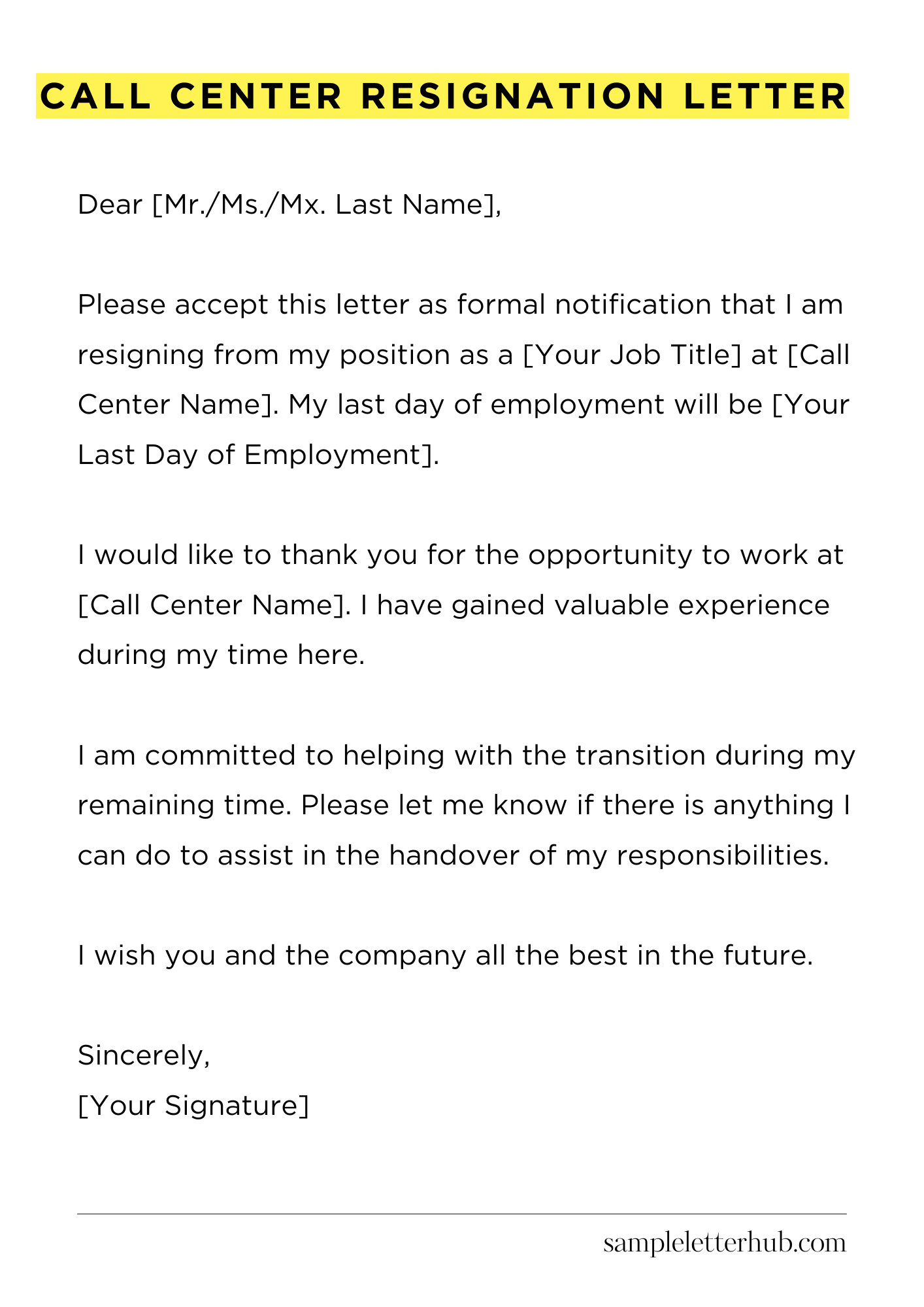
Dear [Mr./Ms./Mx. Last Name],
Please accept this letter as formal notification that I am resigning from my position as a [Your Job Title] at [Call Center Name]. My last day of employment will be [Your Last Day of Employment].
I would like to thank you for the opportunity to work at [Call Center Name]. I have gained valuable experience during my time here.
I am committed to helping with the transition during my remaining time. Please let me know if there is anything I can do to assist in the handover of my responsibilities.
I wish you and the company all the best in the future.
Sincerely,
[Your Signature]
How to Write a Call Center Resignation Letter
1. Getting Started: The Basics You Need
Leaving your call center job? It’s a big step. You’ll need to resign formally, and that means a well-crafted letter. First things first: keep it professional. Avoid venting frustrations, even if you’ve had a tough time. Stick to the facts. This is the foundation of a good resignation. Your reputation matters.
Your goal is to leave on good terms, if possible. Start with your full name, address, phone number, and the date at the top of the letter. Then, address it to your direct supervisor or the appropriate HR representative.
2. Expressing Your Intent to Leave: Clear and Concise
Now, state your intention to resign. This should be direct and to the point. The first sentence is crucial; it sets the tone. Use a phrase like, “Please accept this letter as formal notification that I am resigning from my position as [Your Job Title] at [Company Name].” Easy, right? Remember to include the specific date of your last day of employment.
This is important for payroll and transitioning your duties. This date is usually two weeks from the date you submit the letter. Confirming this with your employer beforehand is always a good idea.
3. Acknowledging Your Time and Expressing Gratitude
Next, it’s a good idea to acknowledge your employment. Briefly mention your time with the company. Expressing gratitude for the opportunity is a professional touch, even if the job wasn’t perfect. A simple “I have enjoyed my time at [Company Name] and appreciate the opportunities I have been given” works perfectly.
However, this is optional, so consider your own circumstances. It shows you’re not burning bridges. It makes you appear more professional, and you never know when you might need a reference.
4. Detailing the Transition: What About Handover?
Think about the transition. Can you assist with the handover of your responsibilities? Mention your willingness to help. Offering support in training your replacement or completing any pending tasks is a great move.
A sentence like, “I am committed to ensuring a smooth transition and am happy to assist in training my replacement or completing any outstanding tasks before my departure” is ideal. This shows professionalism and consideration, which will be remembered. This also helps your former employer and shows good work ethic.
5. Closing and Finalizing: Simple and Polite
Finally, close the letter with a polite statement. Something like “I wish [Company Name] all the best in the future.” Finish with a formal closing, such as “Sincerely,” or “Respectfully,” followed by your full name. Proofread your letter carefully before sending it.
Make sure there are no typos or grammatical errors. After you’ve done this, print the letter and sign it. Consider keeping a copy for your records. Good luck!
FAQs about Call Center resignation letter
What is the primary purpose of a Call Center resignation letter?
The primary purpose of a call center resignation letter is to formally notify your employer of your intention to leave your position. It serves as an official record of your departure and helps to initiate the handover process, ensuring a smooth transition. It also allows you to express your gratitude for the opportunity and, if desired, to provide a reason for your resignation.
What key elements should be included in a Call Center resignation letter?
A well-crafted call center resignation letter should include: your official resignation date, a clear statement of your intent to resign, your name and job title, and a professional closing.
It may also include a brief expression of gratitude to your employer and a mention of your willingness to assist with the handover process. Avoid including negative statements about your employer or the company.
How much notice should I give in my Call Center resignation letter?
The amount of notice you should give in your resignation letter typically depends on your employment contract or company policy. Standard practice is often two weeks, but you should review your contract or consult with your HR department. Providing sufficient notice is crucial for maintaining a positive relationship with your employer and avoiding any potential legal issues.
Should I provide a reason for resigning in my Call Center resignation letter?
While not mandatory, it is often considered good practice to briefly mention the reason for your resignation in your letter, especially if you are leaving on good terms. You can keep it brief and positive, such as “to pursue another opportunity” or “to focus on personal commitments.” Avoid going into excessive detail or including negative feedback about the company or colleagues.
How should I deliver my Call Center resignation letter?
The preferred method of delivering your resignation letter is typically in writing, either on paper or via email. Handing it directly to your supervisor or HR representative is usually best. Make sure to keep a copy of your letter for your records. Following up with a brief conversation to discuss your departure is also recommended, but ensure you do so after delivering the written notice.
Related:
Resignation letter due to rude boss
Resignation letter moving to another state
Resignation letter due to illness of family member
Resignation letter due to study