

A “Cadre resignation letter” is a formal document. It is written to officially inform your organization of your departure. The purpose is to formally notify your employer. It also communicates your last working day.
Are you looking for a sample resignation letter? We’ve got you covered. This article offers several letter samples. You can easily adapt them to your specific situation.
These examples are designed to simplify the process. Use them as a starting point. Craft a professional resignation letter.
Cadre Resignation Letter
Below is a sample of a Cadre Resignation Letter:
[Your Name]
[Your Address]
[Your Phone Number]
[Your Email Address]
[Date]
[Recipient’s Name] (If known, otherwise use title)
[Recipient’s Title]
[Company Name]
[Company Address]
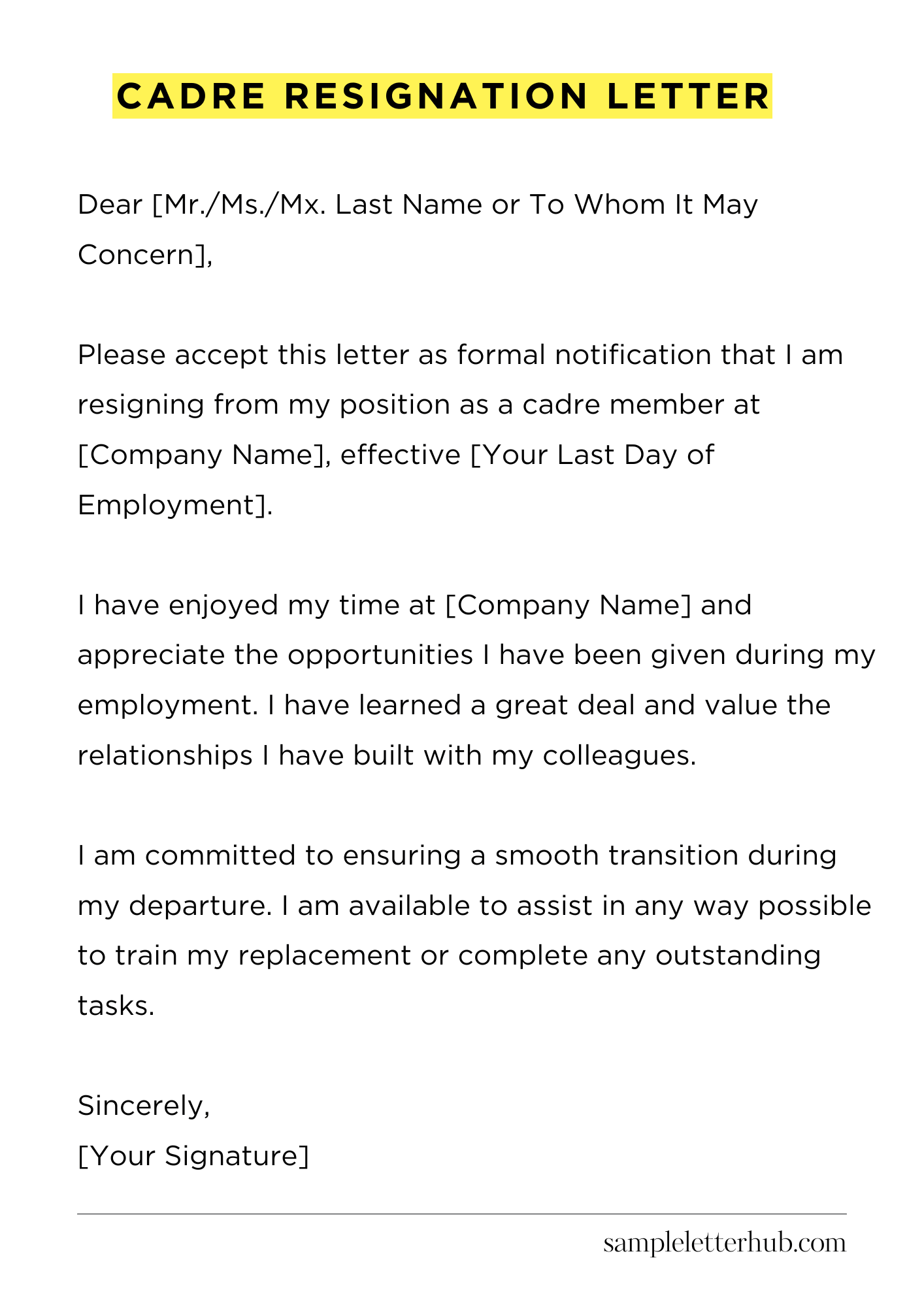
Dear [Mr./Ms./Mx. Last Name or To Whom It May Concern],
Please accept this letter as formal notification that I am resigning from my position as a cadre member at [Company Name], effective [Your Last Day of Employment].
I have enjoyed my time at [Company Name] and appreciate the opportunities I have been given during my employment. I have learned a great deal and value the relationships I have built with my colleagues.
I am committed to ensuring a smooth transition during my departure. I am available to assist in any way possible to train my replacement or complete any outstanding tasks.
I wish [Company Name] continued success in the future.
Sincerely,
[Your Signature]
How to Write a Cadre Resignation Letter
Why a Cadre Resignation Letter Matters
So, you’re ready to move on. That’s a big step! Leaving a cadre position, which typically comes with specific rules and responsibilities, requires a well-crafted resignation letter. It is crucial. Why? It’s not just a formality. This letter serves several important purposes. First, it officially notifies your employer of your intention to leave.
This starts the clock on any notice period you are required to serve. Secondly, it documents your departure. This can be important for your employment records. A thoughtfully written letter can also help maintain positive relationships with your former colleagues and employer. You want to leave a good impression, right?
A poorly written letter, conversely, could create unnecessary complications and damage your professional reputation. Think about it: this letter is your last official communication. Make it count!
Key Components to Include
Now, let’s talk specifics. What should you actually *say* in your letter? There are a few essential elements. Begin by stating your clear intent to resign. Be direct. State your position, and the date you intend for your resignation to be effective. This is non-negotiable. Next, briefly express your gratitude for the opportunity.
This is a chance to show appreciation for your time in the role, even if the experience was not always perfect. This is a professional courtesy. Keep it concise. Do not go on and on. Then, you may want to offer assistance with the transition. Offer to help train your replacement, or complete any outstanding tasks.
This demonstrates your commitment to a smooth handover. It’s often appreciated. Finally, end on a positive note. Wish your employer and colleagues well. This reinforces a good impression. Consider adding your contact information for any follow-up questions.
Formatting for a Professional Look
The letter’s format is just as important as the content. You need to make a good first impression. Start with a formal salutation, addressing the appropriate person.
Often, this will be your direct supervisor or the head of your department. Use a professional tone throughout the letter. Keep it concise and to the point; avoid excessive detail.
Be sure to use a standard business letter format. This typically includes a clear font, like Times New Roman or Arial, and single spacing with a blank line between paragraphs. Proofread carefully. Check for any grammatical errors or typos.
These mistakes diminish credibility. Print the letter on high-quality paper. If delivering it in person, hand it over respectfully. If sending it electronically, be sure to save it as a PDF file. This is to maintain the formatting. A well-formatted letter looks polished and shows respect for the recipient.
Crafting the Right Tone
Your tone is critical. It sets the atmosphere of your letter. Maintain a professional and respectful tone. Even if you are unhappy with your cadre role, avoid any negative or critical comments.
The goal is to leave on a positive note. Focus on the future, not the past. Use positive language. Frame your departure as a personal decision. Avoid blaming others or airing grievances. Instead of dwelling on the negatives, simply state your reason for leaving, if you choose to include one. Keep it brief.
For example, “I am pursuing a new opportunity.” or “I’ve decided to prioritize personal commitments.” Always remain polite. This ensures that you maintain a good relationship. It can be particularly important in close-knit communities or if you anticipate needing to work with these individuals again in the future.
Common Mistakes to Avoid
Avoid common pitfalls when writing your cadre resignation letter. One of the biggest mistakes is being unprofessional. Don’t use slang or informal language. Another mistake is including excessive detail. Keep it short and sweet. Avoid rambling about your job or why you are leaving. Do not burn any bridges.
Resist the urge to criticize or complain about your employer or colleagues. It’s rarely worth it. Don’t be too vague or ambiguous. Ensure you clearly state your resignation date.
This is crucial for payroll and other administrative matters. Also, make sure you keep a copy of your letter for your records. Finally, and most importantly, never submit your resignation without being sure of your decision. Reflect on your choices and their implications.
FAQs about Cadre Resignation Letter
What is a Cadre Resignation Letter?
A cadre resignation letter is a formal document submitted by an individual, typically a government employee or a member of a specialized group (cadre), to officially resign from their position.
It states the employee’s intent to leave their role, the effective date of their resignation, and any other pertinent details as required by the employing organization’s or the cadre’s specific rules and regulations.
What Information Should be Included in a Cadre Resignation Letter?
A comprehensive cadre resignation letter generally includes the employee’s name, designation, and the department/cadre they belong to. It should clearly state the intention to resign, the desired last working day, and a brief and polite reason for leaving.
It may also include expressions of gratitude, offers of assistance during the transition, and contact information for future correspondence. The letter should adhere to any specific format or requirements outlined by the organization.
What are the Key Considerations When Writing a Cadre Resignation Letter?
Key considerations involve understanding the organization’s policies regarding resignations, including required notice periods. The letter should be professional in tone, avoid negative comments or personal attacks, and be grammatically correct.
It’s often beneficial to keep a copy of the letter and proof of its submission. Research and comply with any cadre-specific regulations or guidelines concerning resignations.
How Much Notice Should be Given in a Cadre Resignation Letter?
The required notice period varies depending on the organization’s policies and often the employee’s position and seniority. It is crucial to review the employment contract, cadre rules, or any relevant internal guidelines to determine the appropriate notice period. Common notice periods can range from two weeks to three months or more.
Failing to provide the correct notice may have consequences, such as forfeiture of salary or benefits.
What Happens After Submitting a Cadre Resignation Letter?
After submitting the letter, the employee’s supervisor or the relevant authority will usually acknowledge receipt. There may be an exit interview to discuss the reasons for resignation and any outstanding matters.
The organization will then begin the process of clearing the employee, which includes returning company property, completing final paperwork, and calculating the final salary and benefits. The employee should ensure all necessary steps are completed and keep records of all communications and transactions during this period.
Related:
Resignation letter due to rude boss
Resignation letter moving to another state
Resignation letter due to illness of family member
Resignation letter due to study