

Ready to move on from the world of in-flight service? A cabin crew resignation letter is a formal document. It officially informs your airline of your decision to leave your position. The purpose is straightforward: to state your departure clearly and professionally.
Crafting the perfect resignation letter can feel daunting. We understand. That’s why we’re here to help. We’ll share several templates. You’ll find different examples. These samples will guide you.
Use them as a starting point. Modify them to fit your specific situation. Writing your own letter becomes much easier. Find the right words. Make your transition smooth and respectful.
Cabin Crew Resignation Letter
Below is a sample of a Cabin Crew Resignation Letter:
[Your Name]
[Your Address]
[Your Phone Number]
[Your Email Address]
[Date]
[Hiring Manager Name (if known), or “Hiring Manager”]
[Airline Name]
[Airline Address]
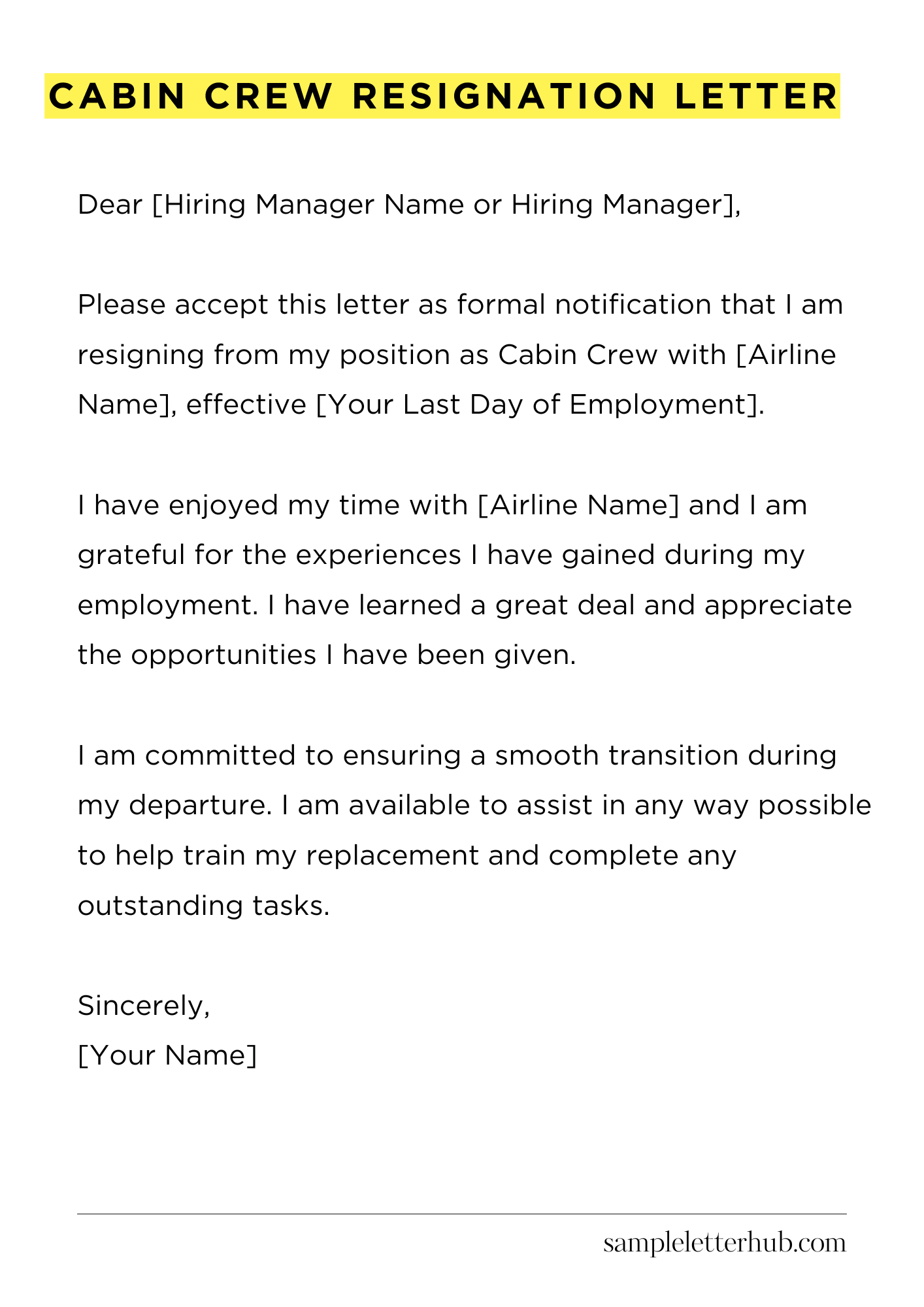
Dear [Hiring Manager Name or Hiring Manager],
Please accept this letter as formal notification that I am resigning from my position as Cabin Crew with [Airline Name], effective [Your Last Day of Employment].
I have enjoyed my time with [Airline Name] and I am grateful for the experiences I have gained during my employment. I have learned a great deal and appreciate the opportunities I have been given.
I am committed to ensuring a smooth transition during my departure. I am available to assist in any way possible to help train my replacement and complete any outstanding tasks.
Thank you for the opportunity to work with [Airline Name]. I wish the company continued success in the future.
Sincerely,
[Your Name]
How to Write a Cabin Crew Resignation Letter
1. Getting Started: The Basics You Need
Leaving a job as cabin crew can be bittersweet. You’ve likely made friends, seen amazing places, and learned a lot. But, if you’re ready to move on, you need to resign properly.
Firstly, it’s important to remember that a formal letter is always the best approach. It shows professionalism and respect, even if you’re leaving on less than friendly terms.
Before you start typing, make sure you know your contract’s terms. Find out how much notice you need to give. This could be two weeks, a month, or even longer, depending on your airline and your employment agreement. Ignoring this crucial detail could lead to problems down the road. You certainly don’t want to be stuck with potential financial repercussions.
2. Essential Elements: What to Include
Your resignation letter needs to be clear, concise, and professional. Start with your full name, address, and the date. Then, address it to the correct person. This is usually your direct supervisor or the relevant HR department. Always double-check this to avoid any confusion.
Next comes the body of your letter. Begin by stating your intention to resign and the date your resignation will be effective. For instance: “Please accept this letter as formal notification that I am resigning from my position as Cabin Crew, effective [Date].” Keep it simple. Now, express your appreciation for the opportunity.
Even if you’re unhappy, a little gratitude goes a long way. Mentioning specific experiences you enjoyed or skills you gained can be a nice touch.
3. Crafting the Perfect Wording
The tone of your letter should be polite and respectful. Avoid negativity or making complaints, even if you have them. Focus on the facts and keep it brief. This is not the place to air grievances.
When stating your reason for leaving, you can be vague if you prefer. Saying something like, “I am pursuing other opportunities” or “I have decided to explore a new career path” is perfectly acceptable.
Avoid getting into detailed explanations unless you specifically want to. The most important thing is to sound professional and not burn any bridges.
4. Final Touches: Proofreading and Format
Before you send your letter, proofread it carefully. Check for any spelling or grammatical errors. These mistakes can undermine your professionalism. It also gives the impression you don’t care enough.
The format should be clean and easy to read. Use a standard font like Arial or Times New Roman. Ensure proper spacing between paragraphs. Your letter should be well-organized and presentable. Finally, make a copy for your records. You never know when you might need it.
5. After the Letter: What to Expect
Once you’ve submitted your letter, your employer will likely acknowledge receipt of it. They may schedule an exit interview. This is a chance for them to ask you questions about your experience.
Be prepared to answer honestly, but again, remain professional. You can use it as an opportunity to provide feedback, but don’t dwell on negativity.
Remember that your reputation matters. Leaving on good terms is important for future references. Follow the agreed-upon notice period. Be available to help with the transition if asked. Good luck with your future endeavors. Your career is just beginning!
FAQs about Cabin Crew resignation letter
What is the standard format for a cabin crew resignation letter?
The standard format typically includes your name, address, contact information, the date, the recipient’s name and title (e.g., your direct manager or Head of Cabin Crew), the company’s name and address, a clear statement of resignation, your last day of employment, a brief expression of gratitude (optional), and your signature. It’s usually a formal business letter format.
What key information must be included in a cabin crew resignation letter?
Essential information includes a clear and concise statement of your intent to resign, the effective date of your resignation (your last day of employment), and your name and employee identification number, if applicable. While optional, you might also briefly mention reasons for leaving, particularly if there’s a professional standard or policy to abide by.
How much notice should a cabin crew member give when resigning?
The required notice period is generally specified in your employment contract or company handbook. Common notice periods range from two weeks to one month. Always refer to your contract for the specific terms. Adhering to the stipulated notice period is crucial to avoid any potential breaches of contract.
Should I include the reasons for my resignation in the letter?
It is usually optional to include your reasons for leaving. If you have a particularly positive experience you might mention a reason that is a positive one (e.g., accepting a new role in a different area).
If you experienced any particularly challenging situations, you might prefer to have a separate conversation with your manager or Human Resources. Keep the tone professional, regardless of your reasons.
How should I deliver the resignation letter and what should I expect after submitting it?
Submit your resignation letter according to your company’s policy. This is often in person to your direct supervisor or to HR, and then you can keep a copy of the letter for your own records.
After submitting, expect a response from your manager or HR confirming receipt of your letter. They will typically discuss your exit process, including the return of company property, final pay arrangements, and any necessary exit interviews.
Related:
Resignation letter due to rude boss
Resignation letter moving to another state
Resignation letter due to illness of family member
Resignation letter due to study