

So, you’re a Business Development Specialist ready to move on. A resignation letter is your official goodbye. It formally announces your departure from the company. It’s an important document. It helps to ensure a smooth transition.
Crafting the perfect resignation letter can feel tricky. Don’t worry, we’ve got you covered. We’ll provide you with various letter templates. You’ll find different examples here. They will cover diverse situations.
These samples are designed to help. Adapt them to fit your specific needs. Easily customize them. Writing your own letter becomes simple. Focus on your next adventure.
Business Development Specialist Resignation Letter
Below is a sample of a Business Development Specialist Resignation Letter:
[Your Name]
[Your Address]
[Your Phone Number]
[Your Email Address]
[Date]
[Employer’s Name]
[Company Name]
[Company Address]
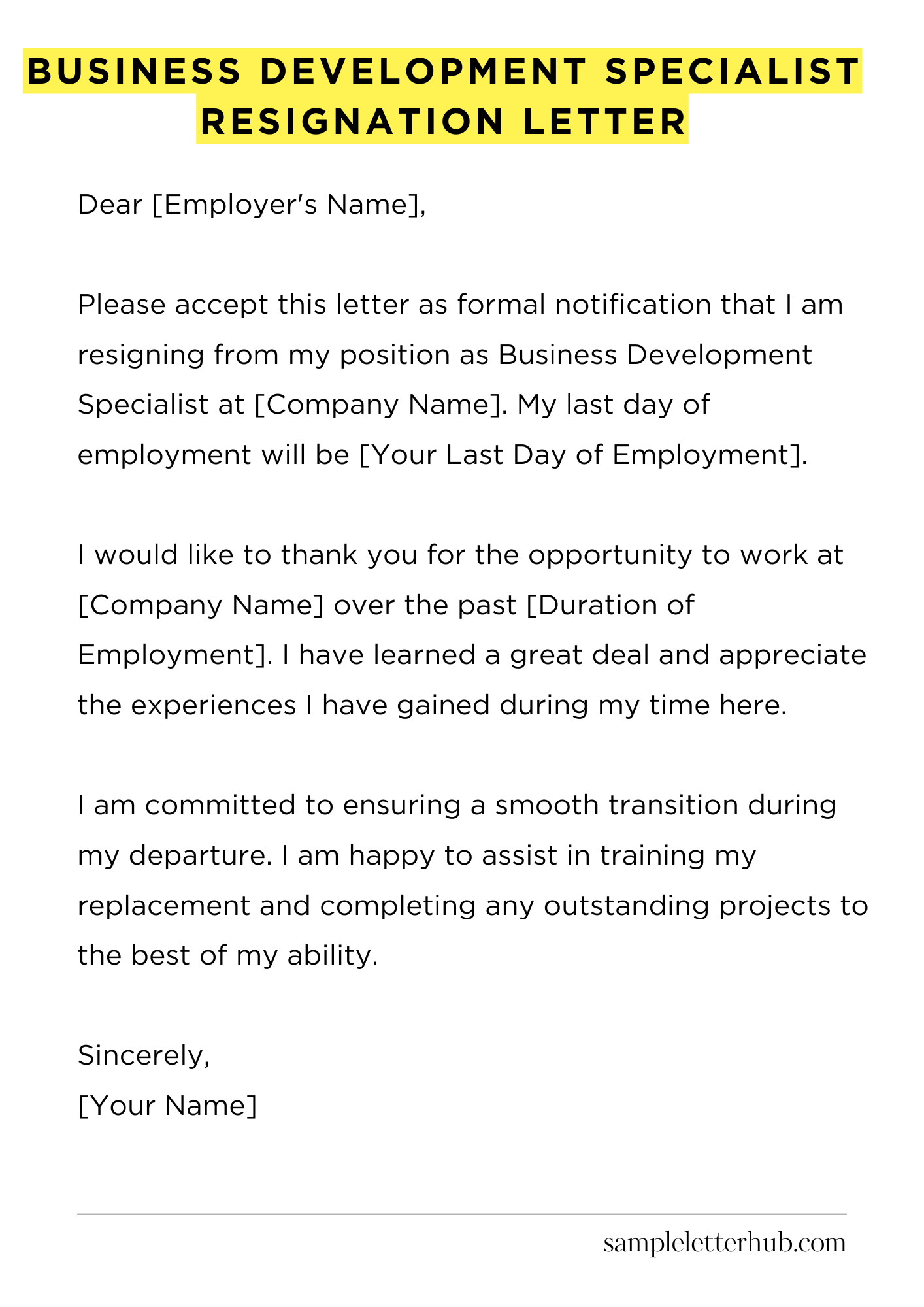
Dear [Employer’s Name],
Please accept this letter as formal notification that I am resigning from my position as Business Development Specialist at [Company Name]. My last day of employment will be [Your Last Day of Employment].
I would like to thank you for the opportunity to work at [Company Name] over the past [Duration of Employment]. I have learned a great deal and appreciate the experiences I have gained during my time here.
I am committed to ensuring a smooth transition during my departure. I am happy to assist in training my replacement and completing any outstanding projects to the best of my ability.
I wish you and [Company Name] all the best in the future.
Sincerely,
[Your Name]
How to Write a Business Development Specialist Resignation Letter
So, you’ve made a big decision. You’re ready to move on. Maybe you’ve found a better opportunity. Perhaps the current role isn’t the right fit. Whatever the reason, you’re looking to pen a resignation letter, and you want to do it right.
Crafting a professional and effective resignation letter is vital. It’s your final formal communication with your current employer, and it helps you maintain a positive relationship. Let’s get started on creating your letter.
1. Subject Line & Basic Structure: The Foundation
First things first, let’s talk about the subject line. Keep it short, sweet, and to the point. A simple “Resignation – [Your Name]” works perfectly. This will allow your recipient to quickly understand the email’s purpose.
Now for the body of the letter. Start with a formal salutation: “Dear [Manager’s Name],” or “Dear [Hiring Manager’s Name],” is appropriate. Next, clearly state your intention to resign and the effective date of your resignation.
Example: “Please accept this letter as formal notification that I am resigning from my position as Business Development Specialist, effective [Date].” That’s a direct and respectful way to start.
2. Expressing Gratitude: Showing Appreciation
This is where you demonstrate professionalism and grace. Even if your experience hasn’t been ideal, expressing gratitude is highly recommended. You’re not only being polite, but you’re also leaving a positive lasting impression.
Mention something specific you appreciate about your time there. Did you learn valuable skills? Were there particular colleagues you enjoyed working with?
“I am grateful for the opportunities I’ve had to develop my skills in [specific area] during my time here,” or “I appreciate the support and mentorship I received from [colleague’s name/manager’s name]” are both great options. A little bit of sincerity goes a long way!
3. Providing Assistance: Smoothing the Transition
This step highlights your commitment to professionalism. It also makes your departure easier for everyone involved. Offer your assistance in the transition process. Consider what you can do to help ensure a smooth handover of your responsibilities.
You might write: “I am committed to ensuring a smooth transition during my departure and am happy to assist in training my replacement and transferring my responsibilities,” or “I am available to assist in any way possible to facilitate the transition before my departure date.” This demonstrates your dedication and willingness to support your team even after your resignation.
4. Formal Closing and Contact Information: Final Touches
Close your letter with a formal closing: “Sincerely,” or “Best regards,” followed by your name. Ensure your contact information is readily available for reference. This should include your phone number and email address.
Consider adding a line that reiterates your thank you: “Thank you again for the opportunity to work at [Company Name].” Always proofread your letter carefully before sending it. Check for any typos, grammatical errors, and ensure the formatting is consistent. Make sure it’s perfect before pressing send.
5. Review and Refine: Make it Your Own
Before submitting, review your letter critically. Does it accurately reflect your intentions? Is the tone professional and respectful? Does it align with your personal brand?
Adjust the language to reflect your own style. Tailor the content to your specific situation and experiences. Customize the specifics and consider the company’s culture. Your resignation letter is a reflection of you. Make it count. By following these guidelines, you’ll create a polished, professional resignation letter that leaves a positive lasting impression. Good luck!
FAQs about Business Development Specialist Resignation Letter
What are the essential elements to include in a Business Development Specialist resignation letter?
A well-crafted resignation letter should include: your formal announcement of resignation, the effective date of your departure, a concise statement of your reason for leaving (optional, but can be helpful), a brief expression of gratitude to the company and your colleagues, and an offer to assist with the transition process.
It’s also professional to include your contact information for future correspondence.
How far in advance should a Business Development Specialist submit their resignation letter?
The standard practice is to provide at least two weeks’ notice, as outlined in most employment contracts and generally accepted in professional settings.
However, depending on your company’s policy and your seniority, longer notice periods may be expected. Always review your employment agreement for specifics and consider the impact your departure might have on ongoing projects.
Should a Business Development Specialist provide a reason for resigning in their letter?
While not strictly required, stating a reason, even a brief one, can be beneficial. It helps provide context for your departure and can assist the company in understanding potential areas for improvement (though this is not your primary goal). Keep the reason concise and positive. Examples include seeking new opportunities, career advancement, or a personal decision.
How should a Business Development Specialist handle confidential information in their resignation letter and during the transition?
Protecting confidential information is crucial. Your resignation letter should not reveal any proprietary information. During the transition, adhere to all company policies regarding data security, and avoid discussing confidential matters with competitors or outside parties.
If necessary, confirm your obligations in your employment agreement or seek guidance from your manager or HR department.
What is the best tone to use in a Business Development Specialist resignation letter?
Maintain a professional and positive tone throughout your resignation letter. Express your gratitude for the opportunities you’ve been given, and focus on the future. Avoid negative comments about the company or its employees. A polite and respectful tone ensures that you leave on good terms, preserving your professional reputation.
Related:
Resignation letter due to rude boss
Resignation letter moving to another state
Resignation letter due to illness of family member
Resignation letter due to study