

So, you’re a Business Development Representative (BDR). You’re ready to move on. A resignation letter is your official goodbye. It informs your employer of your departure. It’s a professional way to end your employment.
Writing this letter might feel tricky. Don’t worry, we’re here to help. We’ve got you covered. We’ll give you different templates. You can use them as a starting point. Choose the one that suits your needs.
We’ll share examples. These samples will make it easy. You can adapt them to your situation. Craft your perfect resignation letter today. It’s time to say farewell.
Business Development Representative Resignation Letter
Below is a sample of a Business Development Representative Resignation Letter:
[Your Name]
[Your Address]
[Your Phone Number]
[Your Email Address]
[Date]
[Hiring Manager Name] (If known, otherwise use title)
[Hiring Manager Title]
[Company Name]
[Company Address]
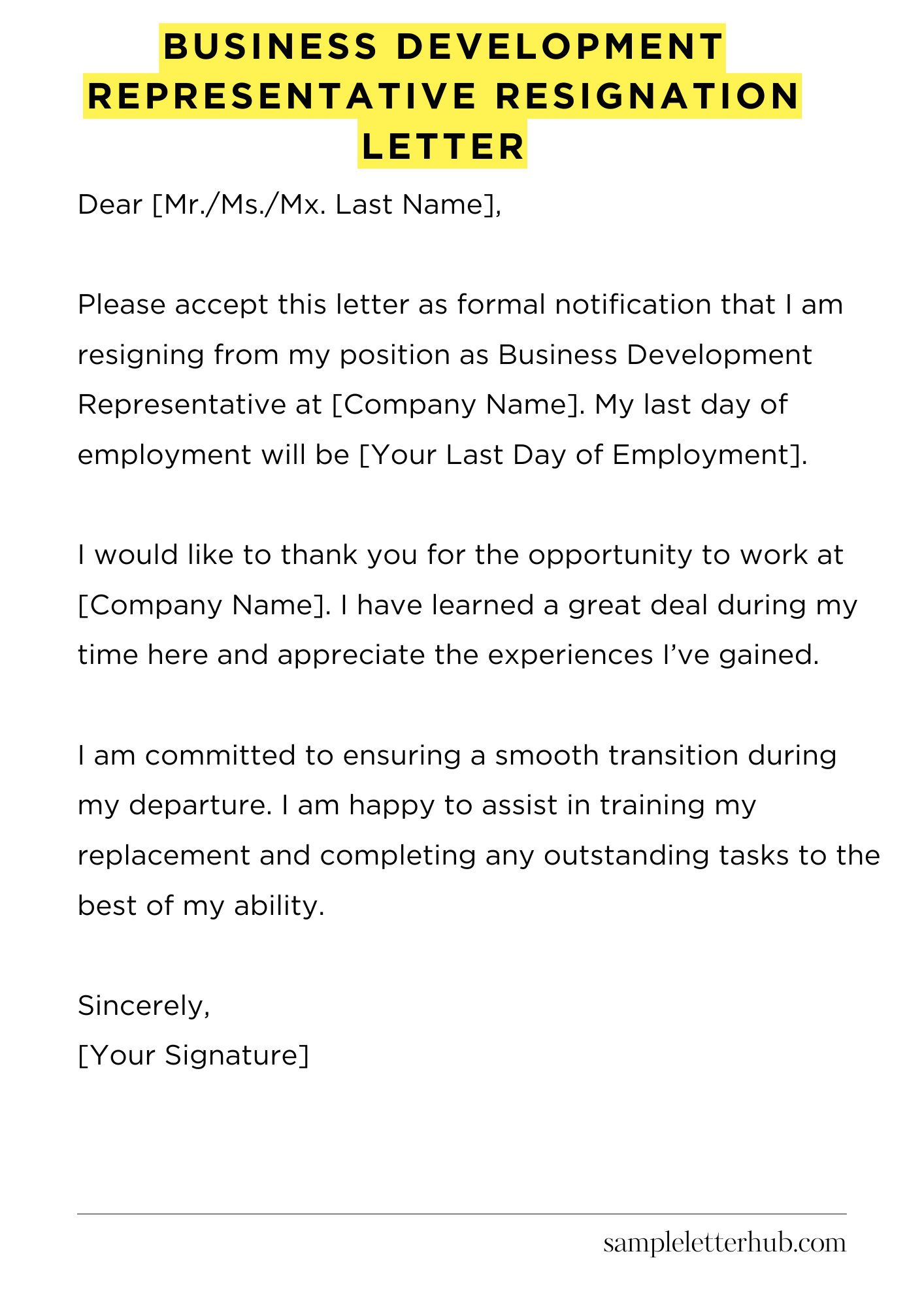
Dear [Mr./Ms./Mx. Last Name],
Please accept this letter as formal notification that I am resigning from my position as Business Development Representative at [Company Name]. My last day of employment will be [Your Last Day of Employment].
I would like to thank you for the opportunity to work at [Company Name]. I have learned a great deal during my time here and appreciate the experiences I’ve gained.
I am committed to ensuring a smooth transition during my departure. I am happy to assist in training my replacement and completing any outstanding tasks to the best of my ability.
I wish you and [Company Name] all the best in the future.
Sincerely,
[Your Signature]
How to Write a Business Development Representative Resignation Letter
Why Resigning Requires a Well-Crafted Letter
Leaving a job is a big deal, right? You’ve invested time and effort, and built relationships. Even if you’re not entirely thrilled, exiting professionally matters.
Your resignation letter is more than just a formality; it’s a critical document. Think of it as a bridge, ensuring you leave on good terms. You’re preserving your professional reputation.
Consider future opportunities. A well-written letter can open doors later. A poorly written one, could slam them shut. Therefore, this document deserves your careful attention.
Essential Elements: What to Include
So, what exactly needs to be in this all-important letter? First, you must state your intentions clearly. Specify your official resignation. Use clear and concise language.
State the date of your last day of employment. Next, express gratitude. Thank your employer for the opportunity. Mention any specific positive experiences you’ve had.
Now, consider the transition. Offer assistance with the handover process. Be prepared to help train your replacement. Lastly, keep it positive. Avoid negativity. Do not list grievances. That’s for another time and another place. Keep your tone professional.
Crafting the Right Tone and Style
The tone you choose sets the stage. Professionalism is key. This is not the time for sarcasm, complaints, or personal attacks. The language should be polite and respectful.
Keep the writing style formal. Use proper grammar and punctuation. Proofread carefully before sending it. You want to make a positive, lasting impression.
You want your letter to be read and understood easily. If in doubt, err on the side of caution. Overly casual language can undermine your message. You want to leave a good memory.
Formatting and Presentation Tips
How your letter looks is also important. Start with a professional header. Include your name, address, and the date. Next, address the letter to your direct manager or HR.
Use a standard business letter format. Choose a readable font, like Times New Roman or Arial. Keep the letter concise; typically, one page is enough. Use clear paragraphs for easy reading.
Avoid long, rambling sentences. If you’re sending it via email, use a clear subject line like “Resignation – [Your Name]”. Also, attach a PDF copy for proper formatting.
Finalizing and Delivering Your Letter
Before you send it, proofread again. Check for any errors in grammar or spelling. Ensure your contact information is correct. Consider who needs a copy of the letter. If needed, give it to your manager first. Inform HR too. Do it in person if possible. Discuss the letter briefly and professionally.
Then, deliver it with a smile, or a polite demeanor, even if it’s virtual. Be prepared to answer any questions. Finally, remember, your resignation letter sets the stage for your future. Send it with confidence. You’ve got this.
FAQs about Business Development Representative resignation letter
What is the essential information to include in a Business Development Representative (BDR) resignation letter?
A BDR resignation letter should clearly state your intention to resign, the effective date of your resignation, and a brief expression of gratitude for the opportunity.
While not mandatory, it is often considered professional to briefly mention your reason for leaving (e.g., pursuing other opportunities), especially if it’s a positive reason, such as a promotion or a career change. Also, be sure to include your name, contact information, and any specific requests regarding your final responsibilities or handover process.
What is the recommended format and tone for a BDR resignation letter?
The recommended format is a formal business letter. Use a professional and respectful tone, even if your experience with the company has been less than ideal.
Keep the letter concise and to the point. Start with a polite salutation (e.g., “Dear [Manager’s Name]”), followed by the clear statement of resignation, the effective date, and a thank-you note.
End with a professional closing (e.g., “Sincerely,” or “Best regards,”) followed by your signature and typed name. Proofread carefully before sending.
How much notice should a Business Development Representative give when resigning?
The standard notice period for a BDR, as with most professional roles, is typically two weeks. However, the specific notice period may be outlined in your employment contract or company policy.
Always refer to your contract and company guidelines. Providing adequate notice is crucial for maintaining a positive relationship with your employer and ensuring a smooth transition. Providing more than the required time is often appreciated.
Can I include feedback or constructive criticism in my BDR resignation letter?
While it’s acceptable to express gratitude, including extensive negative feedback or criticism in a resignation letter is generally not recommended. The resignation letter’s primary purpose is to formally announce your departure.
If you have constructive feedback to offer, consider discussing it separately with your manager during your exit interview or in a follow-up conversation, rather than in the letter itself. Keep it brief and constructive, if included.
What are some common mistakes to avoid when writing a BDR resignation letter?
Common mistakes to avoid include: being overly emotional or negative, using unprofessional language, including excessive detail about your new job or opportunities, failing to proofread for errors, and not adhering to your contractually obligated notice period.
It is also important not to burn bridges by being disrespectful or unprofessional. Always prioritize maintaining a positive and professional tone.
Related:
Resignation letter due to rude boss
Resignation letter moving to another state
Resignation letter due to illness of family member
Resignation letter due to study