


A Burial Insurance Cancellation Letter is a formal document. Its purpose is to cancel your burial insurance policy. You send this letter to the insurance company. This officially ends your coverage.
Dealing with insurance can be tricky. Writing the perfect burial insurance cancellation letter can be daunting. We have you covered. This article offers helpful letter templates. You can use them as a guide. We’ll share burial insurance cancellation letter examples. These are designed to simplify the process.
Our goal is to help you. These sample letters are straightforward. They cover various scenarios. Choose the one that fits your needs. This will make canceling your burial insurance easier. Get ready to draft your Burial Insurance Cancellation Letter today!
[Your Name/Your Company Name (If Applicable)]
[Your Address]
[Your Phone Number]
[Your Email Address]
[Date]
[Insurance Company Name]
[Insurance Company Address]
Dear [Insurance Company Name/Claims Department],
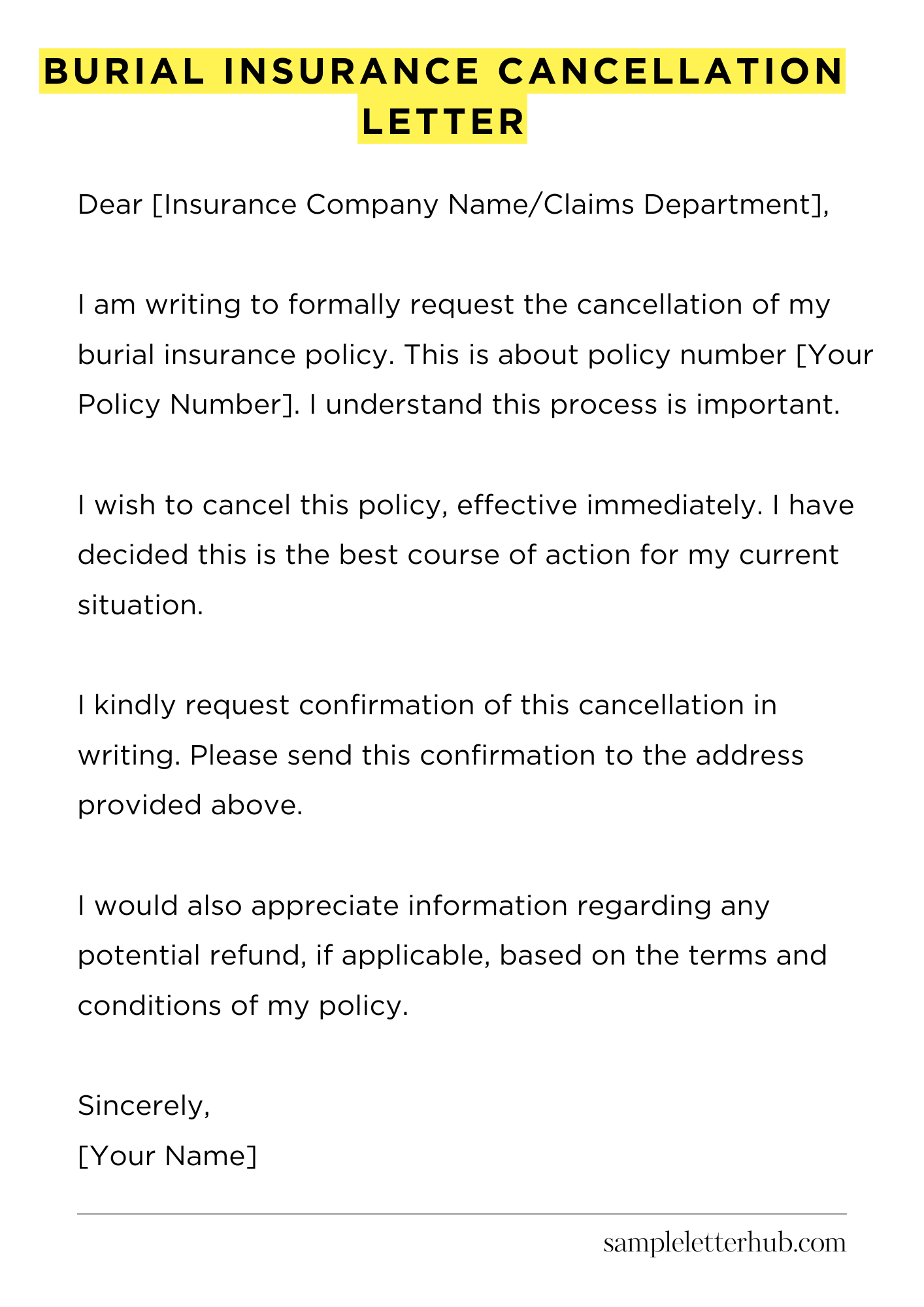
I am writing to formally request the cancellation of my burial insurance policy. This is about policy number [Your Policy Number]. I understand this process is important.
I wish to cancel this policy, effective immediately. I have decided this is the best course of action for my current situation.
I kindly request confirmation of this cancellation in writing. Please send this confirmation to the address provided above. This will help ensure everything is correctly processed.
I would also appreciate information regarding any potential refund, if applicable, based on the terms and conditions of my policy. It’s good to be informed about this. Please outline the refund process clearly.
Thank you for your prompt attention to this matter. I appreciate your assistance in finalizing this request. I look forward to receiving your confirmation soon.
Sincerely,
[Your Name]
How to Write Burial Insurance Cancellation Letter
Terminating a burial insurance policy requires a meticulous approach. This process, although seemingly straightforward, necessitates precision to ensure your request is processed expeditiously and without incident. This guide provides a comprehensive roadmap for crafting an effective cancellation letter.
1. Identifying the Policy Details
Before putting pen to paper (or fingers to keyboard), assemble all pertinent policy information. Locate your policy number; it’s the most crucial identifier.
This alphanumeric sequence is your key. Also, ascertain the full name of the policyholder (which could be you or someone else) as it appears on the official documentation. Retrieve the name of the insurance company. Finally, note the date the policy was issued. This preliminary reconnaissance will ensure accurate identification of the contract you intend to dissolve.
2. Formatting the Letter: The Formal Framework
Adhere to standard business letter etiquette. Begin by placing your contact information in the upper left-hand corner: your full name, address, phone number, and email address.
Below this, on the right side, include the date. Directly beneath the date, supply the insurance company’s address. Use a formal salutation, such as “Dear [Insurance Company Representative/Department].” This structure sets a professional tone, which is fundamental in any formal correspondence.
3. The Salient Statement: Expressing Your Intent
The core of your letter lies in clearly articulating your intention. Begin with an unequivocal statement. For example: “I am writing to formally request the cancellation of burial insurance policy number [Your Policy Number].” Keep the language direct and unambiguous. This eliminates any possibility of misinterpretation. State your purpose with concise efficacy.
4. Providing Supporting Data: Reinforcing Your Request
Subsequently, include the policyholder’s full name, the effective date of the policy (if known), and any other identifying information from your policy documents.
Be sure to reference the policyholder’s relationship to you, if it is not your policy. Include details regarding the method of payment to ensure this is appropriately addressed. The more context you provide, the less likely it is that the cancellation will get delayed.
5. Specifying Instructions: Seeking Confirmation and Handling Refunds
Outline your desired outcome. Specify how you want the cancellation handled. Request written confirmation of the cancellation, including the effective date.
If you are due a refund, clearly state the preferred method of reimbursement – check, direct deposit, etc. Provide the necessary banking details for a swift transaction. Explicit instructions expedite the process and prevent ambiguities.
6. The Concluding Remarks and Signature
Conclude your letter with a polite, yet assertive, closing. Use a professional closing, such as “Sincerely” or “Respectfully.” Sign your name above the typed name, ensuring a legible signature. If you have chosen to write the policyholder’s name, make sure the policyholder signs and dates the letter.
7. Delivery and Follow-Up: Ensuring Receipt and Verification
Send the letter via certified mail with return receipt requested. This provides proof of delivery. Retain a copy of the letter, the return receipt, and any other correspondence for your records.
If you do not receive a response within a reasonable timeframe (typically 3-4 weeks), follow up with the insurance company. Persistence and meticulous tracking are key to a successful cancellation. This allows you to verify that your instructions have been followed.
FAQs about Burial Insurance Cancellation Letter
What information should I include in a burial insurance cancellation letter?
Your cancellation letter should clearly state your intent to cancel the burial insurance policy. Include your full name, address, phone number, and policy number for easy identification. Reference the policy you are canceling and include the date you want the cancellation to take effect.
If you have any specific requests regarding the return of premiums or outstanding balances, you should also mention them in the letter. Some insurers may require a specific form, so be sure to check your policy documents.
What is the proper format for a burial insurance cancellation letter?
A burial insurance cancellation letter should be a formal business letter. Begin with your contact information (name, address) followed by the date, and then the insurance company’s contact information (name, address).
Address the letter to the appropriate department, usually the policy administration or cancellation department. Keep the letter concise, clear, and professional, avoiding emotional language. Use a standard business letter format with a salutation (e.g., “Dear [Insurance Company Name]”) and a closing (e.g., “Sincerely,” or “Respectfully,”).
How do I send my burial insurance cancellation letter?
The best way to send your cancellation letter is typically through certified mail with a return receipt requested. This provides proof that the insurance company received your letter and the date of receipt.
You can also send the letter via email if the insurance company accepts cancellations that way, and some may have an online portal. Always retain a copy of the letter and the confirmation of delivery for your records.
What happens after I send the cancellation letter?
After sending the cancellation letter, the insurance company will process your request. They should send you a confirmation of the cancellation, typically within a few weeks, which may include details on any premium refunds or outstanding amounts. The confirmation letter serves as your official record of the cancellation.
If you do not receive a confirmation within a reasonable timeframe (as specified in your policy), follow up with the insurance company to ensure the process is complete.
Can I get a refund of my premiums when cancelling burial insurance?
Whether you receive a refund of your premiums depends on the terms of your specific burial insurance policy. Some policies, especially whole life policies, may have a cash value that can be refunded upon cancellation (minus any surrender charges). Term life policies typically do not offer a refund of premiums.
Review your policy document for details on cancellation terms, refund policies, and any associated fees or penalties before sending the cancellation letter.
Related:
Resignation letter due to rude boss
Resignation letter moving to another state
Resignation letter due to illness of family member
Resignation letter due to study