

Leaving a biology job? You’ll need a resignation letter. It formally notifies your employer of your departure. This letter is a key step in a professional exit.
Writing a resignation letter can be tricky. We can help make it easier. We’ve compiled helpful templates and examples. These are designed to guide you.
Use these samples to craft your own letter. Find the perfect words to fit your situation. Resigning with grace is now simple.
Biologist Resignation Letter
Below is a sample of a Biologist Resignation Letter:
[Your Name]
[Your Address]
[Your Phone Number]
[Your Email Address]
[Date]
[Employer’s Name]
[Employer’s Title]
[Company Name]
[Company Address]
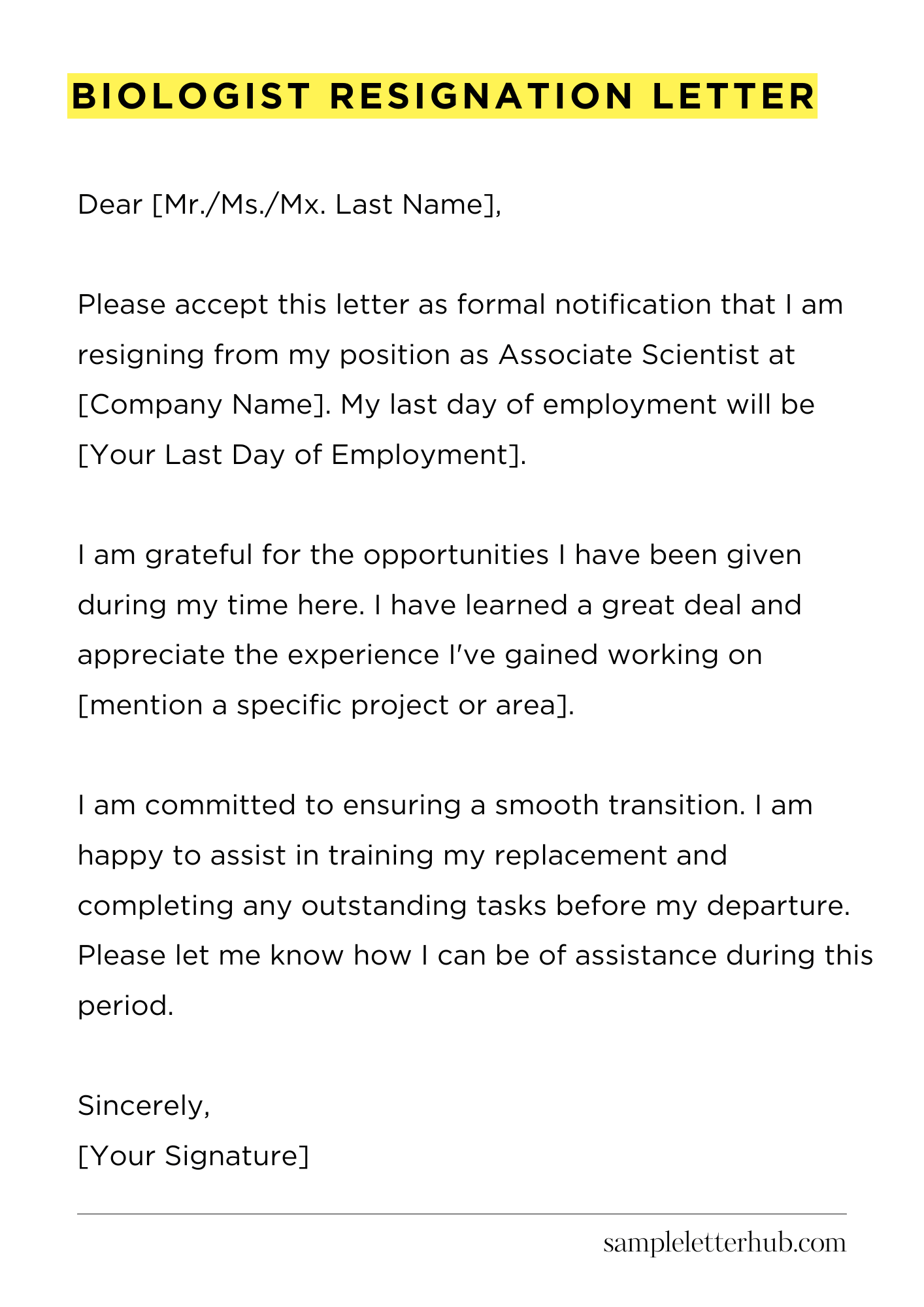
Dear [Mr./Ms./Mx. Last Name],
Please accept this letter as formal notification that I am resigning from my position as Biologist at [Company Name]. My last day of employment will be [Your Last Day of Employment].
I would like to express my gratitude for the opportunities I have been given during my time here. I have learned a great deal and appreciate the experience I’ve gained working on [mention a specific project or task].
I am committed to assisting with the transition during my remaining time here. Please let me know how I can be of assistance in the handover of my responsibilities.
I wish you and [Company Name] all the best in the future.
Sincerely,
[Your Signature]
How to Write a Biologist Resignation Letter
Understanding the Basics
Resigning from a job can be a big step. Especially when you have been working as a biologist. It is important to remember professionalism is key. A well-crafted resignation letter is your official notice to your employer. Think of it as a formal goodbye. It signals your intention to leave your current position.
This document helps to ensure a smooth transition. It also protects your professional reputation. You have to ensure that all is done correctly.
Your letter should be concise, clear, and respectful. Avoid any negativity or personal grievances, even if you are not happy. Keep things factual and to the point. The main goal is to inform your employer of your departure. You want to state the effective date of your resignation. Also, show your willingness to assist with the handover process.
Structuring Your Letter: The Core Components
There are some simple parts that are often included in a typical resignation letter. Start with your contact information (name, address, phone number, and email address). Put the date of the letter below your details. After that, address your supervisor or the appropriate HR representative with their name. Always use formal language, like “Dear Mr./Ms. [Last Name]”.
The body of your letter has to clearly state your intention to resign. Specify your current role. Mention the specific date of your last day of employment. This is really important. In a sentence or two, express your gratitude for the opportunity to work there. You can briefly mention any positive experiences or skills you’ve gained.
Offer your assistance with the transition. You could write that you are happy to help train your replacement. You can also offer to document any crucial projects. End the letter with a professional closing. Use phrases like “Sincerely,” or “Best regards,” followed by your full name. Don’t forget to sign the physical letter if you are submitting a hard copy.
Crafting the Right Tone
Maintain a professional and positive tone. Even if you are leaving due to dissatisfaction. Your letter is a reflection of your character. It’s also part of your permanent record. Avoid any complaints, criticisms, or negative language. Be gracious and polite throughout the letter.
Focus on the future. Briefly acknowledge your past experience, but concentrate on your decision. Acknowledge your intention to move on. Focus on your new opportunity. This is all that matters. Refrain from revealing too much about your future plans. Keep it brief and professional.
Essential Information and Best Practices
Double-check all the facts before sending your letter. Be sure the date is accurate. The name of the recipient should be correct. The resignation date should align with your employment contract or any company policies. Make a copy of the letter for your records. Save it for future reference.
Submit your letter according to company policy. Whether it is hard copy or email. Ensure you follow all the rules of your workplace. Do not leave this step out. Always be professional. Provide enough notice. The standard is typically two weeks. However, this may change depending on your job. Ensure you meet all requirements.
Example Resignation Letter (Biologist)
Here is an example you can use as a guide:
[Your Name]
[Your Address]
[Your Phone Number]
[Your Email Address]
[Date]
[Supervisor’s Name]
[Supervisor’s Title]
[Company Name]
[Company Address]
Dear Mr./Ms. [Last Name],
Please accept this letter as formal notification that I am resigning from my position as Biologist at [Company Name], effective [Your Last Day of Employment].
I am grateful for the opportunities I have been given during my time here. I have learned a lot and appreciate the experiences I have gained.
I am willing to assist in the transition process. I am prepared to help train my replacement and document my ongoing projects as needed.
Sincerely,
[Your Signature]
[Your Typed Name]
FAQs about Biologist resignation letter
How should a Biologist start their resignation letter?
A Biologist should begin their resignation letter formally and professionally. Start by addressing the recipient (usually their direct supervisor or HR department) with their title and name.
Clearly state your intention to resign from your position as a Biologist, and include the effective date of your last day of employment. This establishes the purpose of the letter immediately.
What key information should be included in a Biologist’s resignation letter?
The core elements of a Biologist’s resignation letter should encompass: the formal declaration of resignation and the last day of employment. Briefly express gratitude for the opportunities provided.
Optionally, you can give a brief, professional reason for leaving, if desired, and provide contact information for any follow-up questions. Consider offering to assist with the transition of your responsibilities, such as training a replacement.
Should a Biologist include a reason for leaving in their resignation letter?
Including a reason for leaving is optional. If you choose to, keep it concise and professional. You might briefly mention pursuing a new career opportunity, relocation, or personal reasons.
Avoid providing negative commentary about your employer or colleagues. If you prefer not to disclose the reason, that is perfectly acceptable. It is important to maintain a professional tone throughout.
How should a Biologist address their obligations and ongoing projects in their letter?
In your resignation letter, it’s wise to address your existing obligations and ongoing projects. You could briefly state your willingness to assist in the transition.
This might include providing documentation, training a replacement, or completing any urgent tasks before your departure. Offering a smooth handover demonstrates professionalism and helps maintain a positive relationship with your former employer.
What is the appropriate tone and format for a Biologist’s resignation letter?
The appropriate tone and format for a Biologist’s resignation letter is formal, professional, and respectful. Use a business letter format, including your contact information, the date, the recipient’s information, and a clear subject line (e.g., “Resignation”).
Maintain a positive and appreciative tone, even if you are leaving due to negative circumstances. Proofread carefully before submitting your letter to avoid errors.
Related:
Resignation letter due to rude boss
Resignation letter moving to another state
Resignation letter due to illness of family member
Resignation letter due to study