


Dealing with life insurance can be tricky. One key aspect is naming your beneficiary. This is the person or people who will receive the death benefit. A Beneficiary Change Request Letter for Life Insurance allows you to update this crucial information. It officially informs your insurance provider about changes.
Need to change your life insurance beneficiary? No worries! We’ve got you covered. We’re here to make the process easier. This article offers templates and examples. We’ll show you various sample Beneficiary Change Request Letter for Life Insurance formats.
Writing this letter can feel daunting. But, with our help, it’s simple. We want to empower you. Our goal is to simplify this important task. We hope the templates will help you create your own life insurance beneficiary change letter quickly and accurately.
[Your Name]
[Your Address]
[Your Phone Number]
[Your Email Address]
[Date]
[Insurance Company Name]
[Insurance Company Address]
Subject: Beneficiary Change Request – Life Insurance Policy [Policy Number]
Dear Sir/Madam,
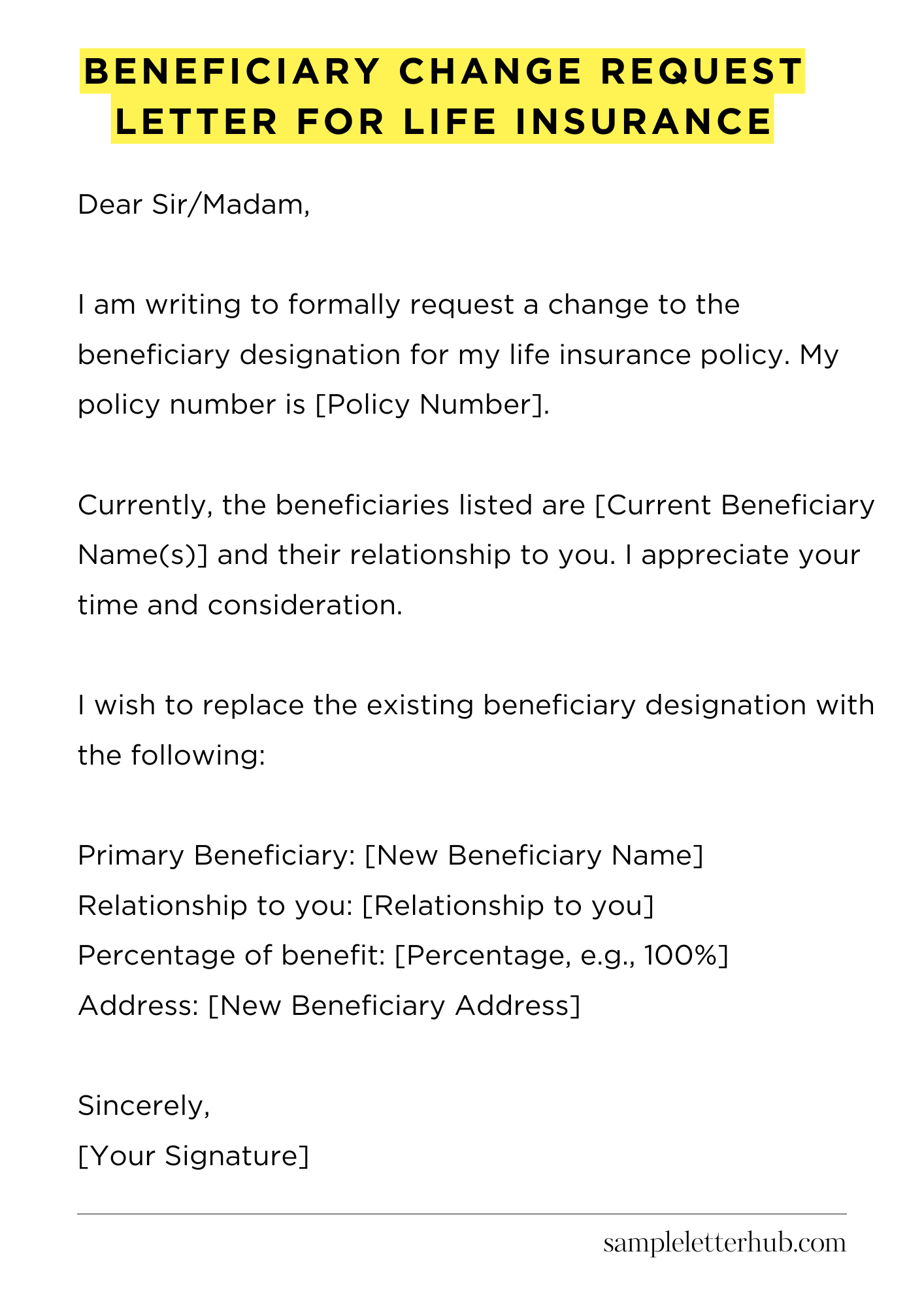
I am writing to formally request a change to the beneficiary designation for my life insurance policy. My policy number is [Policy Number]. I would like to update the information on file. This is important for my family’s future.
Currently, the beneficiaries listed are [Current Beneficiary Name(s)] and their relationship to you. I appreciate your time and consideration.
I wish to replace the existing beneficiary designation with the following:
Primary Beneficiary: [New Beneficiary Name]
Relationship to you: [Relationship to you]
Percentage of benefit: [Percentage, e.g., 100%]
Address: [New Beneficiary Address]
[If applicable, add information for a second beneficiary, following the same format, for example:
Secondary Beneficiary: [New Beneficiary Name, if any]
Relationship to you: [Relationship to you]
Percentage of benefit: [Percentage, e.g., 50%]
Address: [New Beneficiary Address]
]
Please find enclosed a copy of my driver’s license for verification purposes. I’ve also included a completed beneficiary change form. Completing this ensures everything is up-to-date. I have signed and dated all necessary sections.
Please confirm receipt of this request and let me know when the change has been processed. I’d like to ensure everything is in order. You can reach me at the phone number or email address listed above.
Thank you for your assistance with this matter. I understand that processing these things may take some time.
Sincerely,
[Your Signature]
How to Write Beneficiary Change Request Letter for Life Insurance
Life insurance policies are critical for financial security. Ensuring your beneficiaries are accurately designated is paramount. A beneficiary change request letter initiates the process of altering who receives the death benefit upon your passing. Here’s a comprehensive guide to navigate this process with alacrity.
1. Understanding the Stipulations: Your Policy’s Fine Print
Before you begin, scrutinize your life insurance policy. Each insurer has its unique protocols. Examine the policy’s specific requirements for beneficiary modifications.
Some policies may mandate particular forms, notarization, or specific language. Ignorance of these stipulations can lead to rejection and unnecessary delays. Familiarize yourself with the policy’s lexicon and any associated rider terms. This will streamline the procedure.
2. Gathering Pertinent Data: Essential Information Collection
Gather the requisite information. This encompasses your full name, the policy number, and the names of both the current and the intended beneficiaries.
For each beneficiary, collect their full legal name, date of birth, address, and social security number. Having this data readily available mitigates errors and expedites the submission. Ensure the information is exact; discrepancies can be problematic.
3. Crafting the Salutation: Addressing the Insurer
Address your letter formally. Begin by writing the insurer’s name and address. Following this, use a proper salutation, such as “To Whom It May Concern” or, preferably, the name of a specific contact person, if known. Maintaining a professional tone from the outset is prudent; it sets the right tone for your request.
4. The Body of Your Request: Articulating Your Intent
The body of your letter is where you communicate your explicit intentions. State clearly that you’re requesting a beneficiary change. Include your policy number.
Then, provide the details for the current beneficiaries (if any) and the updated beneficiaries you are designating. Specify the percentage each beneficiary should receive, remembering the total should equal 100%. State that you wish this change to be effective immediately, or provide the date.
5. Precision is Paramount: The Importance of Accuracy
Double-check all information before finalizing your letter. Spelling mistakes, inaccurate dates, or incorrect beneficiary details can cause substantial complications. Verify that the names match those on legal documentation, and that the percentages allocated are correct. Proofread meticulously. Errors can result in rejection or delays, potentially causing financial disquiet in the future.
6. The Formal Closure: Sign, Date, and Submit
Conclude your letter with a formal closing, like “Sincerely,” or “Respectfully.” Sign your name above your printed name. Date the letter. Consider having your signature notarized. Some insurance companies require it, or it may be recommended.
Make a copy of your letter for your records. Send the original via certified mail with return receipt requested. This provides proof of delivery and ensures a traceable trail.
7. Follow-Up Protocol: Monitoring the Process
After submitting your letter, monitor its status. The insurance company should send you confirmation of the change. Retain all correspondence. Contact the insurer within a reasonable timeframe (typically a few weeks) if you haven’t received confirmation.
This ensures your request is processed correctly and that your life insurance beneficiaries are updated as intended, providing peace of mind. Keeping on top of this matter is crucial to financial prudence.
FAQs about Beneficiary Change Request Letter for Life Insurance
What is a Beneficiary Change Request Letter for Life Insurance?
A beneficiary change request letter is a formal document used to update the individuals or entities designated to receive the death benefit from a life insurance policy. It officially notifies the insurance company of the policyholder’s desire to change the beneficiaries named on their policy.
What Information Should I Include in a Beneficiary Change Request Letter?
The letter should include the policyholder’s full name, policy number, and the names, relationships, and contact information of the new beneficiaries. Specify the percentage of the death benefit each beneficiary is to receive.
It’s often recommended to include the policyholder’s signature, date, and sometimes, a witness signature is required. Always reference the specific policy number.
How Do I Submit a Beneficiary Change Request Letter?
The submission process typically involves sending the completed and signed letter to the insurance company. Methods of submission vary; it can be mailed, faxed, or sometimes submitted online through the insurer’s portal. Confirm the acceptable submission methods by reviewing the policy documents or contacting the insurance provider directly.
Can I Change Beneficiaries on a Life Insurance Policy at Any Time?
Generally, yes, a policyholder can change beneficiaries at any time, as long as the policy is in force and they have the right to do so. However, there might be restrictions if an irrevocable beneficiary has been named or if the policy is involved in a legal dispute. Always review your policy’s specific terms and conditions.
How Long Does It Take for a Beneficiary Change to Be Processed?
The processing time varies depending on the insurance company and the complexity of the request. Typically, it can take anywhere from a few days to a few weeks. The policyholder usually receives written confirmation of the change once it has been processed. Keeping copies of all documents submitted is recommended for your records.
Related:
Resignation letter due to rude boss
Resignation letter moving to another state
Resignation letter due to illness of family member
Resignation letter due to study
Resignation letter due to long commute