

A Behavior Therapist resignation letter is a formal document. It informs your employer of your intention to leave your job. The letter officially states your last day of employment. It helps you end your professional relationship respectfully.
Need to quit your Behavior Therapist job? Writing a resignation letter can feel tricky. We’ve got you covered. We’ll share several helpful templates. These examples will guide you. They’ll make writing your own letter much easier.
These sample letters offer different approaches. Find the best fit for your situation. Adapt them to reflect your own unique circumstances. You can make it simple, or add more details. We aim to ease this process.
Behavior Therapist Resignation Letter
Below is a sample of a Behavior Therapist Resignation Letter:
[Your Name]
[Your Address]
[Your Phone Number]
[Your Email Address]
[Date]
[Employer’s Name]
[Employer’s Title]
[Company Name]
[Company Address]
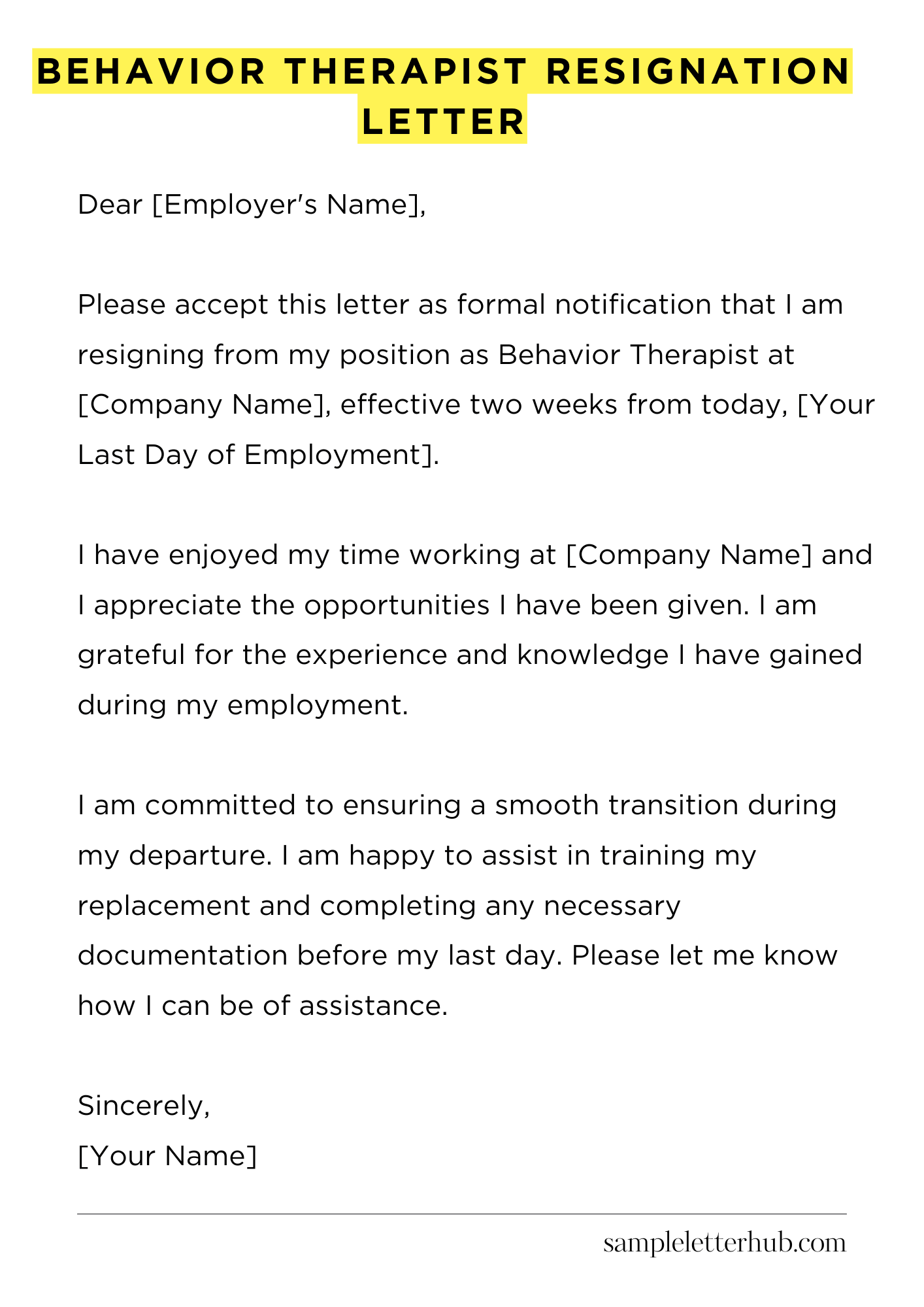
Dear [Employer’s Name],
Please accept this letter as formal notification that I am resigning from my position as Behavior Therapist at [Company Name], effective two weeks from today, [Your Last Day of Employment].
I have enjoyed my time working at [Company Name] and I appreciate the opportunities I have been given. I am grateful for the experience and knowledge I have gained during my employment.
I am committed to ensuring a smooth transition during my departure. I am happy to assist in training my replacement and completing any necessary documentation before my last day. Please let me know how I can be of assistance.
I wish you and [Company Name] all the best in the future.
Sincerely,
[Your Name]
How to Write a Behavior Therapist Resignation Letter
Leaving a job, especially one as important as a behavior therapist, requires careful consideration. It also demands a professional and well-crafted resignation letter. Don’t just dash something off quickly; it’s a critical communication. This letter serves as your formal notice, sets the tone for your departure, and reflects your professionalism. Here’s a guide to help you do it right.
1. Start with the Basics: Formatting and Essentials
First things first, format matters. Your letter should be typed, not handwritten. Use a standard business letter format. Include your name, address, and contact information at the top, followed by the date. Then, state the recipient’s name and title, and the organization’s address. Begin with a formal salutation like “Dear [Manager’s Name],”
The core components are mandatory:
- Statement of Resignation: Clearly state your intent to resign from your position. Include the effective date of your last day of employment. Be precise.
- Job Title: Mention your job title (Behavior Therapist) for clarity.
- Professionalism is Key: Keep your tone positive and respectful, even if you’re leaving due to negative experiences.
2. Express Your Gratitude (and Be Sincere)
This is extremely important. Even if you’re not thrilled about leaving, acknowledge the opportunities you’ve had. Thank your employer for the experience and any training or support received.
A simple “I would like to express my gratitude for the opportunities I have been provided during my time at [Organization Name]” goes a long way. Mentioning specific positive aspects, such as working with a particular team or learning new skills, can make your letter more impactful. It proves you were paying attention. Show that you valued the time there.
3. Provide a Reason (If You Choose To)
You aren’t required to state your reasons for leaving. However, it can sometimes be beneficial, especially if the reason is positive. For example, if you’re pursuing further education or a new job opportunity, briefly mention it.
If you choose to share a negative reason, be professional and avoid negative criticism. You can phrase it as a change in career goals. Keep it short and neutral. The focus should be on your future.
4. Offer Assistance with Transition
This shows your dedication. Offer to help with the transition process. Suggesting to train a replacement, completing outstanding tasks, or assisting in any way possible demonstrates commitment to the clients and the organization.
For example, you could write: “I am committed to ensuring a smooth transition and am available to assist in training my replacement or completing any outstanding tasks before my departure.” This also maintains a positive image of yourself and your professional reputation.
5. Closing and Formalities
Conclude your letter with a professional closing, such as “Sincerely” or “Respectfully,” followed by your typed name. Sign your name above your typed name. Proofread the entire letter carefully for any spelling or grammatical errors. Before sending it, make sure you have a copy of the letter for your records.
Consider hand-delivering the letter to your manager or HR department. Following this approach guarantees a clean and considerate departure.
FAQs about Behavior Therapist resignation letter
How do I start my resignation letter as a Behavior Therapist?
Begin by clearly stating your intention to resign from your position as a Behavior Therapist. Include the date of your resignation (typically two weeks from the date of the letter) and the name of your employer. You should also address the letter to the appropriate person, such as your supervisor or HR department.
What key details should I include in my Behavior Therapist resignation letter?
Your letter should include your name, the date, your current role, and the effective date of your resignation. While it’s optional, you may briefly state the reason for your departure (e.g., pursuing other opportunities, relocation). It is crucial to express your gratitude for the experience and the opportunity to work there, and offer assistance with the transition process.
Should I provide a reason for resigning in my Behavior Therapist resignation letter?
While not mandatory, providing a brief, professional reason can be helpful. This offers context for your departure. Keep the reason concise and positive, focusing on future opportunities or personal circumstances, rather than negative aspects of your current role.
How should I express gratitude in my Behavior Therapist resignation letter?
Express your appreciation for the opportunities and experiences gained during your employment. Acknowledge any support you received and the contributions of your colleagues. This demonstrates professionalism and leaves a positive lasting impression.
What is the appropriate tone and format for a Behavior Therapist resignation letter?
Maintain a professional and respectful tone throughout your letter. Use a standard business letter format: your contact information, the date, the recipient’s information, a formal salutation (e.g., “Dear [Name]”), a clear and concise body, a closing (e.g., “Sincerely,”), and your typed name. Proofread carefully before submitting.
Related:
Resignation letter due to rude boss
Resignation letter moving to another state
Resignation letter due to illness of family member
Resignation letter due to study