


Ever received a dreaded auto insurance cancellation letter? It’s a formal notice from your car insurance provider. It tells you your car insurance policy is ending. The letter outlines the reason and the effective date of the cancellation. Understanding this letter is crucial.
This article is your guide. We will share auto insurance cancellation letter templates. Need to cancel your auto insurance? We’ve got you covered. You can use our sample cancellation letters. We made it easy. We will help you understand how to write these letters.
We provide practical examples. You can adapt these cancellation letter samples. They cover various situations. From switching providers to dealing with policy issues, we can help. Craft your perfect auto insurance cancellation letter with ease.
[Your Name]
[Your Address]
[Your Phone Number]
[Your Email Address]
[Date]
[Insurance Company Name]
[Insurance Company Address]
Subject: Cancellation of Auto Insurance Policy – Policy Number [Your Policy Number]
Dear [Insurance Company Representative or To Whom It May Concern],
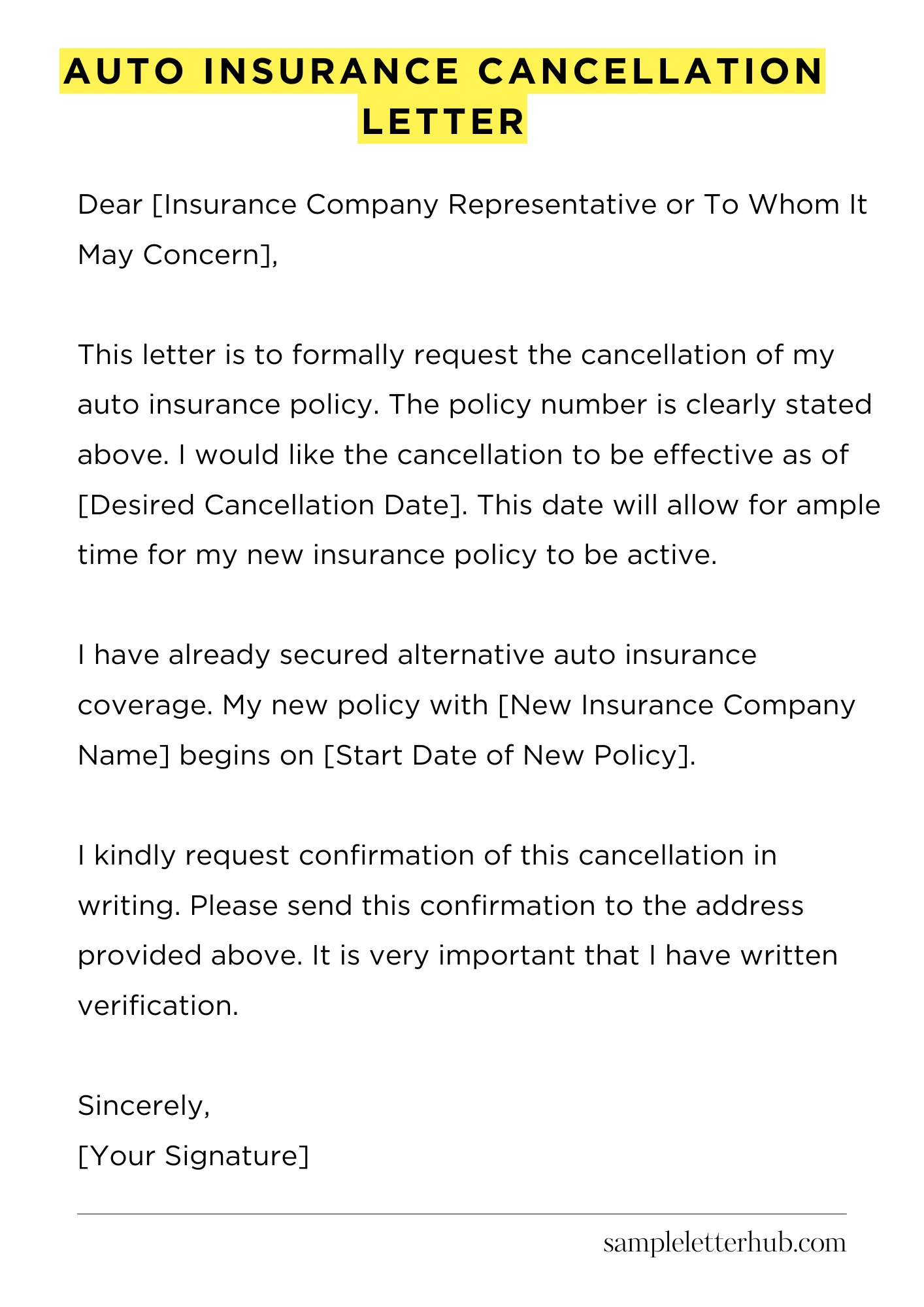
This letter is to formally request the cancellation of my auto insurance policy. The policy number is clearly stated above. I would like the cancellation to be effective as of [Desired Cancellation Date]. This date will allow for ample time for my new insurance policy to be active.
I have already secured alternative auto insurance coverage. My new policy with [New Insurance Company Name] begins on [Start Date of New Policy]. Please ensure there is no lapse in coverage.
I kindly request confirmation of this cancellation in writing. Please send this confirmation to the address provided above. It is very important that I have written verification.
I would also appreciate information on any potential refund due to the early cancellation of my policy. Please let me know how I might expect to receive any refund. This matter is time sensitive.
Thank you for your prompt attention to this matter. I appreciate your assistance in processing this request efficiently.
Sincerely,
[Your Signature]
How to Write Auto Insurance Cancellation Letter
Abruptly terminating your auto insurance policy can seem daunting. There are, however, specific procedures to be undertaken. Your cancellation letter is not just a formality; it is a critical instrument that protects your rights and ensures a smooth transition.
1. Identify Your Objective and Stakeholders
Before putting pen to paper (or fingers to keyboard), you must have a clear objective. What precisely are you trying to accomplish? Are you switching insurers, disposing of a vehicle, or simply reducing coverage? Consider all stakeholders, which includes the insurance company, any lienholders on your vehicle, and potentially, your state’s Department of Motor Vehicles (DMV).
2. Gather Pertinent Information
Assembling the right data beforehand saves time and potential headaches. Locate your policy number, the effective dates of your coverage, and the vehicle identification number (VIN) of your car. Also, ensure you have the full legal name and address of your insurance provider. You might also need information about your new insurance policy if you are transitioning.
3. Crafting the Content: A Discerning Approach
The core of your letter demands precision. Begin with a formal salutation to the appropriate department or individual at the insurance company.
State the purpose of your letter clearly in the opening paragraph: “This letter serves as formal notification that I, [Your Full Name], am requesting the cancellation of my auto insurance policy.” Subsequently, provide your policy number, vehicle information, and the desired cancellation date, bearing in mind that there is a required timeframe. Always specify the date.
4. Stating the Rationale: Articulating the Justification
While not always mandatory, briefly stating the reason for cancellation can be advantageous. Are you selling your car? Have you secured a more advantageous policy? Provide concise clarity. This allows the insurer to process your request more efficiently. Be truthful and professional, and keep it brief.
5. Delivery Protocol: The Mechanics of Submission
Dispatching your cancellation letter demands methodical attention. While email is becoming increasingly accepted, certified mail with return receipt requested offers the most ironclad proof of delivery. Retain a copy of your letter and any accompanying documentation for your records. This serves as your armor should any disputes arise.
6. Confirmation and Verification: Scrutinizing the Acknowledgement
After submission, anticipate confirmation from your insurance provider. Carefully review the cancellation confirmation for accuracy. Confirm the cancellation date, the refund amount (if any), and the final effective date of coverage. If any discrepancies occur, contact your insurer immediately to clarify or contest these issues.
7. Remaining Vigilant: A Post-Cancellation Checklist
After the cancellation, a degree of diligence is required. Ensure you have proof of new coverage if applicable, and if you have a state DMV registration.
Also, remember to review your driving record; it will be essential for future insurance prospects. Finally, keep all documentation associated with the cancellation process, including letters, confirmations, and receipts. Such records provide invaluable protection.
FAQs about Auto Insurance Cancellation Letter
What is an auto insurance cancellation letter and why is it used?
An auto insurance cancellation letter is a formal notice sent by either you (the policyholder) or your insurance company to terminate your auto insurance policy. It serves as documented proof of the cancellation and outlines the effective date. Insurance companies may cancel a policy for reasons like non-payment, fraud, or changes in eligibility.
You, as the policyholder, might cancel for reasons such as finding a better rate, selling your vehicle, or no longer needing coverage.
What information should be included in an auto insurance cancellation letter?
A comprehensive cancellation letter should include the policyholder’s full name, address, and policy number. It must clearly state the intention to cancel the policy and the desired cancellation date.
If you are cancelling the policy, it’s advisable to include a forwarding address for any refunds or related correspondence. If the insurance company is cancelling, they must include the specific reason for cancellation as mandated by state laws.
What are the potential consequences of auto insurance cancellation?
Cancelling your auto insurance can have several implications. If you cancel, you may be eligible for a refund of any unearned premiums. However, if you are driving without insurance, you could face hefty fines, suspension of your driver’s license, and even vehicle impoundment.
Frequent cancellations can also make it more difficult and expensive to obtain insurance in the future, as insurance companies view this as an increased risk. If the insurance company cancels the policy, it’s essential to understand the reason, as it could affect your future insurability.
How do I write an effective auto insurance cancellation letter?
When writing a cancellation letter, be sure to use clear and concise language. Include all necessary details (policy number, effective date, etc.).
It’s recommended to send the letter via certified mail with return receipt requested to ensure proof of delivery. Keep a copy of the letter for your records. If you’re cancelling the policy, you might want to briefly mention the reason, although this is not always required. Be sure to follow any specific instructions provided by your insurance provider.
What are the legal requirements and regulations surrounding auto insurance cancellation?
Legal requirements vary by state, but generally, insurance companies must provide written notice of cancellation, and this notice must specify the reason for cancellation and the date the cancellation takes effect.
There are specific notice periods mandated by law, usually ranging from 10 to 30 days, depending on the reason for cancellation and the state. You should consult your state’s insurance regulations to understand the specifics.
Furthermore, certain circumstances, such as non-payment, may allow for shorter notice periods. Some states also have laws protecting policyholders from unfair cancellation practices.
Related:
Resignation letter due to rude boss
Resignation letter moving to another state
Resignation letter due to illness of family member
Resignation letter due to study